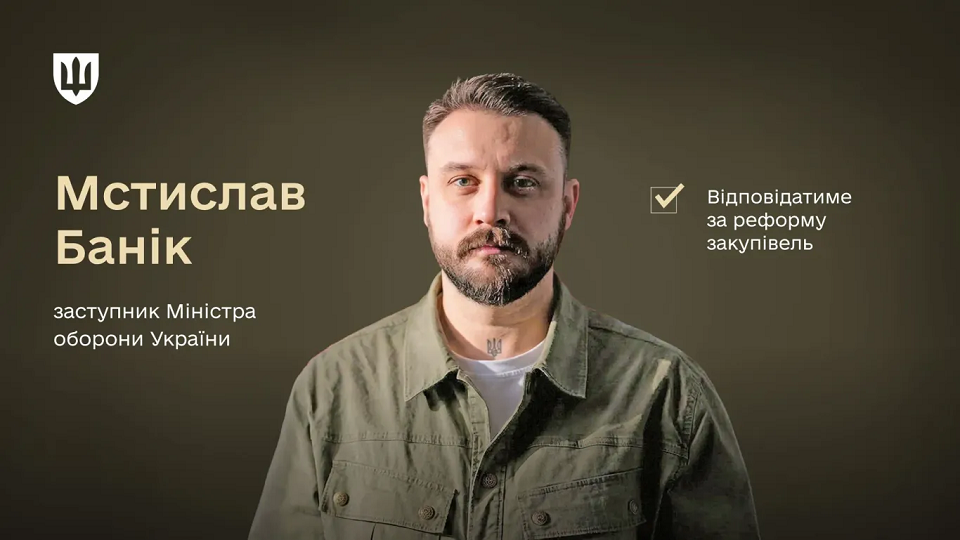
Mstyslav Banik — Deputy Minister of Defense for Procurement Reform: What Will Change for the Front?
The Ministry of Defence has updated its leadership: Banik has been given control over centralized procurement, Yurii Myronenko — the role of general inspector. We examine why this matters now and what questions remain open.

By Tetiana Suchkova-Ladik
March 26, 2026 · 3 min read
What happened
The Cabinet approved personnel changes at the Ministry of Defense: Mstyslav Banik has been appointed deputy minister responsible for procurement reform, and Yurii Myronenko — inspector general. This was officially announced by Minister of Defense Mykhailo Fedorov.
"We continue transforming the Ministry of Defense into an effective institution that delivers results at the front."
— Mykhailo Fedorov, Minister of Defense
Briefly about the figures and their experience
Banik has a practical background in government digital projects: he was involved in launching and developing the Diia app, and at the Ministry of Defense he led the development of the Army+ and Reserve+ services. He has combat experience — he served as a volunteer, rose from soldier to officer, worked with FPV drones and in staff units (his participation in the Kursk operation as part of unit CODE 9.2 is mentioned).
Myronenko, the former head of the State Service for Special Communications and deputy minister of defense, will be responsible for independent assessment of troop status and the effectiveness of decisions — from analyzing policy implementation to recommendations for operational adjustments.
Defense Ministry's position: centralization for the sake of speed and transparency
From January 1, all procurement for the army — from weapons to food and fuel and lubricants — must be carried out by a single Defense Procurement Agency under the control of the Ministry of Defense. The goal stated by the ministry is to make processes more transparent, responsive and scalable to the needs of the front.
"We are forming a team capable of quickly scaling solutions, efficiently using resources and delivering results for the front."
— Mykhailo Fedorov, Minister of Defense
Why it matters
Procurement is not just accounting: the effectiveness of procurement determines the speed of deliveries of ammunition, gear, fuel and food. For a soldier at the front, delays in supply chains can have a direct impact on survival and on a unit's operational capability. The reform aims to reduce fragmentation of the process and shorten decision-making times.
Risks and questions that need answering
Alongside the announcement of centralization, critical remarks have emerged: the Ministry of Defense's Public Council opposed the merger of procurement institutions and demanded clear economic arguments proving that the merger would increase efficiency. NATO also advised retaining certain agency functions at least for the duration of the war.
So the key questions now are: what specific metrics of transparency and savings will be implemented; how the new centralized processes will be protected from corruption risks; and whether the speed of response for tactical needs at the front will be preserved.
What this means for citizens and partners
For the public, this is a matter of trust: central procurement can reduce administrative costs and provide better reporting, but only if clear indicators and independent oversight are in place. For international partners, it is a signal of an intent to systematically reform defense processes, which may affect the volume and conditions of assistance.
Conclusion
The appointments of Banik and Myronenko are a bet on digital experience and institutional scrutiny of decisions. But the announcement of personnel changes is only the beginning. Now it is important to see concrete steps: public performance metrics, mechanisms for external oversight, and guarantees of responsiveness for the front. It is by these indicators that the public and partners will judge whether this change produced the expected result.
Whether the new team can turn declarations into measurable results is a question on which both security at the front and public trust depend.



