Mountain Centre to be built at the summit of Vysokyi Verkh — $1.5 billion investment and up to 1 million tourists a year
GORO Mountain Resort unveiled the Mountain Centre plan: a 1,000-seat food hall, a chef’s restaurant and all-season infrastructure. We examine why this is important for the Lviv region and when to expect results.

By Tetiana Suchkova-Ladik
March 16, 2026 · 2 min read
Project details
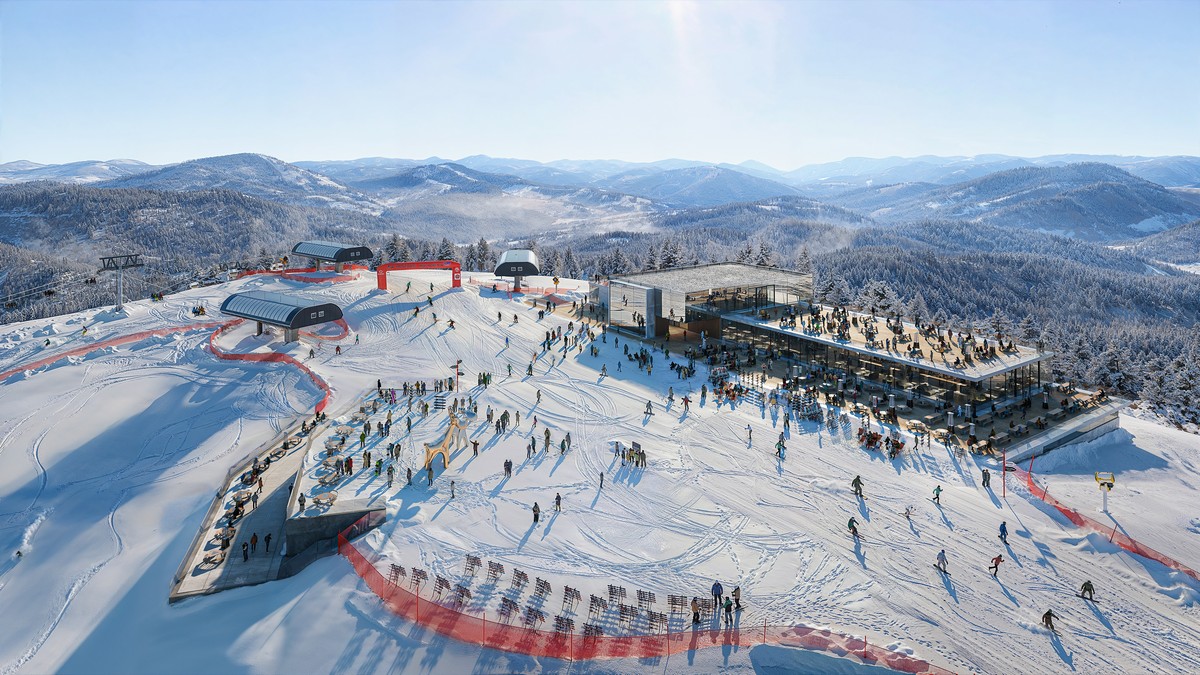
GORO Mountain Resort has announced plans to build a two-story Mountain Centre on the summit of Vysokyi Verkh, with a total area of 5,800 sq. m. According to the press service, the centre will include a food hall for 1,000 seats, an à la carte restaurant with 150 seats, and a lounge bar with a terrace of more than 1,000 sq. m. The project envisions three levels: an underground cultural and artistic space with a conference hall, a quick-service gastronomic area, and a chef’s restaurant with panoramic views of the Carpathians.
"The new building on the mountain is intended to organize one of the most visited points of the mountain range and turn the summit of Vysokyi Verkh into an all-season public space for resort guests."
— Goro Development press service
Timeline, infrastructure, scale
Construction of the Mountain Centre is planned to begin in the summer of 2026, with opening in 2028. The preliminary launch of the Welcome Centre and the gondola lift is scheduled for 2027; as of March 2026 the Welcome Centre is 40% complete.
The project is part of the first phase of GORO Mountain Resort, which OKKO Group has been developing since October 2024 in the Slavska community. The first phase covers 127 ha, and includes 10 ski runs, an artificial snowmaking system, a gondola lift and two chairlifts, and five hotels with more than 1,100 rooms. Once the first phase is operational, the resort will be able to accommodate up to 5,000 skiers at a time and up to 1 million visitors per year.
Economic and regional impact
The total investment in the project is estimated at approximately $1.5 billion. For Lviv Oblast this is not only new leisure locations but also jobs, tax revenues and a boost for related industries — from logistics to food service and hospitality. Importantly, the Mountain Centre is positioned as a year-round space: in winter as part of the ski infrastructure, and in warmer months as a starting point for hiking routes and cultural events.
The project is a signal to investors and to the local economy: even in challenging times there is demand and willingness to invest in long-term infrastructure. However, implementation will require oversight of schedules, environmental assessments and coordination with the local community to ensure the positive impact is sustainable.
What’s next?
If the timeline holds, 2027 should deliver the first infrastructure results (the Welcome Centre and the gondola lift), and 2028 the full opening of the Mountain Centre. The next step is to ensure transparent execution of the plans and the inclusion of local businesses in the service chain. The key now is to turn the large numbers into concrete jobs and accessible infrastructure for tourists and residents of the region.



