Negotiations Ongoing Since 2005: Ukraine and Serbia Resume Work on Free Trade Agreement
Kachanets and Lazarevich signed a joint statement in Belgrade on resuming negotiations — but the statement is not an agreement, and the main obstacle remains: Serbia is still not a member of the WTO.

By Tetiana Suchkova-Ladik
May 21, 2026 · 3 min read
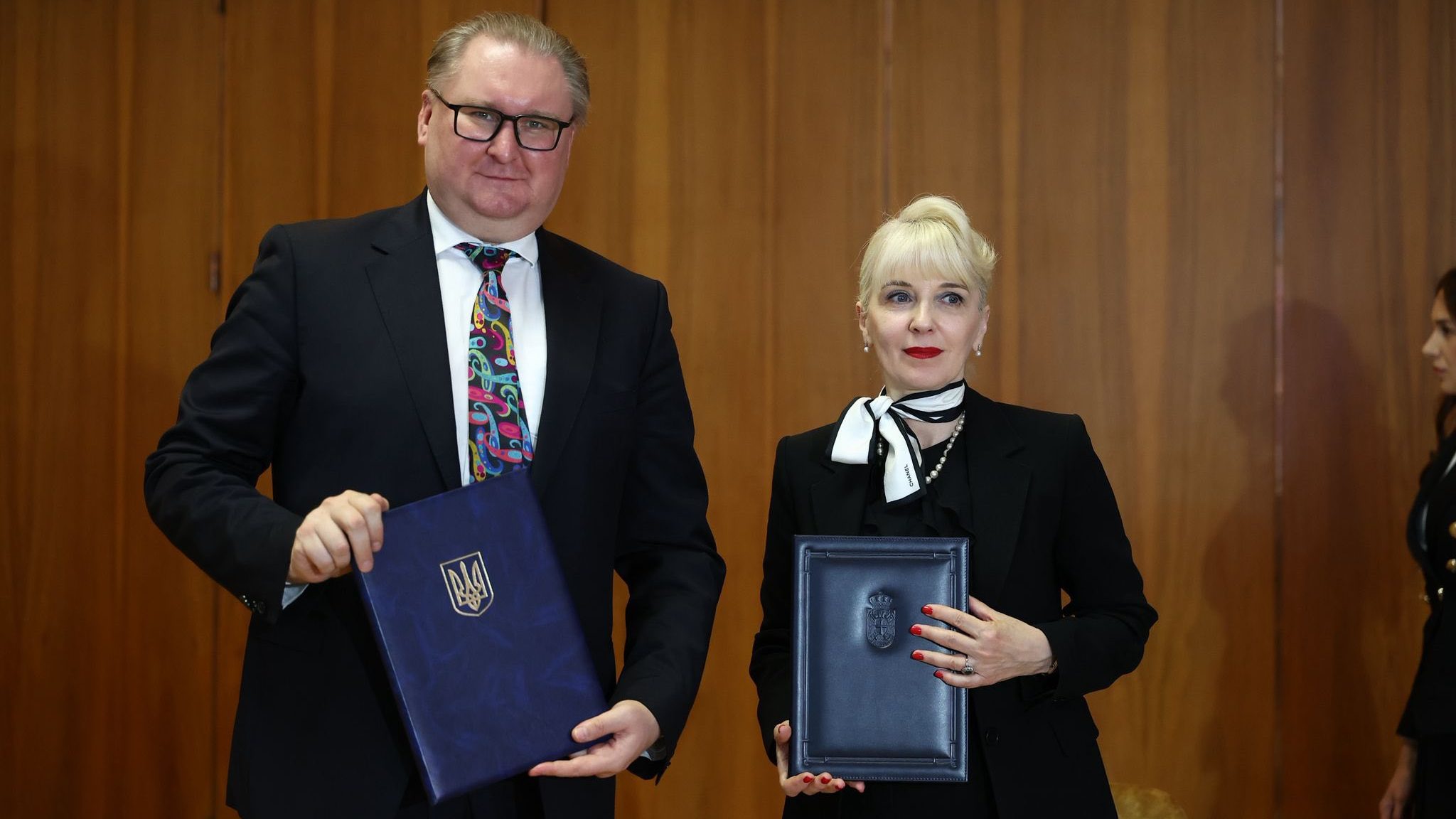
On May 21 in Belgrade, Ukraine's Vice Prime Minister Taras Kachka and Serbia's Minister of Trade Jagoda Lazarevic signed a joint statement on resuming negotiations regarding a free trade agreement. The document fixes an intention — not timelines, not an arbitration mechanism, not a date for signing the final agreement.
20 years and a fourth attempt
Negotiations between the two countries began in 2005 — as part of Serbia's accession process to the World Trade Organization. Since then, there have been at least four rounds, including a Kyiv round, where the parties "achieved progress in agreeing on market access for goods" — yet the agreement was never signed. At the end of last year, the Ukrainian side renewed interest in the negotiations and submitted a draft framework of conditions for their conduct.
The President of the Serbian Chamber of Commerce and Industry noted that the document is being signed "after direct contacts between competent institutions were renewed last year", and called the signing "a long-awaited step forward."
What stands between the statement and a real agreement
Ukraine is the only country in Europe with which Serbia has not signed a free trade agreement. The reason is not a lack of political will, but a structural problem: Serbia is still not a member of the WTO. The latest European Commission report directly indicates that the accession process has stalled primarily due to the lack of a GMO law that meets WTO requirements, and due to incomplete bilateral negotiations on market access with several members of the organization.
"Despite the crisis Europe is experiencing, it remains our key partner in foreign trade. But it is also important to open new markets"
— Serbia's Minister of Trade Jagoda Lazarevic, Serbian Monitor
For Serbia, the most attractive goods on the Ukrainian market in case of concluding an FTA could be fertilizers, polymers, electrical equipment, pharmaceuticals, rubber products, tires and auto parts — meaning the agreement could theoretically shift trade from a narrow exchange of raw materials to a greater quantity of processed goods from both sides.
Figures that explain the motivation
In 2025, Serbian exports to Ukraine amounted to 179.6 million euros, imports from Ukraine — 212.2 million euros, and total trade reached approximately 391.8 million euros. Ukraine's Ambassador to Serbia Oleksandr Lytvynenko, in an interview with Interfax-Ukraine, called this level "relatively low" and noted that an FTA could revive bilateral economic ties while organically fitting into the European integration of both countries.
What has been signed — and what is missing
The joint statement is a political signal, not a legal obligation. It contains no deadlines, no dispute resolution mechanism, and no answer to the key question: how will an agreement be structured with a country that is not a WTO member and does not have WTO-compliant GMO legislation — products that make up a significant share of Ukrainian agricultural exports.
- Signed: joint statement on resuming negotiations
- Not signed: free trade agreement, schedule of rounds, monitoring mechanism
- Structural obstacle: Serbia outside the WTO, GMO law does not meet the organization's requirements
- Trade volume: ~392 million euros per year — one of the lowest figures among Ukraine's neighbors in the region
If Belgrade does not adopt a WTO-compliant GMO law by the end of 2025, the current statement risks repeating the fate of the previous three — remaining an intention without a result.



