Polish President Called Not to Trust Fake Drones — and Appointed the Author of These Fakes to Anti-Disinformation Council
Navrocki personally warned against Russian disinformation about drones over Poland. On the same day that NASK filed a complaint against Swinarsky's YouTube channel for the same fakes, the president was preparing a place for him on the Council of New Media.

By Tetiana Suchkova-Ladik
April 18, 2026 · 2 min read
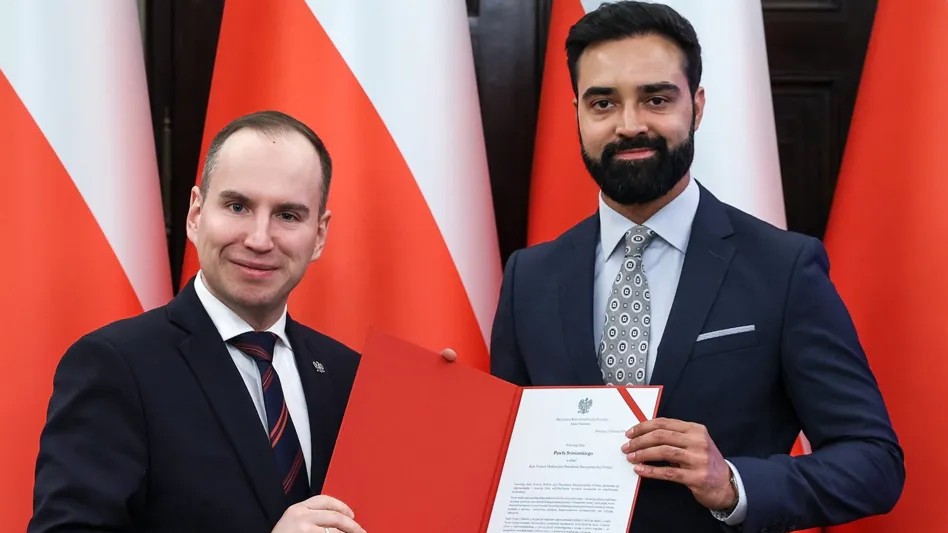
Karol Nawrocki spoke at the National Security Council and called on Poles "not to succumb to Russian disinformation" — the kind that attributed to Ukraine drones that violated Polish airspace. Almost simultaneously, the state NASK submitted a complaint to Google about a video from the YouTube channel "Dla Pieniędzy": that was precisely where it was claimed that the drones could have been a Ukrainian provocation. A few days later, Nawrocki appointed the author of this channel, Paweł Świnarsky, to a newly created Media Council — a body designed to combat disinformation.
What exactly did Świnarsky say
The "Dla Pieniędzy" channel is not a marginal platform. Świnarsky spread several narratives that align with Russian information operations: the version about "Ukrainian drones," reports about supposedly "giant deposits of resources" in the Suwałki Corridor area, and accusations of theft during the construction of the Eastern Shield.
The Headquarters of the Main Command of the Polish Armed Forces used fragments of his materials in its own video — as an illustration of what Russian disinformation looks like.
Wprost, wp.pl
NASK — the Polish state cybersecurity institute — appealed to Google to remove Świnarsky's video precisely because of the disinformation nature of the content, according to Wirtualne Media.
Reaction: from irony to "shame"
Criticism came not only from the opposition camp. As OKO.press notes, voices of disagreement also appeared from the right wing of the Polish scene. Deputy Prime Minister, Minister of Digitalization Krzysztof Gawkowski assessed the appointment briefly: the president "does not have a good hand with people" and "was more concerned with gathering people than checking their biographies." Patryk Słowik from Kanał Zero wrote: "it is a shame — both for the president and for the Polish state."
- Council composition is criticized for one-sidedness: almost all members are from the right-conservative circles.
- Świnarsky, according to Wirtualna Polska, is considering the possibility of refusing the position, but as of the time of publication had not announced a decision.
- Media Council operates under the president, its powers and mechanism for controlling decisions are not publicly defined.
A paradox built into the system
The problem is not just in this specific candidacy. The Council was created without a transparent mechanism for selecting members and without publicly defined criteria for what constitutes disinformation — that is, a body with a mandate to "combat fakes" is itself not accountable to any verification procedure.
If Świnarsky remains on the council, a specific question arises: will NASK be able to continue initiating complaints against content from members of the presidential advisory structure — or will their informal status protect them from the same tools that the state applies to everyone else?



