Five leading European armies launch low-cost air defense: what it means for Ukraine
In high diplomacy, quiet agreements matter. Germany, France, Italy, Poland and the United Kingdom have launched the LEAP initiative for the rapid development of scalable, low-cost air‑defense systems — we examine why this could become a strategic advantage for Ukraine and which questions remain open.

By Tetiana Suchkova-Ladik
February 20, 2026 · 2 min read
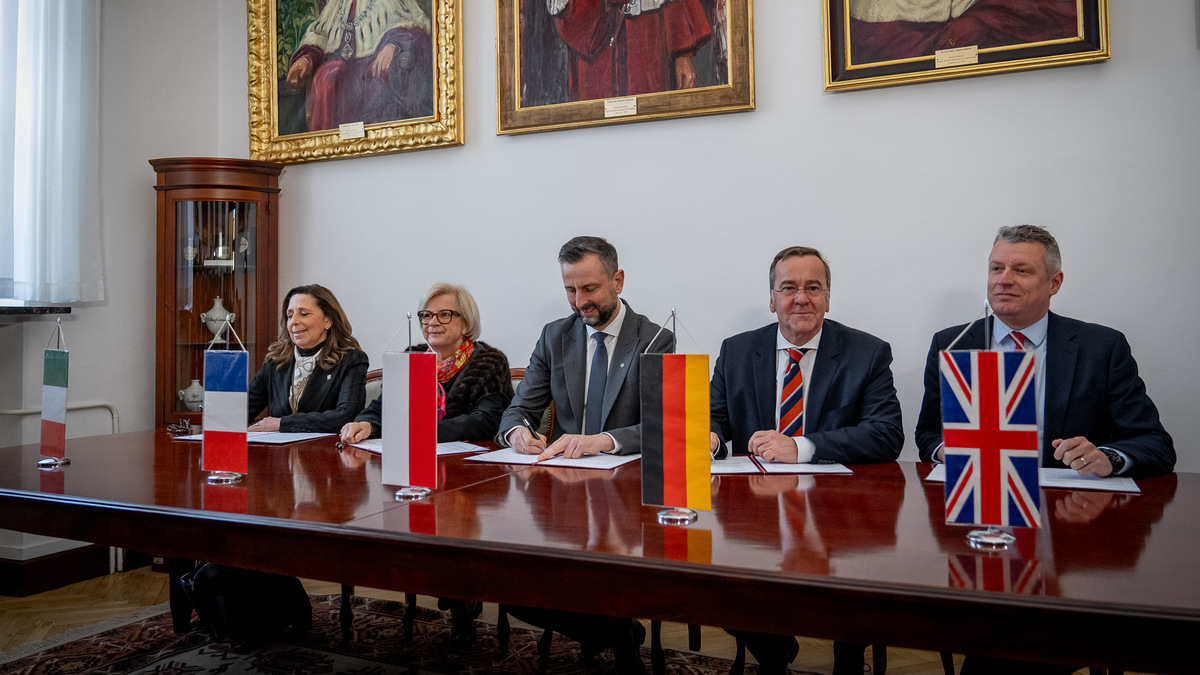
In high diplomacy, quiet agreements matter
At a meeting of ministers in Poland, the five countries with the largest defence budgets in Europe — Germany, France, Italy, Poland and the United Kingdom — agreed to pool resources to create low-cost, scalable air-defence means. The initiative is called Low-Cost Effectors and Autonomous Platforms (LEAP) and, according to the Polish Ministry of Defence and Reuters, aims to speed up the development and establishment of production for such systems.
What was announced and the timelines
The official statement emphasizes a desire for speed: Britain's Minister for Defence Readiness and Defence Industry Luke Pollard has outlined plans to start production “within 12 months.” At the same time, Reuters clarifies that the first project under LEAP must be delivered no later than 2027 — meaning work will proceed simultaneously on prototypes and longer-cycle projects.
“These are multi‑million commitments in pounds and euros… we very much hope this will result in an effector that will be put into production within 12 months”
— Luke Pollard, Minister for Defence Readiness and Defence Industry (United Kingdom)
Why it matters for Ukraine
Economics is transforming defence: in 2023 the New York Times calculated that shooting down a single “Shahed” drone with a missile costs several times more than the drone itself — roughly $20,000 for the UAV versus $140,000 to $500,000 for missiles like the S-300 or NASAMS. Mass production of cheap effectors and interceptors changes that math — it allows protecting airspace not with isolated expensive interceptions but with a series of inexpensive solutions.
Ukrainian experience has shown that cheaper interceptors and interceptor drones (estimated ranges $1,500–$16,000) can be effective elements of a defence system if properly integrated with sensors and command systems. Therefore LEAP potentially strengthens not only Europe’s defence but also creates opportunities for supplies and cooperation with Ukraine.
Financial math and technological risks
The advantages are clear: lower cost per interception, scalability and the possibility of standardisation. But the risks are real as well: coordinating industrial supply chains across five countries, compatibility with existing air-defence systems, questions of certification and logistics, and time — even rapid projects require testing and adaptation to combat conditions.
“This is the challenge of our time — technologies are changing, and we must respond very quickly”
— Vladyslav Kosiniak‑Kamysz, Minister of Defence (Poland)
Conclusion
The LEAP initiative is not an instant fix, but an important structural step: countries with large defence budgets are seeking to change the ratio of costs to outcomes in air defence. For Ukraine the key question is simple: will these ambitions be turned into serial contracts and practical deliveries? The answer will determine how quickly cheap effectors help counter cheap and mass threats.



