Five Years of Denials — and Finally in the Registry: Krippa Officially Becomes Owner of Dnipro Hotel and Completes the Circle Around Khreshchatyk
# English Translation A businessman whom journalists linked to the privatization of Dnipro back in 2020 has officially confirmed his co-ownership. Now under his control are a hotel, the Parus business center, Ukraina, and a land plot designated for development between Khreshchatyk and Hrushevsky.

By Tetiana Suchkova-Ladik
April 9, 2026 · 2 min read
Five Years — From Anonymous Buyer to Public Owner
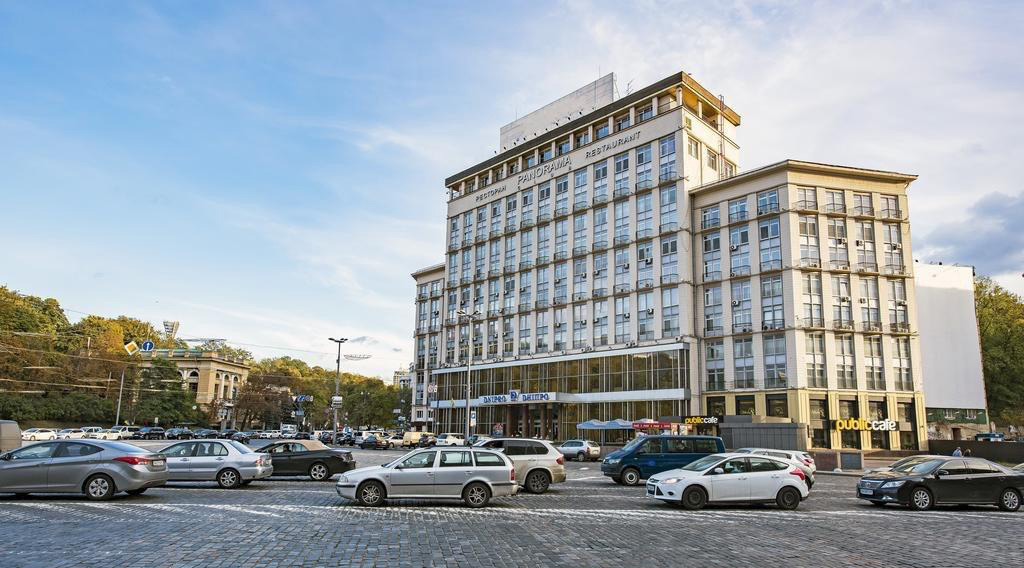
In July 2020, LLC "Smartland" won an auction held by the State Property Fund and purchased the Dnipro hotel on Khreshchatyk for 1 billion 111 million hryvnias. Immediately after the auction, NAVI cybersports team founder Oleksandr Kokhanovskyi identified himself as the actual buyer, announcing plans to transform the hotel into a cybersports hub. However, journalists—including LIGA.net—simultaneously documented the name Maksym Krippa. The businessman's representatives denied this.
On April 9, 2025, Krippa's press office officially confirmed: he is a co-owner of the Dnipro. Verification took nearly five years.
What Stands Behind the Hotel: The Bigger Picture
The Dnipro is only part of the structure. A large-scale cybersports project was initially planned for the hotel site, but plans changed along with the composition of investors. Instead, Krippa built a different logic: consolidation of premium real estate in the heart of the capital.
- In 2020, he purchased the Dnipro hotel; in 2023, the suburban complex in Koncha-Zaspa, as well as the Parus business center.
- In 2024, Krippa's Ola Fine company won the privatization auction for the Ukraina hotel—the final price was 2.51 billion hryvnias, with over 3 billion hryvnias transferred to the state budget including VAT.
- In February 2025, the Antimonopoly Committee allowed the ARS Capital investment fund—whose sole beneficiary is Krippa—to gain control over LLC "Graal," which leases a plot for development on Khreshchatyk, 5, next to the Dnipro hotel.
The concept provides for the construction of the "Stolitsa" office and hotel complex, as well as large-scale reconstruction of adjacent territories around European Square and Khreshchatyk. The State Architecture and Urban Development Inspectorate issued a construction permit in August 2024.
Ritz-Carlton or Four Seasons: Brand as a Market Signal
Attracting an international operator is not merely marketing. For a luxury-class hotel in wartime Kyiv, it is primarily a matter of insurance, financing, and reputation assurance for foreign guests.
"After the war ends, such assets will be worth two to three times more than today's valuation, and even more after renovation."
Maksym Krippa, Forbes Ukraine
Regarding the Ukraina hotel, Krippa is considering the "Four Seasons Ukraine" format. According to the press office, both Ritz-Carlton and Four Seasons are being considered for the Dnipro—both brands require complete reconstruction to their standards, which effectively means the current Dnipro in its present form will not be preserved.
What This Means for the City
The "Stolitsa" project provides for 219 apartments, offices, retail spaces, and a multi-level underground parking—the total area of the complex is 44,140 square meters. Combined with two hotels and the Parus business center, a single private investor effectively controls development in several blocks of the country's most expensive location.
Financing of transactions is carried out exclusively through the own funds of investment structures, without attracting budget financing—at least according to ARS Capital itself. Krippa has not publicly disclosed details of ownership structure or capital sources.
A key question for Kyiv's real estate market: if no international brand signs an LOI with the owner of the Dnipro or Ukraina by the end of 2026, it will mean that the investment logic is built on expectations of post-war recovery—rather than on actual demand here and now.



