RegioJet exits Poland after five months: advertising banned, slots slower, fine on the way out
# A Czech Private Carrier Entered the Polish Market in September 2025 and Left by May 2026, Managing to Receive a Threat of a Million-Dollar Fine and Accuse State Rival PKP Intercity of Predatory Behavior. The Case Now Goes Far Beyond Just Railways.

By Tetiana Suchkova-Ladik
April 9, 2026 · 2 min read
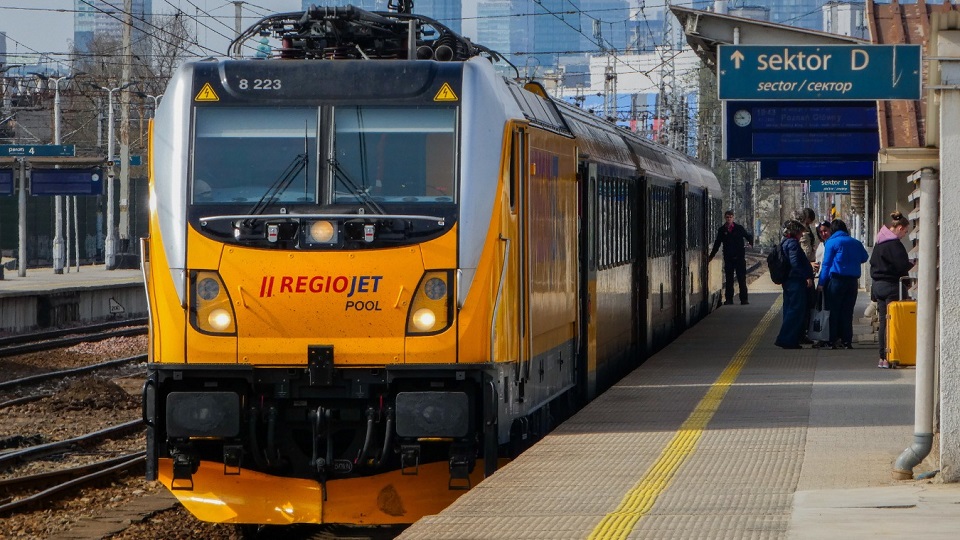
Five months — that's how long it took Czech RegioJet to understand that Poland's domestic rail market is closed to newcomers. Starting May 3, the company is halting all domestic routes in Poland and refunding passengers.
How it started — and where it broke down
RegioJet launched its first Polish route, Krakow-Warsaw, in September 2025. In December, additional routes were supposed to appear: Warsaw-Gdynia and Poznan-Warsaw. But already in November, the company postponed Poznan — because PKP Intercity allegedly allocated it slower time slots on the same routes where PKP itself travels faster. Simultaneously, RegioJet claimed that the state carrier blocked competitor advertising at train stations.
PKP Intercity rejected both accusations, stating it "operates completely transparently and in accordance with the highest ethical standards." However, the regulator was moving in another direction: on April 8, 2026, the Polish railway authority recognized that RegioJet violated passenger rights through mass cancellations immediately after entering the market, and announced a possible fine of up to 2% of the company's annual revenue.
"Unfortunately, we are forced to cease operations on the domestic Polish market."
— Radim Jančura, RegioJet owner, in a statement to employees (quoted by Money.pl)
What remains and what comes next
RegioJet is not leaving Poland entirely. International routes — Warsaw-Prague and Przemyśl-Krakow-Prague — continue to operate. In other words, the company remains a transit player but is abandoning domestic competition.
In a statement to the Polish press, RegioJet said it had "lost hope and faith" in the possibility of fair business in Poland and hinted at filing a complaint with the European Commission regarding anticompetitive practices. This is not the first conflict in the company's portfolio: in Czechia, RegioJet has been in court for years with state-owned České dráhy over similar accusations.
Why this is bigger than one carrier
Poland is one of the EU's largest rail markets, and PKP Intercity receives significant state subsidies. There is effectively no mechanism to prevent these subsidies from being used to squeeze out private competitors through price or operational advantage — or such a mechanism doesn't work fast enough. RegioJet encountered this and exited. The next private carrier attempting to enter Poland's domestic rail market will have this precedent before its eyes.
- Market entry: September 2025
- Stated obstacles: slower time slots, advertising ban at train stations, dominance of subsidized competitor
- Fine threat from regulator: up to 2% of annual revenue
- Exit: May 3, 2026
- Next step: possible complaint to the European Commission
If the European Commission does open proceedings against PKP Intercity — it will change the game rules for the entire EU rail liberalization market. But if the case stalls in years of procedures, the precedent will mean something else: state railway monopolies can effectively block competitors without even breaking any formal rules.



