Russia has accelerated logistics in occupied territories — what does this mean for Ukraine's security?
Over the past year Moscow has invested billions in roads, railways and ports to bypass the Crimean Bridge and consolidate control. We examine why this is happening now and what the consequences are for de‑occupation and our strategy.

By Tetiana Suchkova-Ladik
March 27, 2026 · 3 min read
Briefly
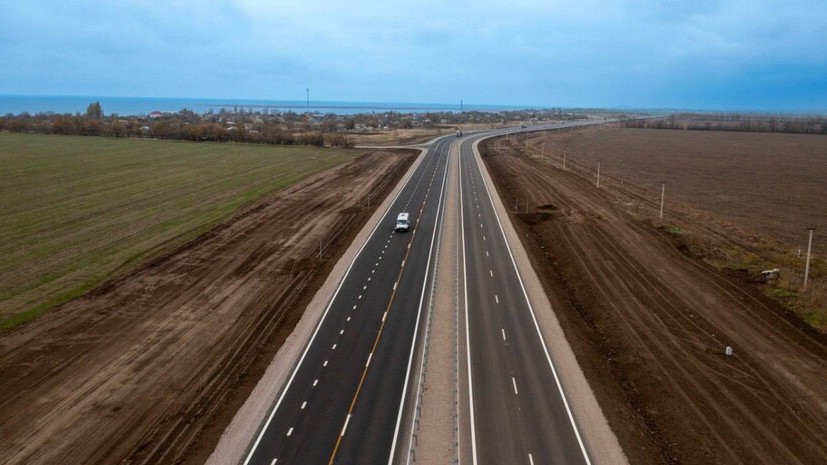
Reuters records: since 2024 Russia has spent about $11.8 billion on infrastructure projects in four newly occupied regions — three times more than in 20 regions of the Russian Federation under similar programs. Main projects: 525 km of new railway and 630 km of road, dredging in the ports of Mariupol and Berdiansk, and the sale of resource assets, including the rights to the Bobrykivka gold ore deposit.
Evidence and what has already been done
Satellite imagery (July 2023 — November 2025) shows the laying of a 60‑kilometre section between Novoselivka and Koloske in Donetsk Oblast and significant progress on a 100‑kilometre stretch of road between Taganrog and Mangush. This forms an "Azov ring" — routes that allow bypassing the Crimean Bridge and create alternative corridors for moving equipment, fuel and cargo.
At the same time, mines and agricultural lands are being put up for sale at state auctions. Documents and satellite imagery indicate that extraction at some deposits is already being carried out under the control of companies aligned with the Kremlin.
"The scale and pace of the projects indicate not a temporary presence, but an attempt to consolidate control over these territories for many years."
— Karolina Herd, national security researcher, Institute for the Study of War (ISW)
"In three years, what has been done in the new territories is what took decades to implement in Crimea. It was a training ground for them."
— Olga Kuryshko, Representative of the President of Ukraine in Crimea
Why Moscow is acting now
There are several related reasons. First, a military‑logistical necessity: the Crimean Bridge is a vulnerable node, and alternative routes reduce risks when redeploying forces. Second, political‑legal and economic consolidation: investments and the sale of assets create facts on the ground — administrative and economic integration that make future return of the territories more difficult. Third, financing the war: exploitation of resources and control over ports provide additional revenues and logistical capabilities.
These conclusions are reinforced by signals from international outlets and official assessments: The Washington Post and European experts warn about the depletion of Russia's financial reserves, yet Moscow has so far been able to reallocate and concentrate resources on key projects.
Consequences for Ukraine — risks and opportunities
The risks are obvious: strengthened infrastructure increases the resilience of holding occupied territories and complicates operational planning for de‑occupation. At the same time, the concentration of road and rail corridors, terminals and mines also creates vulnerable points: these facilities are clear logistical targets for reconnaissance and precision strikes, as well as for sanction‑based and legal pressure by partners.
Analysts and intelligence data also point to another aspect: rapid infrastructure deployment may indicate a "big‑spend" strategy and the risk of economic overstretch for the Kremlin. Ukrainian intelligence and international experts warn of a possible financial crisis in Russia within the coming year — this creates room for international pressure and selection of instruments that can weaken Russia's ability to complete such projects.
What to do next
From a practical perspective: strengthen monitoring of satellite data and open sources, coordinate with partners on sanctions and legal cases regarding asset sales, focus intelligence on logistic hubs, and work with international port operators to complicate commercial exploitation of ports and transshipment facilities.
The question that remains open: can Western partners turn informational and financial signals into practical instruments that will complicate further "infrastructure annexation" — and how quickly must this be done to preserve options for future de‑occupation?



