Saldo to face trial for theft of grain worth UAH 5.3 billion — prosecutor's office classifies it as a war crime
The Office of the Prosecutor General has forwarded an indictment to the court against the head of the occupying administration in Kherson region — a case that will test the mechanism for bringing collaborators before the International Criminal Court.

By Tetiana Suchkova-Ladik
March 25, 2026 · 2 min read
What happened
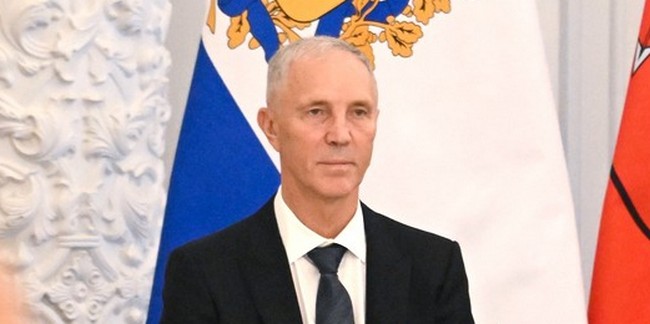
On 20 March the Office of the Prosecutor General sent a new indictment to court against Volodymyr Saldo — the head of the occupation administration on the left bank of the Kherson region. He is accused of organizing a systematic scheme to seize and smuggle Ukrainian grain; according to the investigation, the total value of the appropriated products exceeds UAH 5.3 billion. The case was investigated as a war crime, and the prosecutor's office says it intends to seek to hold the accused accountable also before the International Criminal Court.
"The indictment in the proceeding was forwarded to the court on the grounds of organizing the systematic theft of grain and its removal from temporarily occupied territories"
— Office of the Prosecutor General
Mechanics of the scheme
According to the investigation, in 2022 under Saldo's leadership the occupation administration systematically confiscated grain from farmers and seized enterprises and grain terminals. The stolen goods were transported to the ports of temporarily occupied Crimea and to Russian regions (Krasnodar Krai, Rostov Oblast), from where they were shipped by sea to Syria, Egypt, Turkey and Lebanon under the guise of Russian produce. Nine executors of this scheme have already stood trial.
Evidence and timeline
Earlier, in September 2024, the Kherson regional prosecutor's office reported completing the pre-trial investigation in relation to one episode — the removal of around 3,000 tonnes of grain from the Kherson Bread Products Plant. The indictment in criminal proceeding No.1202423000000147 (dated 27 August 2024) has been sent to the Kherson City Court; the Uryadovyi Kuryer noted that Saldo is being summoned to the hearing on 30 March.
International dimension and significance for Ukraine
Qualifying the actions as a war crime opens not only criminal-legal prospects at the national level but also the possibility of international response: from transferring materials to the International Criminal Court to using the evidence in sanctions and restitution processes. This is an important test of the system's ability to restore justice, hold organizers of economic crimes during war accountable, and raise the question of returning stolen property.
What’s next
The next steps are court hearings in Ukraine and coordination with international institutions. There are obvious challenges: collecting evidence in temporarily occupied regions, cooperation with foreign jurisdictions and issues of extradition. Nevertheless, the filing of the indictment itself is a signal: regardless of how long the process takes, the state is documenting the facts and building a legal basis for future claims.
Summary: the Saldo case is not only a criminal proceeding. It is a test for the law enforcement and judicial system, and a message to potential accomplices: economic crimes during aggression are being recorded and will have consequences. Now it is up to the courts — will indictments turn into convictions and will it be possible to recover the stolen assets?



