Starship V3 Took Off With Failures But Still Completed the Mission — What It Means for NASA and SpaceX's IPO
The first flight of the largest rocket in history experienced booster and Ship engine malfunctions, but the spacecraft delivered 22 dummy satellites to the target orbit. SpaceX obtained the data — and motivation ahead of its public offering.

By Tetiana Suchkova-Ladik
May 23, 2026 · 2 min read
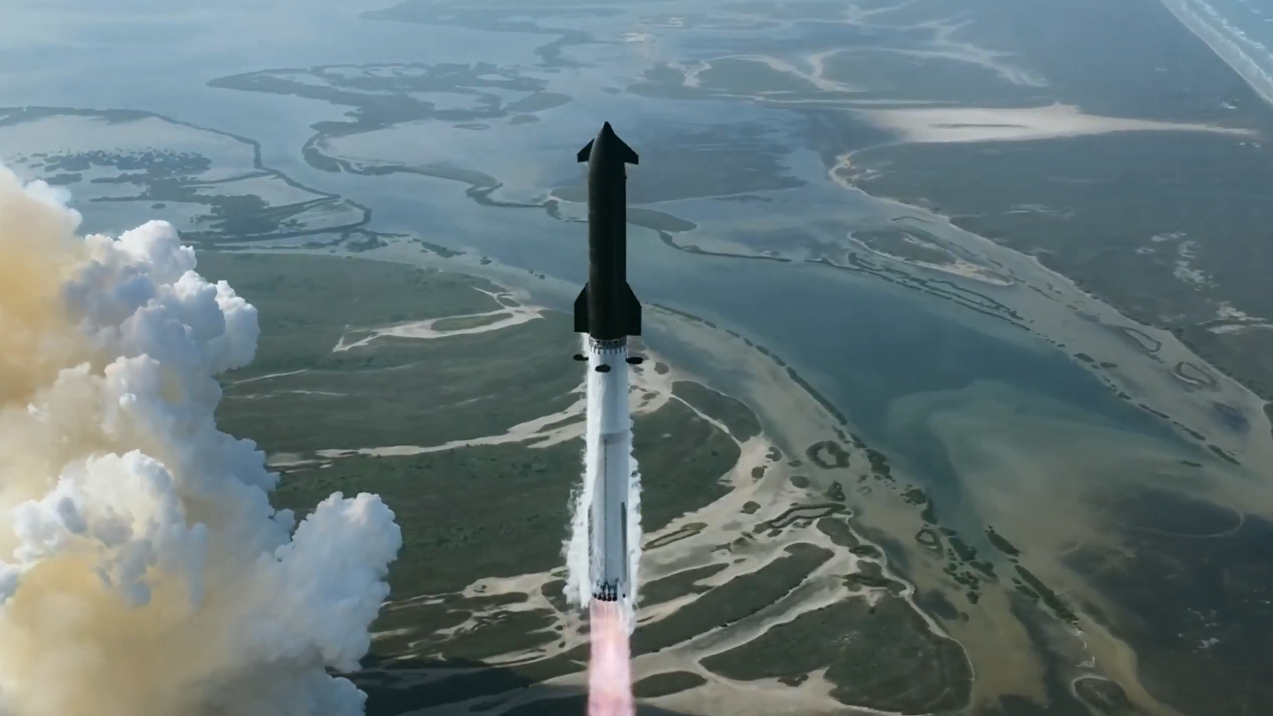
On May 22, 2026, SpaceX launched Starship V3 — the first flight of an updated version of the largest rocket ever built by humanity. The stack height is 124 meters, with record-breaking thrust among all operational launch vehicles. The launch took place from the new Pad 2 site at Starbase in Boca Chica, Texas, one day later than scheduled: the first attempt on May 21 was canceled due to a hydraulic malfunction in one of the launch tower actuators.
What happened during the flight
Liftoff occurred at 17:30 local time. One of the 33 Raptor 3 engines on the Super Heavy booster failed immediately after ascent, but the rocket continued to climb nominally. After hot-stage separation, the booster was to perform a retrograde burn — but it proceeded anomalously: several engines failed, and the structure began rotating. The emergency destruct system was intentionally deactivated. The booster partially restored stability, re-entered the atmosphere, but the braking burn before splashdown did not fire — and it fell into the Gulf of Mexico in an uncontrolled manner.
Ship 39 — the upper stage — also lost one of its vacuum Raptor engines after separation. Six main engines compensated for the loss, and the spacecraft reached its target trajectory. The engine restart at the apex of the trajectory was canceled due to anomalies during ascent — instead, Ship deployed 22 Starlink simulators and completed a planned splashdown in the Indian Ocean.
"Each Raptor 3 engine adds 50,000 pounds of thrust compared to the previous version"
SpaceX, technical briefing before flight
What's new in V3
- Raptor 3 — higher thrust, lower weight, simplified design
- Three enlarged aerodynamic stabilizers instead of four smaller ones
- Integrated hot manifold without a separate adapter section
- Increased fuel tank capacity and equipment for future orbital refueling
- Pad 2 — new launch platform with accelerated fueling and reinforced flame deflector
Why this matters now
The flight occurred two days after Musk announced plans to take SpaceX public on Nasdaq — with the company valued at approximately $1.75 trillion and a target date no earlier than June 12. According to Teslarati, the company holds over $22 billion in active government contracts, and each successful Starship test directly impacts its market valuation.
For NASA, the stakes are concrete: Starship is the only approved lunar lander for the Artemis 4 mission with astronauts in 2028. According to Space.com, NASA Administrator Jared Isaacman was present at the launch personally. Before Artemis 4, SpaceX must master orbital refueling — a technology that V3 is only beginning to test in hardware.
Flight 12 was the first Starship launch of 2026 following five launches in 2025, two of which ended in explosions during test flights over the Atlantic. This time, Ship reached its target — but the booster was lost.
Summary
SpaceX received confirmation that V3 is capable of flying even with engine failures — and this is technically valuable information. But with less than two years remaining until Artemis 4, and orbital refueling still untested under real conditions, one question remains: will SpaceX be able to master the complete lunar mission architecture before NASA is forced to reconsider the date?



