Thousand applications per day: How Oreshnik attack on Kyiv looks in numbers
On the night of May 24, Russia delivered one of its most powerful strikes on the capital since the beginning of 2025—using "Oreshnik" missiles, hundreds of drones, and various types of rockets. The scale of destruction is now measured not only by casualties but also by another wave of applications for state compensation.

By Tetiana Suchkova-Ladik
May 25, 2026 · 2 min read
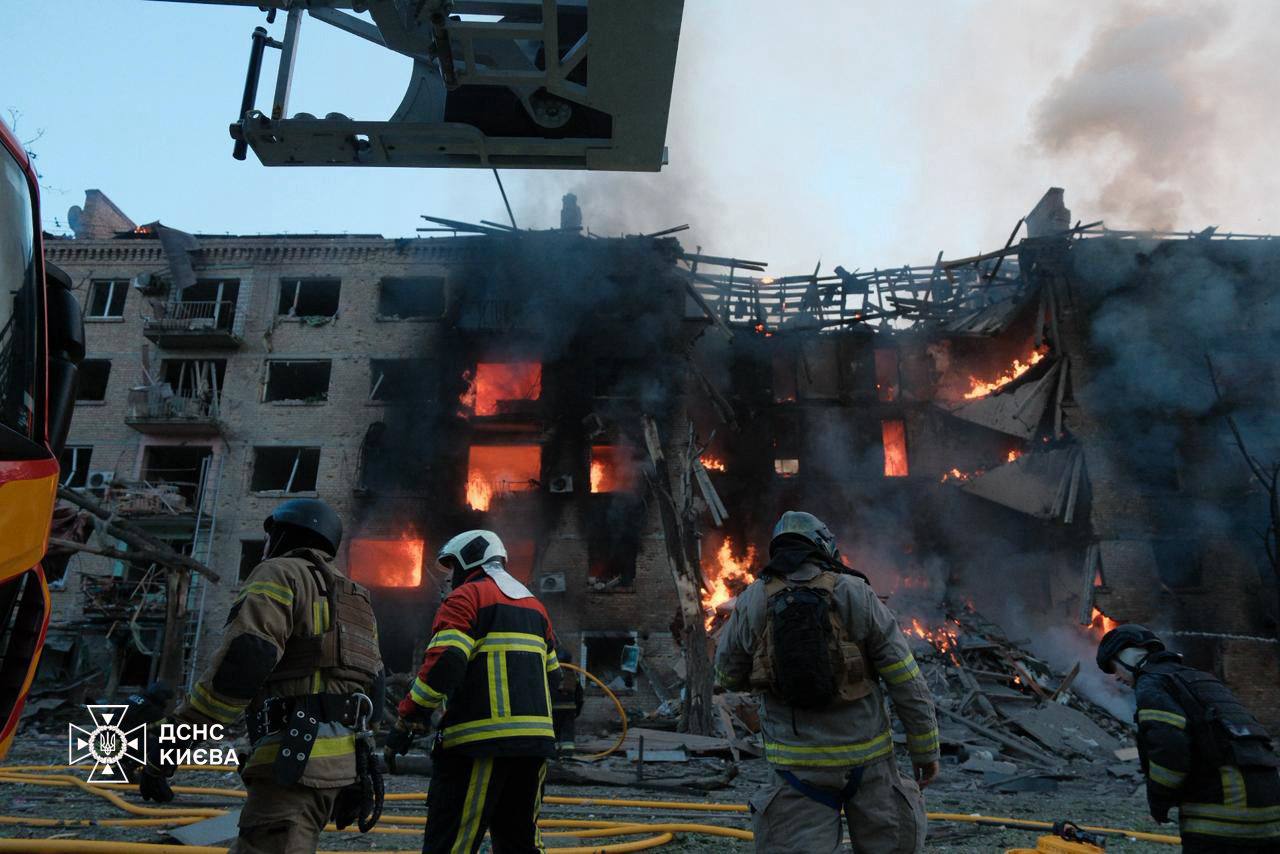
Over the course of one day following the May 24 attack, residents of Kyiv and Kyiv Region submitted through the "Diia" app 1,133 claims for damage compensation — 986 in the city and 147 in the region. Vice Prime Minister for Recovery Oleksiy Kuleba called this figure a direct reflection of the scale of destruction and urged those affected not to delay filing claims.
What and how struck
According to the Ukrainian Air Force, on the night of May 24, the enemy used 14 Iskander-M ballistic missiles, over 44 Kh-101/Kalibr cruise missiles, and at least 549 attack kamikaze drones. Air defense forces neutralized 604 targets. According to ISW's assessment, this was one of the largest combined strikes of the entire war, although the number of missiles remained lower than in previous record attacks.
Separately, Zelenskyy confirmed the use of an Oreshnik intercontinental ballistic missile — the strike hit Bila Tserkva, approximately 80 km from Kyiv. According to Air Force spokesperson Yuriy Ihnat, this was already Russia's third use of the Oreshnik in the full-scale war. Russia's Defense Ministry officially confirmed the missile's use.
"This demonstrates the scale of destruction."
Oleksiy Kuleba, Vice Prime Minister for Recovery
What was damaged in Kyiv
President Zelenskyy reported around 300 damaged facilities in the capital — mostly residential buildings. Mayor Klitschko clarified that destruction was recorded in all districts of the city. Among specific facilities:
- 24-story residential building in Shevchenko District — missile debris, with destruction present;
- shopping and entertainment center "Kvadrat" next to Lukyanivska metro station — completely destroyed;
- building of the Ministry of Foreign Affairs — according to Minister Sibiga, for the first time since World War II, the MFA building suffered damage from an attack;
- building of the Cabinet of Ministers — blast wave shattered windows, no casualties;
- National Bank building — damaged, with details not disclosed by NBU head Andriy Pyshny;
- residence of the Albanian ambassador — according to Albania's Foreign Minister Ferit Hoxha, the strike "put his life at serious risk."
At least two people were killed, and over 80 were injured, with 30 hospitalized — including two children.
Context of the strike
Putin officially ordered the strike in response to what he claimed was a Ukrainian attack on a college dormitory in Starobilsk in Luhansk Region. According to Russian emergency services, at least 20 people were killed there. Meanwhile, Russia had warned back in March that it would respond "adequately" to strikes on its positions — meaning the official pretext appeared after the pre-planned strike had already been prepared.
Compensation: what is actually available
The eRecovery program provides payments for both repairing damaged housing and purchasing new housing in case of total destruction. Additionally, district state administrations compile lists of those needing temporary housing and disburse one-time assistance — approximately 10,000 hryvnias from the regional administration, according to KMDA spokesperson Yevhen Yevliev. According to Kuleba, the state "will ensure all provided mechanisms."
The question is whether the eRecovery system can handle the load: if a single strike generates over a thousand claims from just two administrative units, repeated strikes of this magnitude could overload the payment mechanism before international recovery financing is legislatively secured.



