Ukrtransbezpeka Finds Violations at Kyivpastrans — Risks to Passenger Safety and Support for the Armed Forces
Three unscheduled inspections in 2025 revealed problems with documentation, staffing and insurance at the municipal transport operator. We examine why this matters for Kyiv residents and for the logistics of supporting the armed forces.

By Tetiana Suchkova-Ladik
January 19, 2026 · 2 min read
What happened
The State Service for Transport Safety (Ukrtransbezpeka) carried out three unscheduled inspections of the municipal enterprise "Kyivpastrans" (KP "Kyivpastrans") in 2025 and, as a result, reported a number of violations of licensing conditions. The information is confirmed by a request from LIGA.net; the industry outlet Alltransua wrote about documentation problems for some buses.
Violations found
The inspections revealed several key shortcomings that affect the safety and legality of operations:
- Unqualified staff in maintenance services — some mechanics worked without the required education or retraining.
- Missing documents on drivers' working hours — registration sheets or tachograph printouts for the past year were missing for several buses.
- Incomplete data in EKIS — the enterprise did not timely enter information about some buses and personnel changes.
- Missing insurance contracts for passenger liability in certain bus depots.
- Failure to report an accident: Ukrtransbezpeka was not informed about a road traffic accident with injuries on 3 October 2025 involving a MAZ bus.
"Passenger transportation is subject to mandatory licensing."
— Ukrtransbezpeka, State Service for Transport Safety
Context: humanitarian buses and the war
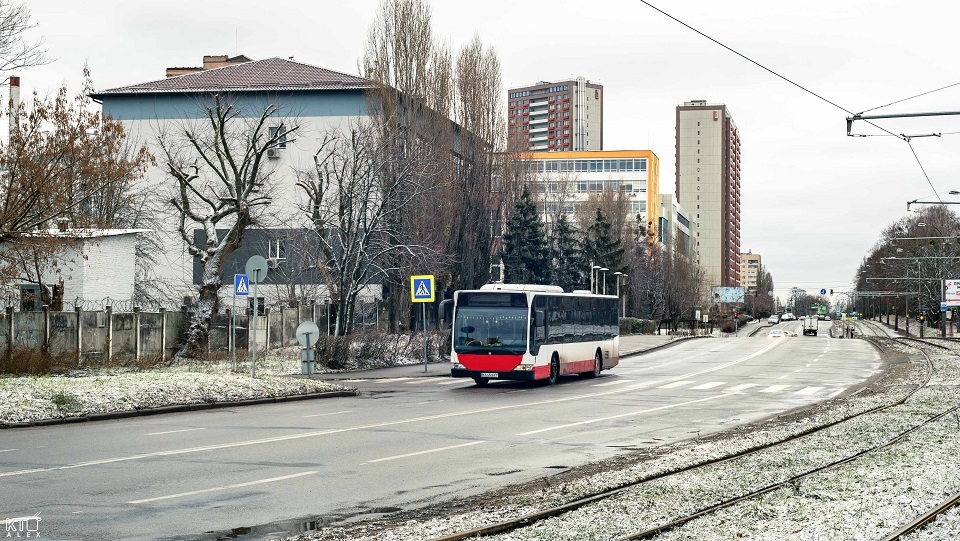
Kyivpastrans received 132 buses from international partners in 2022–2025 (Latvia, Germany, Finland, Slovakia, Croatia, Poland). At the beginning of the year there were 100 such units on the balance sheet; 24 were transferred for the needs of district territorial recruitment and social support centers, military units and other communal enterprises, and another 8 are planned for transfer — the municipal enterprise reports.
In wartime, rapid deployment of additional rolling stock is a necessity. But speed often creates risk: documents, registrations and staff training can lag behind operational needs.
"We are taking measures in accordance with current legislation to address the issue raised in the request. Humanitarian buses are operated on the city's route network."
— KP "Kyivpastrans", response to LIGA.net
Why this matters for Kyiv residents
This is a matter of safety and trust. Incomplete registers, lack of insurance or unqualified staff increase the risk of accidents and complicate compensation and investigation in the event of an incident. For passengers, this means higher danger; for the city — reputational and financial risks.
What the authorities and operator should do
- Quickly update data in EKIS and ensure the availability of all registration sheets and tachograph printouts.
- Verify the qualifications of technical staff and, if necessary, organize retraining or engage certified specialists.
- Adopt transparent procedures for transferring humanitarian transport to the needs of the Armed Forces and communal structures so that operational speed is balanced with safety standards.
- Monitor the presence of passenger liability insurance contracts for all depots.
Short conclusion
The question is not whether the rapid mobilization of buses for the city and the army was necessary — it was. The issue is combining speed with discipline: how to reconcile urgent assistance with basic safety and reporting requirements. The answer depends on how quickly the shortcomings are corrected, transparent accounting and external oversight — and this matters for every Kyiv resident who uses public transport daily.
Sources: Ukrtransbezpeka (LIGA.net request), LIGA.net, Alltransua, response from KP "Kyivpastrans".



