Ukrzaliznytsia will pay mortgages for internally displaced employee workers — but the market is already lagging behind
# Oschadbank and Ukrainian Railways Launch Model Where Employers Top Up First Payment by 20% and Cover Part of Loan for Three Years. The Problem Is That in Kyiv, Apartments Under 2 Million Hryvnias—the Only Limit for IDPs—Are Effectively Disappearing From the Market.

By Tetiana Suchkova-Ladik
April 16, 2026 · 3 min read
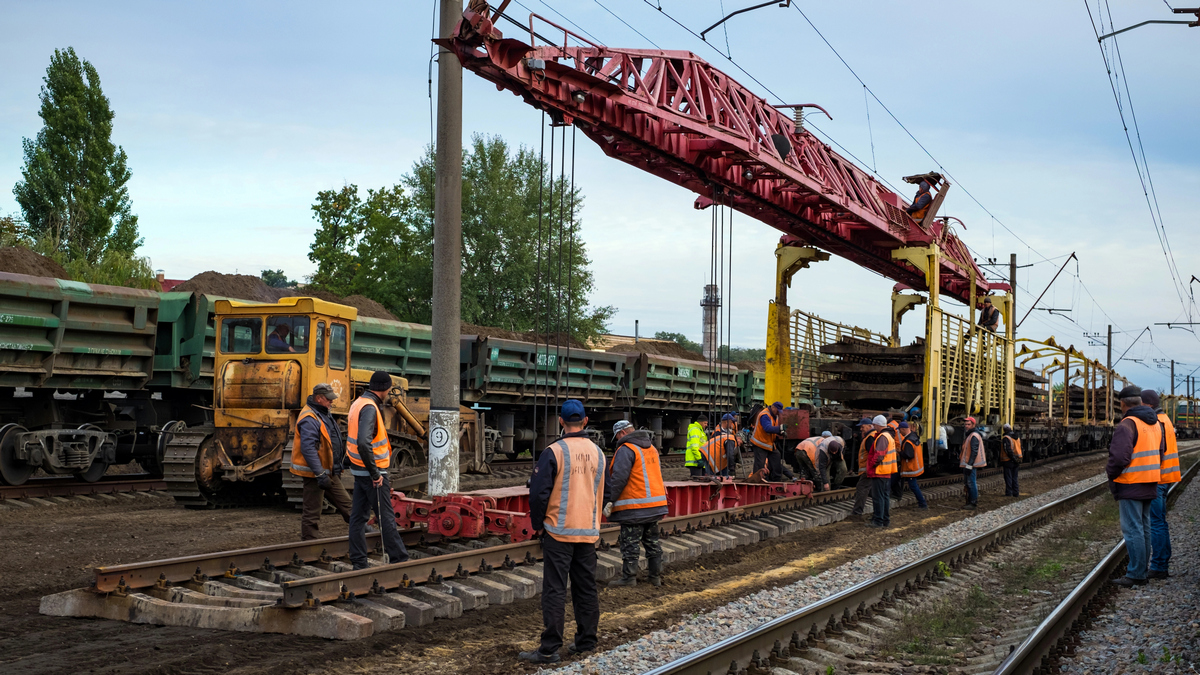
Oschadbank and Ukrzaliznytsia have signed an agreement to launch a new model within the state "eOselya" (eHome) program. Formally, this is an expansion of the standard program — but the financial architecture of the agreement is atypical: the employer assumes part of the debt burden, rather than simply providing access to a preferential rate.
How financing is distributed
The state covers 70% of the initial deposit and 70% of monthly payments during the first year, as well as document processing costs — up to 40,000 hryvnias. Ukrzaliznytsia as an employer adds 20% of the initial deposit and helps with monthly payments for another two years after the state year. As a result, according to Vice Prime Minister Oleksiy Kuleba, a railroad worker can purchase an apartment worth up to 2 million hryvnias with their own down payment of no more than 60,000 hryvnias.
"Railroad workers ensure connectivity, maintain logistics, and help the country move forward even during wartime. The state should support those who support it."
Oleksiy Kuleba, Vice Prime Minister for Recovery
By the end of 2025, the Ministry of Development plans to attract the first 100 railroad worker families to the program.
Where the bottleneck is
The program for internally displaced persons (IDPs) has strict price limitations — housing value cannot exceed 2 million hryvnias. In major cities where most displaced persons are concentrated, this critically narrows the selection. According to LIGA.net, after new area standards took effect in February 2026 — the basic limit for a couple is 52.5 square meters — Kyiv already faces a shortage of apartments that simultaneously fit both these dimensions and the 2-million-hryvnia ceiling.
New eOselya rules that took effect on February 9, 2026, also prohibit participation by those who already own housing exceeding the established area standard. For the primary market, this is a double-edged change: the share of apartments in new construction purchased through eOselya increased to 64% in 2025 — from 32% a year earlier, meaning the program has effectively become the main driver of new construction.
What remains outside the agreement
The agreement between Oschadbank and Ukrzaliznytsia does not contain publicly announced mechanisms to control how long Ukrzaliznytsia will remain a solvent co-financier. The company is state-owned and bears significant wartime burden. Mortgage payments are tied to the duration of employment, but what happens to the loan in case of dismissal or mobilization of an employee — the agreement's conditions are not publicly clarified.
- The first loan with 70-percent state compensation under eOselya for IDPs was issued in September 2025.
- IDPs comprise only 3% of Oschadbank borrowers under the program — the smallest category after teachers and medical workers.
- Ukrzaliznytsia is one of the largest employers among IDPs in Ukraine.
If the shortage of available apartments in major cities does not decrease — the hundred railroad worker families that the Ministry of Development plans to attract risk facing not a bureaucratic, but a purely market barrier: housing within 2 million hryvnias and 52.5 square meters in Kyiv simply does not exist in the required quantity. Whether the price limit for the IDP program will be revised — or whether Ukrzaliznytsia will compensate for the difference above the ceiling — depends on how many applications are rejected in the first months of the agreement's operation.



