EU and Mexico sign new trade agreement — but it won't take effect anytime soon
On May 22 in Mexico, the Modernized Global Agreement and the interim trade agreement ITA were signed. The first requires ratification by all 27 member states, while the second may come into effect earlier — and it is precisely this agreement that will determine whether the signing becomes a real breakthrough or merely a symbolic gesture.

By Tetiana Suchkova-Ladik
May 23, 2026 · 2 min read
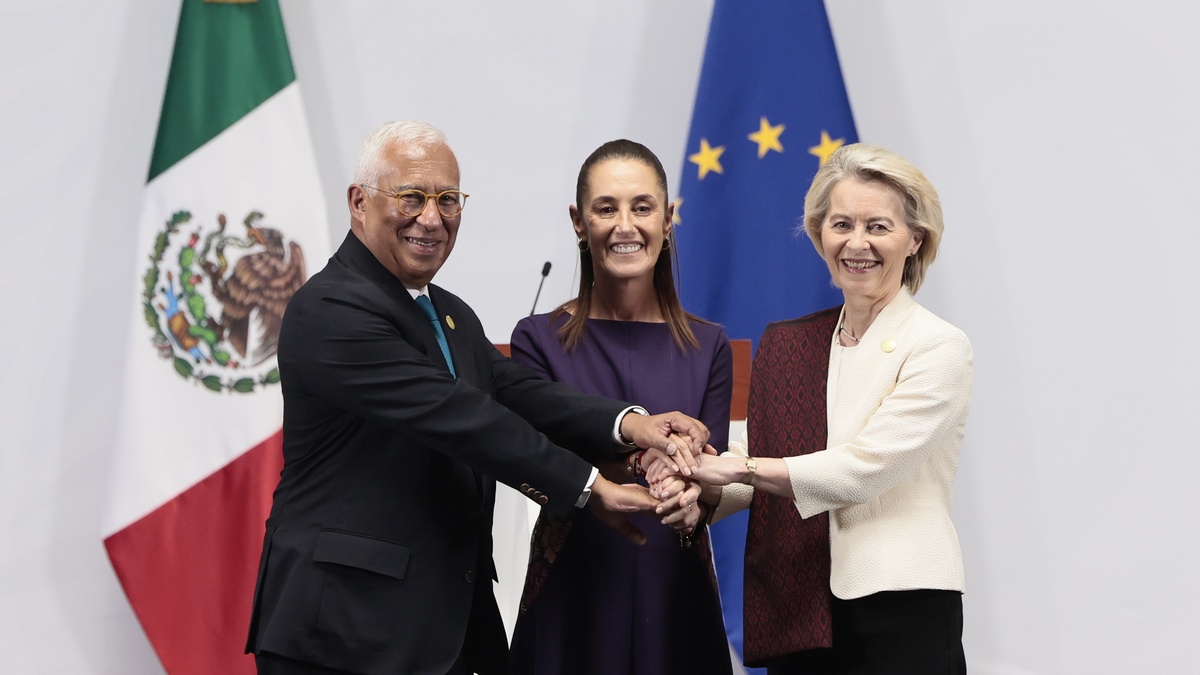
On Friday, May 22, at the EU-Mexico summit in Mexico City, European Commission President Ursula von der Leyen, European Council President António Costa, and Mexican President Claudia Sheinbaum signed two documents: the Modernised Global Agreement (MGA) and a temporary trade agreement (iTA). They will replace the agreement from 2000 — the first in history between the EU and a Latin American country.
What's inside
The iTA covers exclusively the trade component and falls only within EU competence — meaning it does not require ratification by each of the 27 member states separately. It eliminates significant tariffs on key EU export goods: food, machinery, pharmaceuticals, and transport equipment. Mexico, in turn, gains open access for coffee, fruits, chocolate, and agave syrup.
The agreement also protects 568 European and 26 Mexican geographical indications — from Parmesan to tequila. Separate chapters regulate critical raw materials, digital trade, government procurement, and intellectual property rights.
An important precedent — binding commitments on labour rights, environmental protection, and climate action with mechanisms for civil society participation. For comparison: the Mercosur agreement, which entered into force on May 1, faced opposition precisely due to the absence of such guarantees.
Figures that explain the stakes
- Trade volume in 2025 — €86.8 billion
- Over 45,000 EU companies export to Mexico, with the majority being SMEs
- Forecast for bilateral trade growth — 35% over five years (COMCE estimate)
- After signing the agreements, the EU covers with preferential agreements 97% of GDP in Latin America and the Caribbean
Geopolitical context — not rhetoric
Both partners found themselves under pressure from the United States. Mexico is conducting parallel negotiations with Washington on reviewing USMCA. The EU faces threats of new Trump tariffs, despite the 2025 trade agreement. The summit took place for the first time in more than a decade, and this fact itself is telling.
«This is not just about trade — it is a geopolitical statement»
Kaja Kallas, EU's chief diplomat
According to Trade Commissioner Maroš Šefčovič, the agreement is part of a broader diversification strategy: after India, Australia, and Mercosur, this is already the fourth major trade partner with which the EU has solidified relations following Trump's return to power.
Where signing is not yet an agreement
The iTA will enter into force after approval by the European Parliament — without ratification by member states. The full MGA, however, requires passage through the parliaments of all 27 countries, which at best will take years. The Mercosur agreement, signed earlier, remains blocked: MEPs have challenged it in the EU Court of Justice. A precedent exists.
Monitoring mechanisms for compliance — joint councils and specialized committees — are outlined in the MGA text. But as long as the iTA has not entered into force and the MGA has not been ratified, this is an institutional framework without substance.
If the European Parliament votes in favour of the iTA by the end of 2026, the agreement will become the first real test of whether the EU is capable of converting geopolitical rhetoric into concrete trade flows — at a moment when the rules of world trade are being rewritten faster than parliamentary procedures can keep pace.



