Found Oil — Left with Debt: How Brazilian Law Turned a Farmer into a Victim of His Own Discovery
A 63-year-old Sidônio Moreira drilled a well searching for water and found crude oil instead — and continues paying off a 25,000 real loan because under Brazilian law, mineral deposits belong to the state, not the landowner.

By Tetiana Suchkova-Ladik
May 25, 2026 · 2 min read
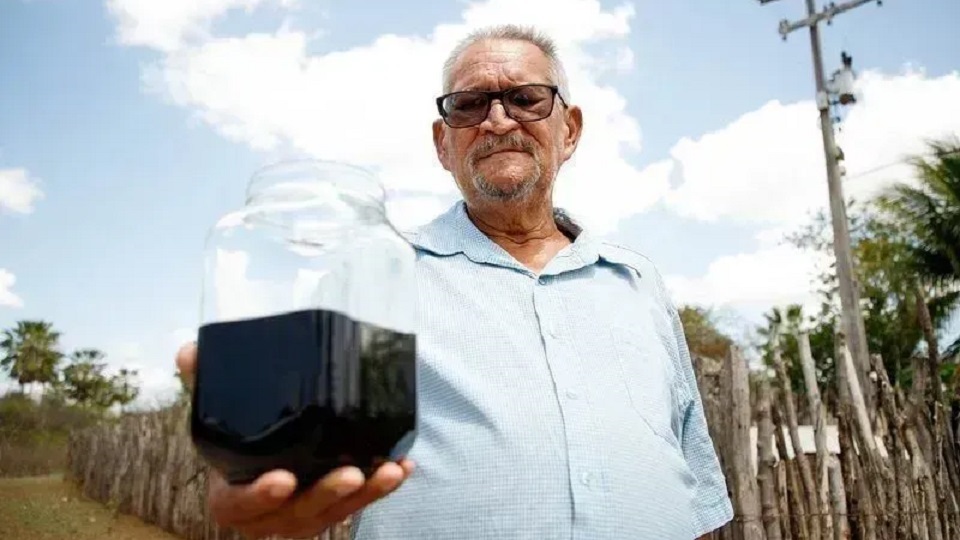
In November 2024, farmer Sidróniu Moreira hired a drilling crew on his plot in the municipality of Tabuleiro do Norte in northeastern Brazil. The goal was simple: an artesian well for irrigating the vegetable garden and watering livestock. But instead of water from underground, a thick black liquid with the smell of fresh asphalt spurted out.
Confirmation without timeline and without money
On May 19, 2025, Brazil's National Agency for Oil, Natural Gas and Biofuels (ANP) officially confirmed: the liquid is crude oil. Results of physical and chemical analyses were handed over to the family the next day and also sent to the Environmental Secretariat of Ceará State (SEMACE) for assessment of environmental consequences.
However, ANP immediately cautioned: no timeline has been established for further technical evaluation — and even after its completion, industrial development of the field is not guaranteed.
"No water, no money — only debt remains."
Sidróniu Moreira, farmer, Tabuleiro do Norte
Why the discovery costs the farmer more than it brings
To drill the well, Moreira took out a bank loan for 15,000 Brazilian reais. His wife, Maria Luciene, simultaneously borrowed another 10,000 reais — to update the livestock herd. The family's total debt amounted to 25,000 reais, with monthly losses exceeding 2,000 reais. The 49-hectare farm is blocked: drilling further or independently disposing of the find is forbidden.
Where the system is broken: constitution against landowner
The Brazilian Constitution (Article 20, Section IX) classifies underground mineral resources as state property — the Union's property. This means: the oil under Moreira's plot was never legally his.
The law, however, does provide for compensation. According to Article 176 § 2 of the Constitution and ANP regulations, the concessionaire company that obtains a mining license is obligated to pay the landowner between 0.5% and 1% of production volume. But this provision is activated only after:
- ANP completes technical evaluation and recognizes the field as commercially viable;
- an auction is held for the right to develop the block;
- the winning company begins actual extraction.
Each of these steps can take years. The farmer has no influence on decisions at any of them — and receives no advance payment.
This is not an exception — this is system architecture
Moreira's case exposes a structural problem: Brazilian subsurface legislation was built for large offshore fields like the "pre-salt" layer, where between discovery and extraction come multi-billion-dollar investments and years of preparation. For a small landowner who accidentally got an onshore find, there simply is no mechanism for quick or guaranteed compensation.
Families in such situations effectively finance exploration at their own expense — through loans, farm downtime, delayed harvests — while the state decides whether it's worth proceeding at all.
If ANP deems the field unviable, Moreira will be left with debt, a contaminated well, and no compensation. If it deems it viable — the auction, concessionaire, and actual extraction may begin in five, ten, or more years. The question is not whether there is oil there — that is already confirmed. The question is whether Moreira's farm will survive until the system finally decides what to do with it.



