272 families, three years of waiting, 144 apartments in the first phase: excavation finally begins in Hostomel
# Military settlement homes destroyed on first day of full-scale invasion. Since then, residents have endured a fruitless French memorandum, housing certificates for some residents, and finally—an actual construction pit.

By Tetiana Suchkova-Ladik
April 7, 2026 · 2 min read
On February 24, 2022, Russian forces attacked the Antonov airfield in Hostomel. Nearby was a military settlement — which, according to the then-leadership of Kyiv RMA, was "completely destroyed". Five apartment buildings, 272 apartments, hundreds of families — all of this disappeared in the first hours of the war.
Three years between memorandums and excavation
Reconstruction could have started earlier. According to The Village Ukraine, in September 2022, French company Neo Eco signed a memorandum on the reconstruction of the settlement — with the participation of then French Foreign Minister and head of KRMA Oleksiy Kuleba. The project provided for six buildings with 310 apartments, a school and kindergarten. The matter went no further than the memorandum.
Only in the summer of 2025 did the Recovery Agency officially become the customer of the work. The project was revised to meet current energy efficiency and inclusivity requirements, and on December 29 it received a positive expert review.
What is being built and for whom
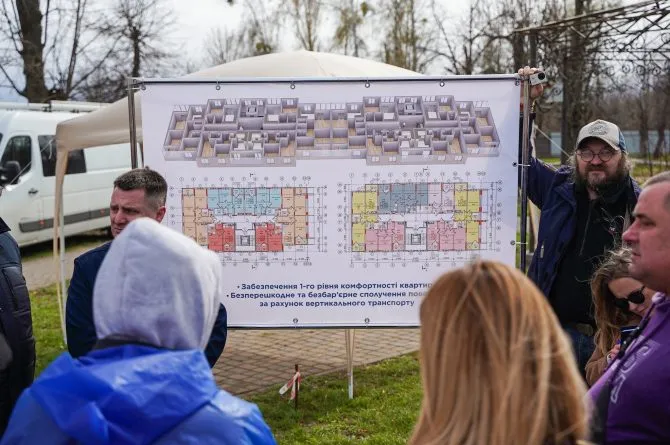
Currently, the site is preparing the excavation, bringing in equipment, and installing construction trailers — this is the first phase: two buildings with 144 apartments. In total, the project provides for the construction of seven-story buildings with 360 apartments instead of the destroyed 272, as well as a radiation shelter and a floor with social and domestic facilities.
"Our task is not just to build houses, but to restore a full-fledged living space. We have such experience in Borodianka, where restoration is happening comprehensively"
— Head of Kyiv RMA Mykola Kalashnyk
However, 106 out of 272 families have already received housing certificates with monetary compensation and most likely independently resolved the housing issue. New apartments will be waiting mainly for those who refused the certificate or did not receive it.
Gap between first and second phase
The first 144 apartments are only half of what was promised. A contractor for the rest of the construction is still being determined: according to Kyivshchyna 24/7, the selection procedure was ongoing at the time the preparatory work started. The full scope of construction — 360 apartments in several buildings — is scheduled to be completed by the end of 2026 according to current plans.
For comparison: in neighboring Borodianka, which Kalashnyk cites as an example, the reconstruction of apartment buildings also dragged on for years — and is still not fully complete.
If a contractor for the second phase is determined by the end of spring, the 2026 timeline is still realistic. If the procedure drags on — residents who have been waiting three years for the excavation risk waiting for the keys even longer.