Bucha opens rehabilitation center for 400 children — three years after the occupation
In the city that has become a symbol of war crimes, a Center for Comprehensive Development and Support for Children with Disabilities has opened. It was built over nearly two years — even as new shelling was being recorded just a few blocks away.

By Tetiana Suchkova-Ladik
March 30, 2026 · 2 min read
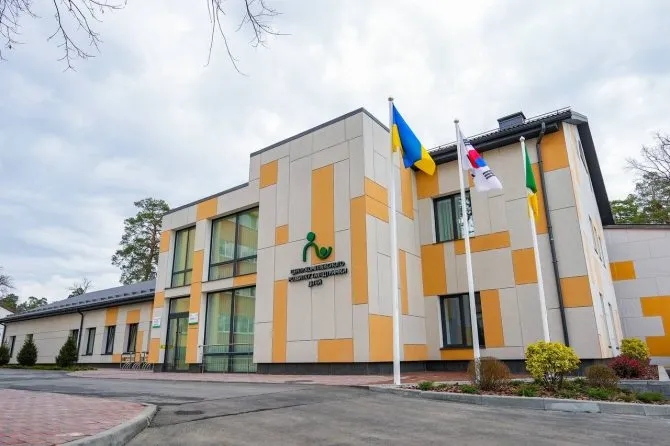
A Center for Comprehensive Development and Support of Children has opened in the Bucha community — a facility whose concept was approved back in 2023, when the community counted over 350 children with disabilities who needed rehabilitation. Now there are about 400.
The number is not standing still. As Bucha's mayor Anatoliy Fedoruk noted when opening a separate rehabilitation department in 2024, the number of people with disabilities in the community "continues to grow" — a result of both pre-war needs and new injuries.
What's inside
The center was not built as just another physiotherapy office. Four services have been consolidated in one space:
- Early Intervention Center — for children from birth to 3–4 years with developmental disorders or at risk of them;
- Rehabilitation Department for children with disabilities;
- Day Care Service;
- Center for Resilience — psychological support for children and families.
The operating principle is a "continuous route": from early identification of needs to long-term support. This means that a family does not have to search for each specialist separately and explain the situation from scratch every time.
Where the money comes from — and why it matters
Rehabilitation at the center is free for all community residents. The project was implemented with the support of the Ministry of Social Policy and budget funds. The Center for Resilience component is part of the nationwide mental health program "How are you?" by First Lady Olena Zelenska; its specialists will undergo training programs with the participation of UNICEF and WHO.
"The project will operate on the principle of a continuous route of assistance — from early identification of needs to long-term support for the child's development and family resilience."
Bucha City Council
The "one-stop" approach for children with disabilities is still rare in Ukraine: most communities either have no rehabilitation services at all, or have scattered offices without coordination between them. Bucha is not the largest city, but one of the few examples where the early intervention service was introduced deliberately, after training specialists in 2025 together with representatives of the Rokytne, Bila Tserkva and Fastiv communities.
Context that cannot be ignored
Bucha is a city with a pre-invasion population of about 37,000 people. After March 2022 it became known to the world because of documented war crimes. Now the community is simultaneously rebuilding infrastructure and accumulating new social needs: among residents are 549 internally displaced persons with disabilities and over 250 veterans who acquired disabilities as a result of combat.
The opening of the center is not a triumphant full stop, but a working start. The real question will arise in a year or two: will there be enough funding to maintain the multidisciplinary team after the end of international grants — and if not, which of the four services will the community be able to sustain on its own?