Subsidies for Generators, Boilers and Solar Panels: How the Irpin Community Is Strengthening Energy Resilience
Irpin will partially reimburse the cost of equipment that helps residents endure power outages. We explain who qualifies for the program, how much can be received, and how quickly applications are processed.

By Tetiana Suchkova-Ladik
March 17, 2026 · 2 min read
About the program and why it is needed
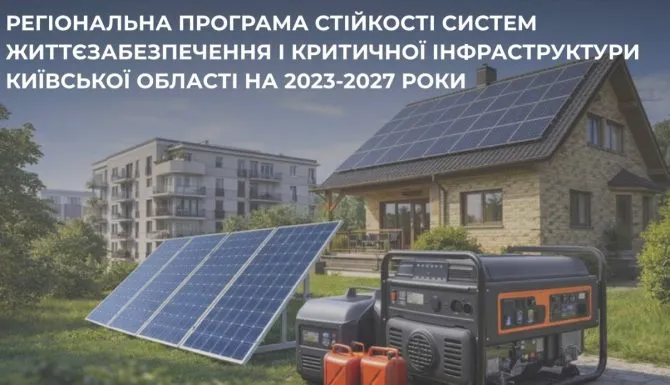
In the Irpin community, implementation is underway of the Regional Program for the Resilience of Life‑Support Systems and Critical Infrastructure of Kyiv Oblast (2023–2027). This is not about one‑off grants — it is about increasing local preparedness for energy challenges that remain more real than before. The district administration and the Kyiv Regional Military Administration (Kyiv OVA) are involved in the work, underscoring the community’s security priorities.
What is compensated and to what extent
For private homeowners: partial compensation of up to 30% of equipment costs with limits — up to 7,000 UAH for two‑circuit boilers, up to 3,000 UAH for gas stoves, up to 50,000 UAH for solar power plants (SPPs) and up to 3,300 UAH for generators.
For associations of co‑owners of apartment buildings (OSBB), housing cooperatives (ZhBK) and apartment building managers: compensation also up to 30% of costs — in particular up to 300,000 UAH for thermal modernization (insulation of facades, roofs, basements) and up to 100,000 UAH for the purchase, installation and commissioning of generators.
Who it suits and how to apply
The program is aimed at private household owners and associations of co‑owners of apartment buildings — that is, those who directly invest in equipment or repairs. Documents can be submitted via the Center for Administrative Services (CNAP) of the Irpin community. Applications are reviewed by commissions at the district administration and Kyiv OVA within up to 10 working days.
An example to understand the scale of assistance
If an SPP costs 150,000 UAH, 30% of that amount is 45,000 UAH; the sum is below the 50,000 UAH cap, so the compensation would be 45,000 UAH. If a generator for a private house costs 11,000 UAH, 30% is 3,300 UAH (within the maximum amount for generators).
"This is a real opportunity to make homes more resilient to energy challenges and to improve people's comfort and safety. We encourage residents and OSBBs to take advantage of this opportunity."
— Serhii Kanyura, Deputy Mayor of Irpin
Practical conclusion: the program makes it possible to reduce part of the costs for equipment and works that increase the energy independence of families and communities. It is not a panacea, but it is a tool of local resilience — and right now, when household budget planning and readiness for outages matter more than ever, it is worth checking your eligibility for support and submitting an application to CNAP.