Knitted trees of Irpin: three years after occupation — new concept replaces faded threads
Volunteers will replace knitted installations in Central Park that were destroyed over time after surviving the occupation. A charity event at the end of April will combine art with real fundraising for tactical medicine.

By Tetiana Suchkova-Ladik
April 7, 2026 · 2 min read
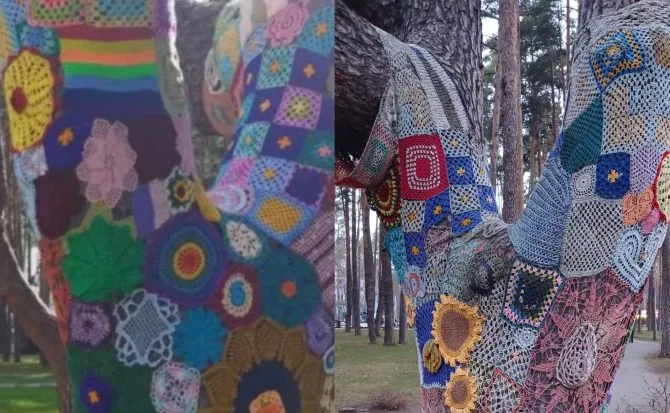
The "Tsentralnyi" park in Irpin spans 6 hectares and has its own story. Opened before the full-scale invasion, it survived the city's occupation in spring 2022. The knitted installations that volunteers managed to create before the war also survived — but time proved to be harsher than occupation.
"Over three years, the knitted elements lost their color and form. So it's time for a complete replacement with a new author's concept," says the NGO "Ukraine — Reboot," which is organizing the event.
Yarn bombing as a mirror of the city's condition
Knitting on trees — the so-called yarn bombing technique — has long transcended street art in global practice. It captures a moment: who is knitting and why. In Irpin, the first installations appeared as an act of peaceful urban activism. Now they are being replaced in a city where restoration work continues following widespread destruction. The organizers are not yet revealing details of the new "author's concept."
Art inseparable from fundraising
The event is planned for the last weekend of April, though the exact date has not been announced. Alongside communal knitting, there will be fundraising for tactical medical supplies for the Defense Forces. This is a characteristic model for volunteer activity in front-line and post-occupation cities: cultural events serve as gathering points — both literally and financially.
"It's time for a complete replacement with a new author's concept (details to follow)."
NGO "Ukraine — Reboot"
The organizers have not specified how many volunteers will be involved, what volume of materials is needed, or how much they plan to raise for medical supplies. For now, there is only an announcement — without numbers.
Irpin as a test case
The city became one of the symbols of resistance in 2022 and, at the same time, one of the most documented examples of recovery. If the "Tsentralnyi" park receives a new installation with a well-thought-out concept, rather than simply replaced yarn, it will send a signal beyond Irpin itself: post-occupation recovery can have its own artistic language, not just construction estimates.
The question remains open: if the new concept is truly author-driven and meaningful, will it become part of a broader public art program in de-occupied cities — or will it remain a one-time action depending on whether the organizers find permanent funding after April?