Destroyed — Modernized: How a Building at 69 Sadova Street in Irpin Becomes a Test Case for Kyiv Region's Entire Reconstruction Program
# Major apartment building renovation in Irpin is not just wall repair. It is a test of whether Ukraine can rebuild better than before the war.

By Tetiana Suchkova-Ladik
April 8, 2026 · 2 min read
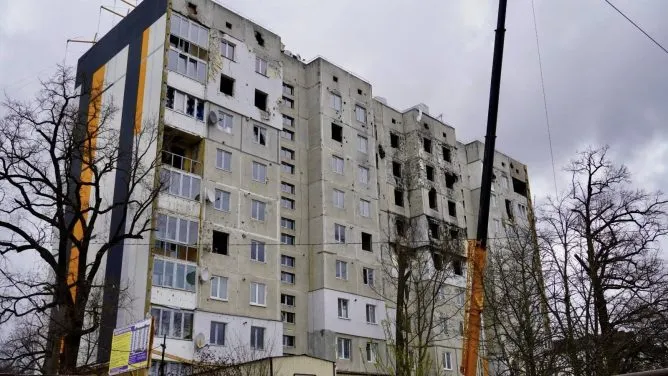
Work is currently underway at 69 Sadova Street in Irpin that, at first glance, appears to be routine repairs following shelling. But considering the scale of the program of which this building is a part, the picture becomes more complex.
What exactly is being done — and why it matters more than cosmetics
The project provides for not restoration to pre-war condition, but comprehensive modernization: roof repairs, basement and elevator work, finishing of common areas, landscaping of the building's surroundings. A particular emphasis is placed on energy efficiency and improved structural safety. In other words, a building that has survived shelling should become safer and cheaper to maintain than it was before 2022.
This is not an initiative of a single community — the work is being carried out as part of the Program for Reconstruction of Multi-Apartment Residential Buildings in Kyiv Region for 2023–2026. According to the Kyiv Regional Military Administration, in 2026 alone, 653 million hryvnias from the regional budget have been allocated to this program. The funding covers new construction, reconstruction, and major repairs of multi-story buildings and dormitories throughout the region.
Irpin as a concentration of the problem
The city in Kyiv Region became one of the symbols of Russian aggression in spring 2022 — and one of the first sites for reconstruction. Currently, work covers residential buildings, sports facilities, and city infrastructure simultaneously. Sadova Street, 69 is one of the nodes in this system.
Reconstruction is not just about walls, it's about people, comfort, and a new quality of life.
Life.kyiv.ua on Irpin's restoration
The phrase sounds like a slogan. But behind it lies a real question: are contractors adhering to energy efficiency standards in practice, not just in project documentation.
Where the bottleneck is
- Timelines. The program runs until 2026, and there is more than one building in the queue.
- Quality control. Public reports track work progress, but independent technical audits of completed work have not been publicly announced.
- Residents. The return of people to repaired apartments is a separate variable: some owners remain abroad or in other regions.
If by the end of 2025 Sadova Street, 69 is put into operation with a confirmed energy passport — this will be evidence that the program works not just on paper. If deadlines are missed or modernization remains merely a declaration, the 653 million hryvnias in 2026 will follow the same logic.