Kobzar in central Irpin: Shevchenko's words as a resource for national resilience
On March 9, Irpin remembers Taras Shevchenko not only as a historical figure but as a practical resource for preserving identity and moral resilience in times of trial, First Deputy Mayor Oleksandr Pashchynskyi stressed.

By Tetiana Suchkova-Ladik
March 9, 2026 · 2 min read
Why this matters
On March 9, Irpin, like the rest of Ukraine, marks the birthday of Taras Shevchenko. The city publicly noted the date — the first deputy mayor, Oleksandr Pashchynskyi, published a post on social media linking Shevchenko's legacy to the country's contemporary challenge. Such public representation of memory is important not only as a symbol: it shapes the local narrative and affects the community's resilience.
“Today, as Ukraine once again fights for its freedom, Shevchenko's words sound especially prophetic and timely. They sustain, inspire and remind us that truth, strength and will always belong to those who fight for their land. We honor the Kobzar and thank him for the word that even today leads Ukraine forward.”
— Oleksandr Pashchynskyi, First Deputy Mayor of Irpin
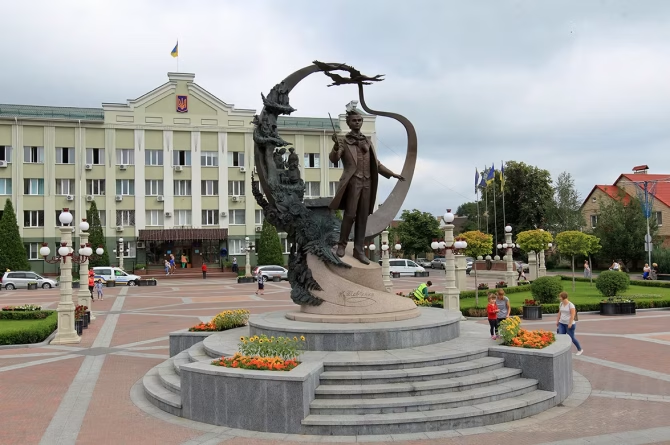
A monument to Taras Shevchenko stands in the center of Irpin, unveiled on 24 August 2017. The monument's authors are the well-known Ukrainian sculptors Borys Krylov and Oles Sydoruk. The monument's distinctive feature is that the Kobzar is depicted as a young man — an image that emphasizes not only the past but also an orientation toward the future: youth, energy and resilience.
One of Irpin's streets bears Shevchenko's name — a daily marker of historical memory that maintains a connection between generations and strengthens local identity.
What this means today
At a time when issues of security and social cohesion are paramount, symbols perform a practical role: they consolidate, motivate and provide a sense of shared past. Cultural analysts note that a properly shaped public narrative — from monuments to street names and educational programs — enhances a community's social resilience and helps resist informational pressure.
The facts — the 2017 monument, the authors, the street name — remain unchanged. The question is different: how will local authorities and the community turn these symbols into concrete tools — educational initiatives, cultural events, memorial practices — so that Shevchenko's word truly works toward the city's recovery and future?
The answer depends on whether Irpin can transform memory into an effective resource: not only to remember, but to shape through it practices of solidarity and institutional support.