1153 hp without V8: Mercedes-AMG strips gasoline from fastest sedan and installs F1 technology
The new AMG GT 4-Door EV is the first production car featuring axial-flux motors and a battery developed in collaboration with Mercedes F1 team. Zero to 100 in 2 seconds — but the acceleration isn't the most interesting part; it's how they achieved it.

By Tetiana Suchkova-Ladik
May 20, 2026 · 2 min read
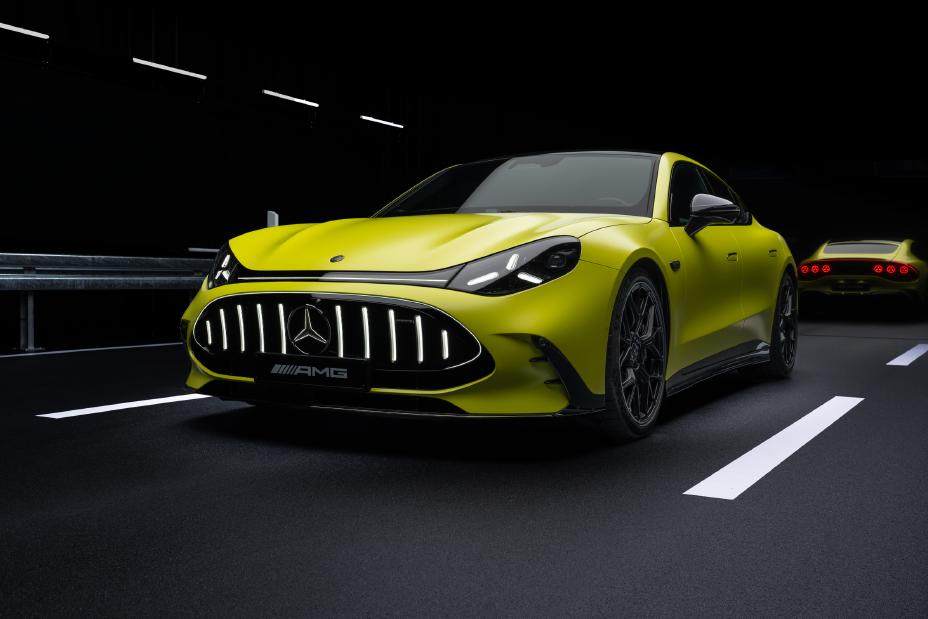
Its predecessor — the AMG GT 63 S E Performance — featured a 4-liter V8 with hybrid assistance. The successor has no internal combustion engine at all. Mercedes-AMG replaced it with a system that weighs only 140 kg and delivers 1153 horsepower — more than any serial production car from the brand to date.
Motors never before seen in production cars
The GT 4-Door EV is the first mass-market car with axial-flux electric motors. Previously, this technology was used in the Rimac Nevera and industrial installations. The fundamental difference from conventional radial motors is significantly lower thickness at the same power output.
The front motor is only 8.9 cm thick and spins up to 15,000 rpm. It activates only during maximum acceleration or regeneration — in normal mode, the car runs on two rear motors. Both rear motors together with the transmission fit within a height of 8.1 cm. According to Engadget, the entire traction unit weighs 309 pounds (approximately 140 kg).
Battery from Formula 1
The 106-kWh battery was developed jointly with the Mercedes-AMG F1 engine division in Brixworth. According to Jalopnik, it contains 2,660 cylindrical cells grouped into 18 modules with direct cooling of each cell individually — a technology transferred directly from the F1 car.
The cells are narrow and tall (10.4 × 2.5 cm) — this format was specifically chosen so that heat travels the minimum distance from the core to the surface. This allows peak power to be maintained even after multiple consecutive acceleration runs on the track.
600 kW charging: what does this mean in practice
Support for 600 kW charging power is currently higher than most public stations can provide. But according to CarSauce, on compatible infrastructure, charging from 10 to 80% takes 11 minutes. According to Motor1, in 10 minutes you can add over 460 km of driving range.
The claimed driving range according to the WLTP cycle is up to 700 km for both versions (GT 55 and GT 63). On the American EPA cycle, this translates to approximately 500 km — a more realistic figure for everyday use.
Competitors and price
Mercedes positions the new model against the Porsche Taycan Turbo GT (from $246,800) and Lucid Air Sapphire ($249,000). The brand has not yet announced specific prices, only noting that it targets the level of its predecessor. Orders start soon, with first deliveries planned for 2027.
"We used knowledge from the AMG One program and our Formula 1 team to achieve a level of thermal management unavailable to standard prismatic or pouch cells."
— Mercedes-AMG representative on the GT 4-Door EV battery technology
One detail deserves special mention that will spark debate: the car reproduces V8 engine sound through 1,600 audio files, including an imitation of "pops" when releasing the throttle. According to InsideEVs, Mercedes engineers describe this as a "sonic interpretation" of driving modes. Whether this is fair to the buyer paying for an electric car is an open question.
If Mercedes truly delivers 600 kW charging without degradation to the 150–200 kW level after several sessions — as happens with some competitors — the GT 4-Door EV rewrites the standards for premium electric performance. If not, the question will be more than just a matter of reputation.



