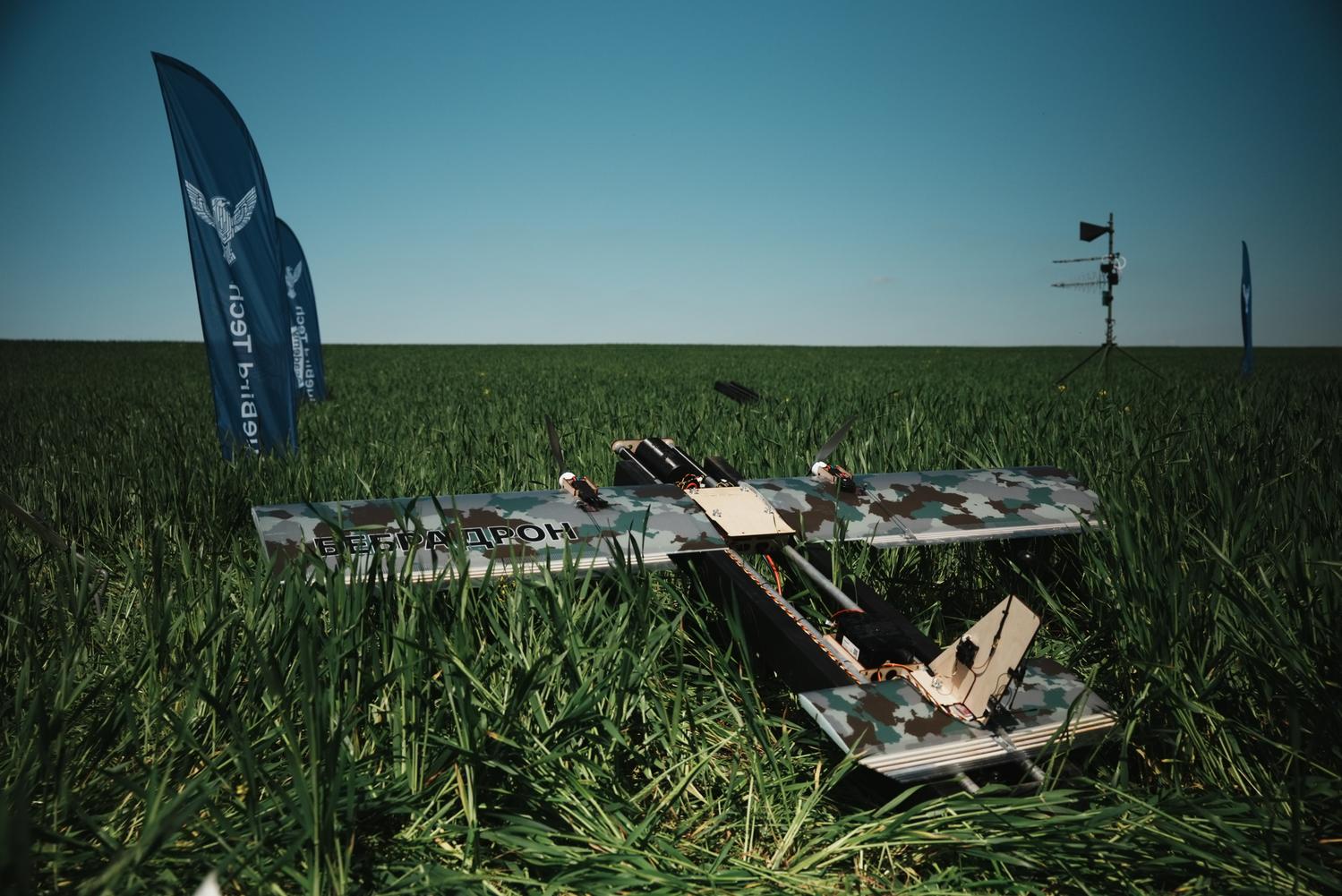
Terra A2: Japanese radar-integrated interceptor deployed to the front — Shahed will meet it 75 km from target
# Tokyo's Terra Drone Deploys Fixed-Wing Terra A2 Interceptor Drone in Ukraine with 75 km Coverage Radius Tokyo-based Terra Drone has deployed its fixed-wing Terra A2 interceptor drone in Ukraine with a coverage radius of 75 kilometers. The system complements the already-deployed Terra A1 and is built around a single principle: a cheaper interceptor against mass cheap threats.

By Tetiana Suchkova-Ladik
May 25, 2026 · 2 min read

On May 19, 2026, Tokyo-based company Terra Drone announced the beginning of combat deployment in Ukraine of the Terra A2 interceptor — a fixed-wing unmanned aerial vehicle developed jointly with Ukrainian WinnyLab. The difference from the vast majority of drones on the front is not tactical, but architectural: the system is designed to intercept threats long before they approach a city or power station.
What makes Terra A2 different
Most interceptor drones currently operating in Ukraine are short-range. Terra A2 occupies a different niche: coverage radius up to 75 km, speed of 312 km/h, airtime over 40 minutes. According to Terra Drone's official press release, the aircraft integrates with radar systems, allowing for wide-area surveillance, target tracking and interception in a single control loop — without manual switching between platforms.
The company's key bet is not a single interceptor, but a layered system: Terra A2 covers the distant perimeter, while Terra A1 (a missile-type platform already deployed earlier) handles the near zone. According to Dronelife, Terra A1 has already confirmed successful interceptions in combat conditions.
Why Shahed is not just a missile problem
Massive Shahed-type attacks have forced a rethinking of air defense logic not only in Ukraine. One interception with a PAC-3 MSE missile costs approximately $13.5 million; a Shahed costs roughly $35,000. Terra Drone is trying to close exactly this asymmetry: an interceptor drone is significantly cheaper than a missile, and its loss in battle does not wipe out a quarterly defense budget.
"As soon as the effectiveness of interception against massively deployed unmanned attack systems such as Shahed is sufficiently confirmed in real conditions, Terra Drone plans to transition to broader deployment and strengthen its production base"
— Terra Drone Corporation, official press release, May 19, 2026
Combat confirmation as a business model
Terra Drone openly calls Ukraine a testing ground for entering the global market. According to the company's statement, the deployment should provide field operational data necessary for scaling sales to other armies. This is a standard scheme for defense startups: Ukraine provides combat confirmation that no test range can replace.
WinnyLab is not merely a contractor: the company is a portfolio asset of Terra Inspectioneering, a subsidiary of Terra Drone. This means the Japanese side is not simply supplying a drone — it is financially embedded in the Ukrainian operator, creating a direct incentive for rapid refinement based on field data.
- Speed: 312 km/h
- Coverage radius: up to 75 km
- Airtime: over 40 minutes
- Integration: radar systems, unified surveillance and interception loop
- Operator in Ukraine: WinnyLab LLC
The ISW and the Armed Forces of Ukraine have not publicly commented on the Terra A2 deployment at the time of publication. The system's combat effectiveness remains an open question — the company itself defines the current stage as data collection, not a confirmed result.
If Terra A2 demonstrates a real interception rate at distances over 50 km, it will change the calculation for armies still hesitant between expensive missile systems and the absence of anything in the far zone. If not, another "combat test" will remain a marketing term.