39,000 hryvnias per strike at 45 km: BlueBird Tech launches 'Bebradrone' into mass production
A kamikaze drone of aircraft type was developed together with fighters of the Special Operations Forces — and now it costs less than many FPV quadcopters. The question is whether the price can withstand the pressure of scaling.

By Tetiana Suchkova-Ladik
May 25, 2026 · 2 min read
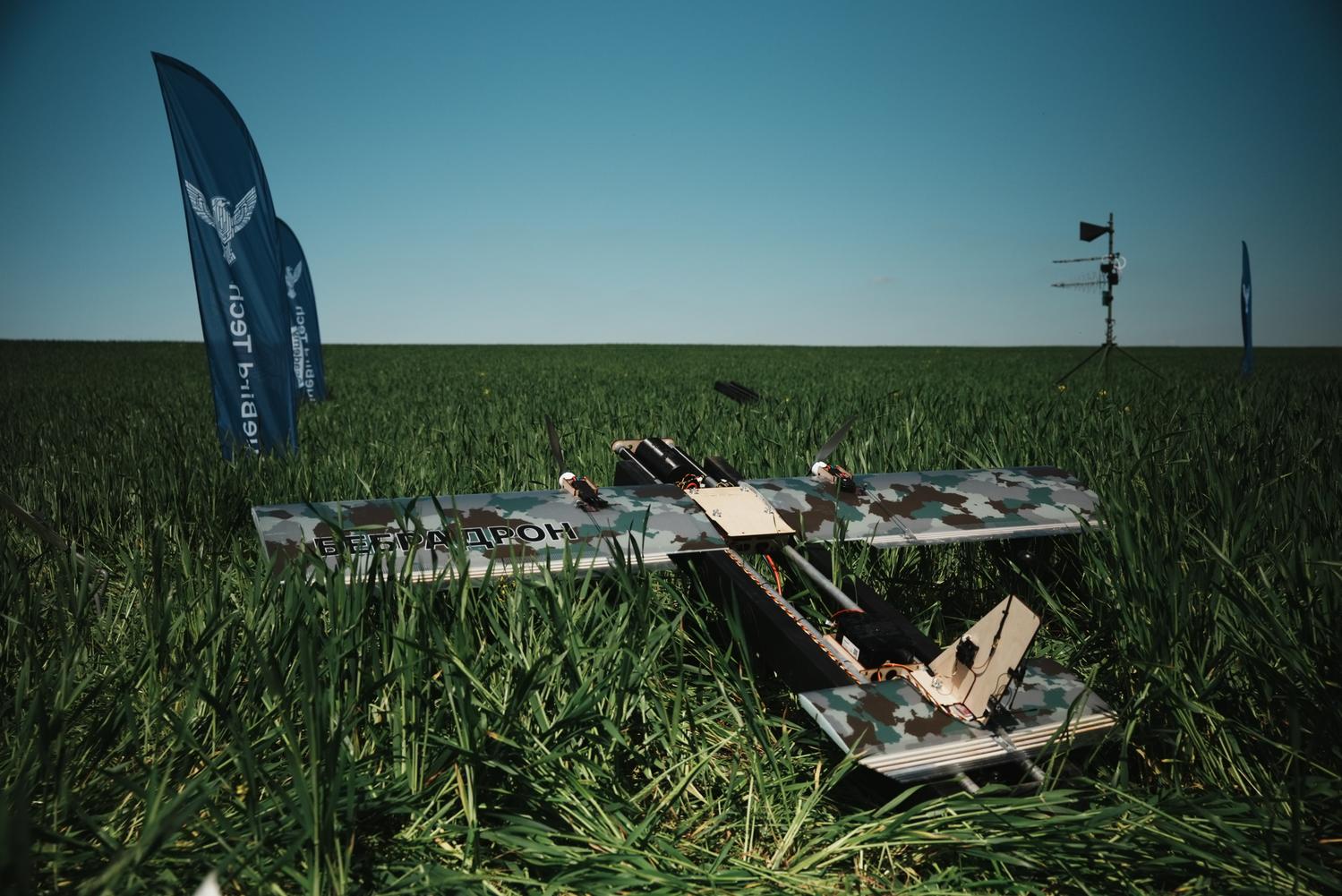
BlueBird Tech conducted the first public flight tests of its kamikaze drone "Bebradron" and immediately announced the start of serial production. Price: 39,000 hryvnias without VAT for a platform capable of striking targets at distances up to 45 km.
A drone ordered by the military themselves
An unusual detail in the development: according to BlueBird Tech director Borys Budeyanskyi, "Bebradron" was created not in a laboratory under a hypothetical technical specification, but at the direct request of Ukrainian Defense Forces service members. Soldiers participated in development — and according to engineers, this determined the main priority: not maximum specifications on paper, but survivability and simplicity in field conditions.
"We created a platform that would be not just another drone, but a tool capable of performing tasks where other solutions might not work."
Borys Budeyanskyi, BlueBird Tech director
The drone is transported disassembled, with full flight preparation taking up to 10 minutes: balance check, installing ammunition in the nose section, testing stabilization elements. Launch is from a pneumatic catapult powered by a car battery, which is sold separately for 14,000 hryvnias.
What's inside
- Type: fixed-wing aircraft (not a quadcopter)
- Cruising speed: 95 km/h, maximum — 150 km/h
- Range: up to 45 km with a 7.5 kg payload; when increasing explosives to 9 kg — range decreases
- Control: ELRS radio channel 433–915 MHz, video on standard FPV frequencies (1.2 / 3.3 / 5.8 / 7 GHz)
- Targets: low-mobility objects, concentrations of infantry in relatively deep rear areas
The key bet is on compatibility with existing FPV infrastructure: controllers, goggles, ground stations already available to units fit without modifications. This lowers the barrier to entry and reduces logistics costs.
Where price is, questions follow
Developers emphasize: "Bebradron" is already being used by some units on the front lines, and the platform is now being launched into mass production. For comparison — combat FPV quadcopters cost from 10 to 25 thousand hryvnias, but their range does not exceed several kilometers. "Bebradron" competes differently in this segment: not on unit price, but on cost per strike per kilometer of distance.
Wikipedia notes that conceptually the platform was developed by reconsidering ideas from the Russian product "Molniya" — which in itself is a telling detail about how Ukrainian manufacturers study and adapt enemy solutions.
If "Bebradron" truly maintains a price of 39,000 hryvnias in serial production — it could become a mass tool for strikes against the second line of defense. The only question is whether this price will be preserved after the first major state contract: state procurement in Ukraine traditionally complicates rather than simplifies cost reduction.