7 kg in a backpack and 150 km range: DZYNE Technologies unveiled Blitz drone with container for 100 UAVs
Blitz is a Group 1 unmanned aerial vehicle weighing approximately 7 kg, capable of carrying reconnaissance, electronic warfare, or strike mission payloads at ranges up to 150 km. It can be launched without an airfield and integrated with a container carrier that can accommodate up to a hundred drones.

By Tetiana Suchkova-Ladik
May 19, 2026 · 2 min read
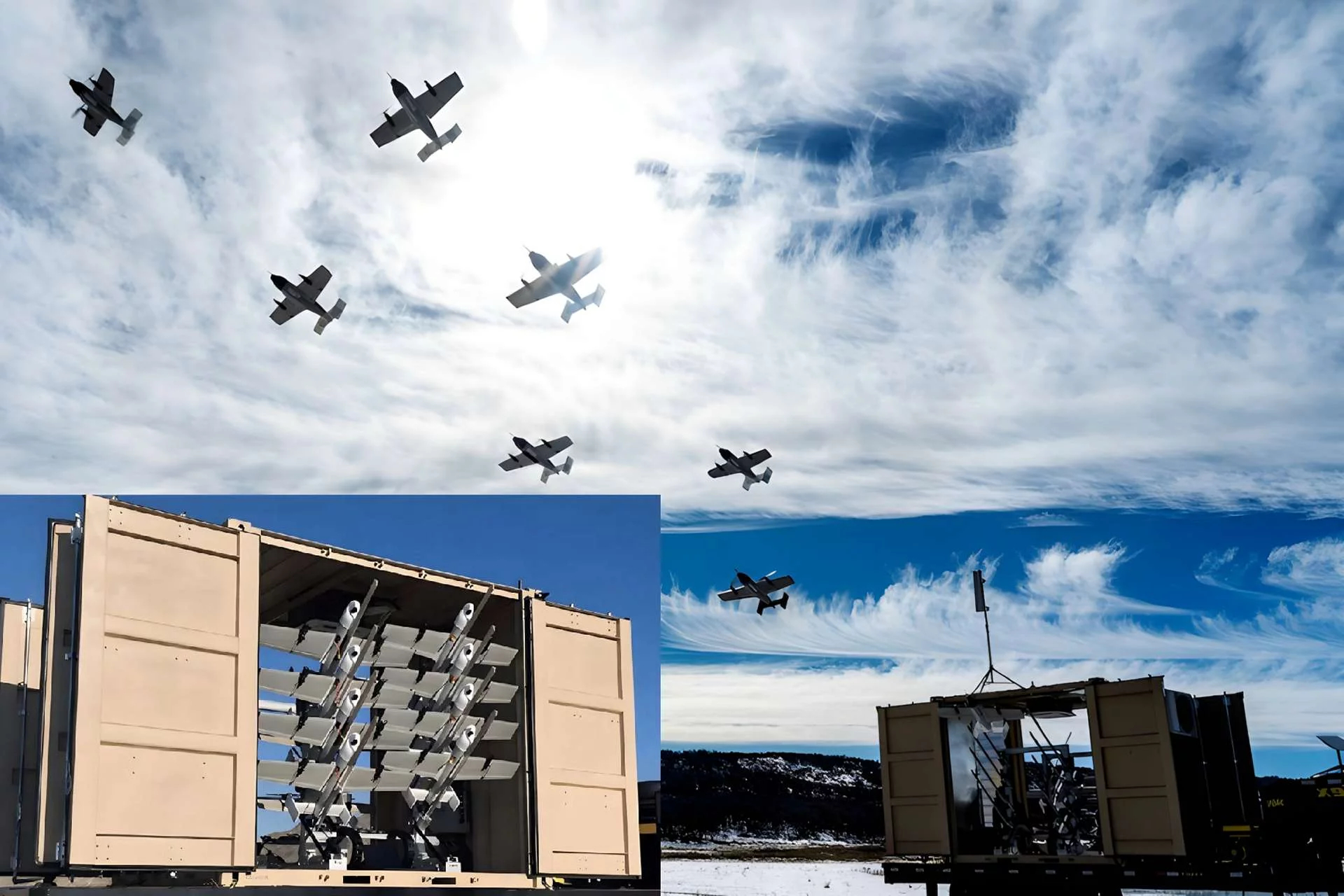
American company DZYNE Technologies has unveiled the Blitz, a Group 1 class unmanned aerial vehicle — the lightest category according to U.S. military classification (up to 9 kg). The drone weighs approximately 7 kg, fits in a backpack, and requires no runway or field infrastructure.
What Blitz Can Do
Depending on the payload configuration, Blitz can travel up to 150 km and remain airborne for up to two hours. Maximum payload capacity is 2.2 kg. The manufacturer positions the platform for four missions: intelligence, surveillance, and reconnaissance (ISR), strike operations, electronic warfare (EW), and disinformation operations — the latter involving the dissemination of signals or content in enemy territory.
DZYNE's key system approach is modularity: the same airframe can be reconfigured for different missions by changing the payload attachment without modifying the platform itself.
A Container for 100 Drones — What This Means in Practice
The company separately showcased a specialized carrier container designed for 100 Blitz units. This approach allows deploying a swarm of drones from a single point without complex logistics — a unit delivers the container rather than a hundred separate cases. Conceptually, this aligns with the direction the U.S. military is pursuing through its Replicator and Autonomous Multi-Domain Adaptive Swarms of Swarms (AMASS) programs.
"Blitz is designed so that a soldier can carry it themselves and launch it from any point — without a runway, without a ground control station"
— DZYNE Technologies, presentation materials
Context: Why Group 1 Matters
Group 1 drones are not replacements for heavy strike systems. Their value lies in scale and cost: a single such aircraft costs significantly less than the target it can strike or expose. Ukraine's experience has shown that saturation with small UAVs overwhelms enemy air defense and intelligence systems. Blitz fits perfectly into this niche — lightweight, relatively inexpensive, and multifunctional.
DZYNE Technologies is previously known for developing the Outlaw, a Group 3 class unmanned aerial vehicle, and for collaboration with U.S. Special Operations Command (USSOCOM). Blitz is a step into the more mass-market, tactical segment of the market.
- Weight: ~7 kg
- Range: up to 150 km (depending on configuration)
- Airtime: up to 2 hours
- Payload: up to 2.2 kg
- Launch: without an airfield, portable in a backpack
- Missions: ISR, strike, EW, disinformation
- Carrier container: up to 100 units
If DZYNE achieves serial production with a competitive unit price — the question is not whether Blitz will appear in the arsenals of Ukraine's allies, but at what pace and in what volumes.