Amazon Shows Antenna for Aircraft with Gigabit Internet Onboard
A company has unveiled Leo, an antenna for commercial aviation with speeds of up to 1 Gbps. This is not merely faster Wi-Fi in the sky, but a bet on reshaping the in-flight connectivity market.

By Tetiana Suchkova-Ladik
April 15, 2026 · 1 min read
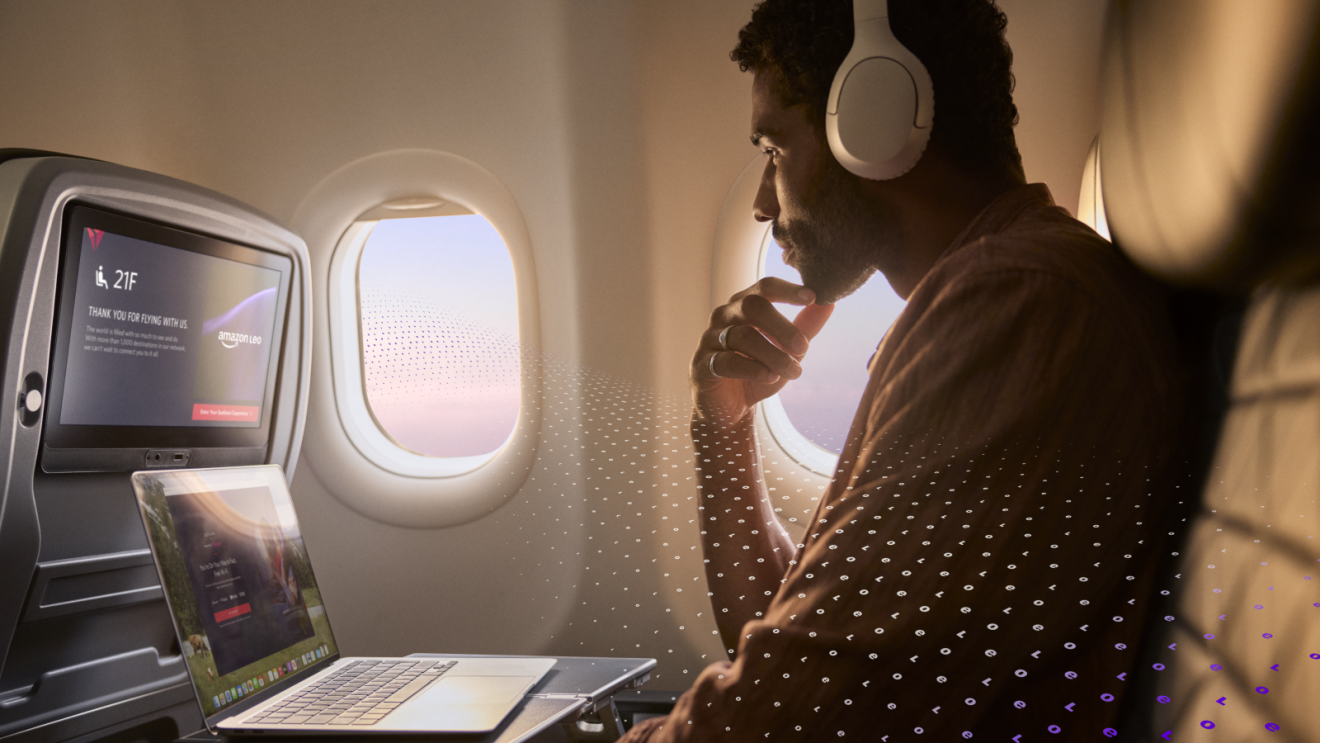
Amazon presented the Leo antenna — a device for connecting commercial airliners to the Kuiper network, the company's satellite internet. The stated specifications: up to 1 Gbps for downloads and up to 400 Mbps for uploads.
To understand the scale: an average passenger Boeing 737 carries approximately 160 people. If you divide 1 Gbps equally — each person gets over 6 Mbps. That's more than millions of subscribers have at home in cities across Central and Eastern Europe.
The current standard for in-flight internet — systems like Gogo or Viasat — provides real-world speeds of 10–50 Mbps for the entire aircraft. A video call on board becomes a gamble, and streaming becomes frustrating buffering. Leo, if the numbers hold up in real-world conditions, fundamentally changes this arithmetic.
The antenna was developed for Kuiper, Amazon's satellite constellation, which the company is building as a direct competitor to SpaceX's Starlink. Kuiper hasn't yet launched for commercial operation — the company is still in the stage of deploying its orbital constellation. In other words, Leo is equipment designed for infrastructure that doesn't yet exist in full.
This is where the real conflict of this announcement lies: Amazon is unveiling hardware for a market dominated by Starlink, which is already flying on the aircraft of several airlines, including Delta and United. Catching up to an incumbent player with an operational network is not a technical problem, but a commercial and operational one.
Airlines choose in-flight internet providers for years in advance: antenna integration into the fuselage, certification, technical maintenance — it's a long cycle. The question isn't whether Leo works, but whether Kuiper will manage to deploy sufficient coverage before airlines sign contracts with competitors.
Will Amazon be able to convince airlines to wait for Kuiper to mature, when Starlink is already offering connectivity today?