Emergency Landing in Larissa: How Technical Malfunction of Secret US Drone Broke 15 Years of Silence
# On March 18, 2026, an American reconnaissance unmanned aerial vehicle, identified in the OSINT community as an RQ-180, made an emergency landing at a Greek air base during daylight — exposing itself more than during all previous years of the program's existence. Now analysts see not just a drone over Greece, but direct evidence of American intelligence operations over Iran.

By Tetiana Suchkova-Ladik
April 7, 2026 · 2 min read
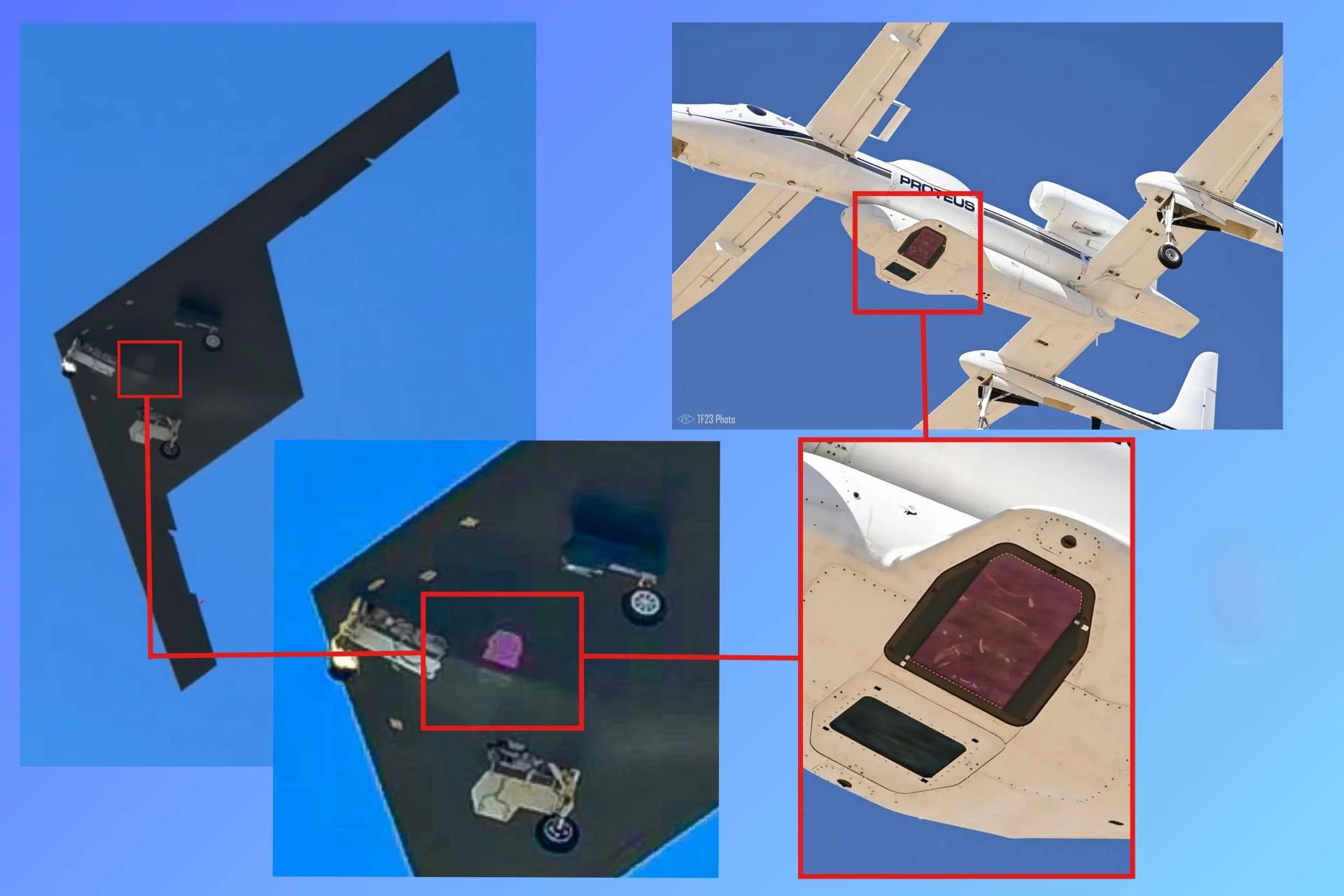
A local Greek portal OnLarissa was the first to publish a photo of an unusual aircraft over Larissa and confidently labeled it as a "B-2 Spirit." Local sources claimed the bomber allegedly deviated due to a technical malfunction. The version held up for a few hours—until OSINT analysts picked apart the images pixel by pixel.
The shape of the wing's trailing edge, the angle of sweep, and the characteristically wide-set landing gear struts—none of this matched either the B-2 or the newer B-21 Raider. As The War Zone notes, the aircraft represents "the best published images of the RQ-180"—an unmanned aerial vehicle whose official existence the U.S. Air Force has still not confirmed.
What the Images Show—and What It Means
Under the fuselage, analysts recorded a protruding element resembling an electro-optical or infrared sensor. In its configuration, it resembles sensor pods previously tested on the Scaled Composites Proteus research aircraft. The aircraft carries no offensive weapons—its role is purely reconnaissance: prolonged loitering at high altitude over protected airspace.
"The technical problem was probably the only reason we saw the drone in daylight at all."
The War Zone
This is the paradox of the event. The RQ-180 revealed itself not through an intelligence failure, but through a mundane mechanical breakdown. Nighttime operations from Larissa are clearly the norm; a daytime landing became an exception that ended up in the frame.
Larissa—No Random Airfield
The base of the 110th Combat Wing of the Greek Air Force has already been used for MQ-9 Reaper operations in the region. As The Aviationist notes, Larissa could be developed as a forward operating base specifically for operations over the Black Sea or even over Ukraine—but for now the focus is clearly different.
The War Zone links the RQ-180's presence to Operation Epic Fury—an American military operation against Iran. Simultaneously, analysts recorded activity by American military transport aircraft near the base—a detail indicating logistical support for extended missions. According to the publication's assessment, the priority mission is: locating and tracking mobile Iranian mobile missile launch systems—exactly what the HALE-class unmanned aerial vehicle class with stealth characteristics was designed for.
Fifteen Years in the Shadows
Northrop Grumman's RQ-180 program for years appeared only as silhouettes over Area 51 and Edwards. The April footage—already the second wave of photos from Larissa taken by Efthymis Siakaras—confirmed: the base has become a regular forward hub, not a site of a one-time emergency landing.
An important nuance noted by The Aviationist: photography near military facilities in Greece is officially restricted and has repeatedly led to arrests of foreign tourists. The fact that the images appeared anyway is further evidence of the situation's unusual nature.
If the RQ-180 is indeed conducting regular missions over Iran from a Greek base, the next question is not about the drone, but about diplomacy: did Greece publicly agree to this—and what did it get from Washington in return?