Bayraktar Kizilelma Tested with Precision-Guided Bombs — What It Means for the Battlefield
Baykar conducted a test launch of precision‑guided munitions from the jet‑powered Kizilelma drone. The outcome is not just about the technology — it is part of a global trend reshaping defense architecture and placing new demands on air defense and intelligence.

By Tetiana Suchkova-Ladik
March 16, 2026 · 2 min read
Brief and Important
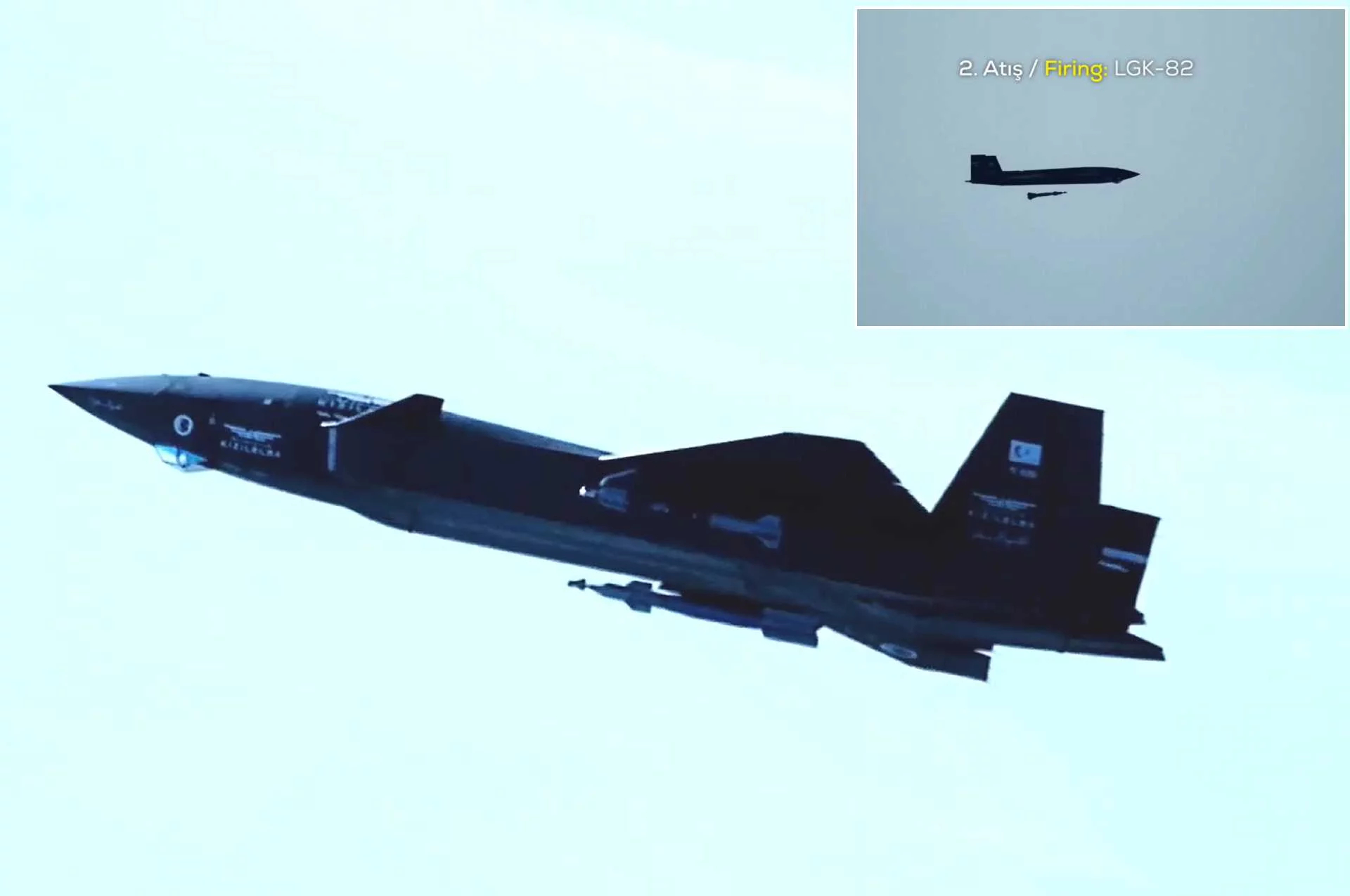
Baykar released the results of flight tests of the jet unmanned fighter Bayraktar Kizilelma, during which the aircraft carried out combat launches of guided bombs. The test confirmed the platform's compatibility with Turkish guidance kits LGK‑82 (Aselsan) and Teber‑82 (Roketsan), which convert standard MK‑82s into precision munitions with laser and GPS/INS guidance.
What the tests showed
The tests took place on March 15 and included firings using two guidance systems. LGK‑82 uses semi‑active laser guidance and is suitable for engaging both moving and stationary targets; Teber‑82 combines GPS/INS and laser guidance, adding aerodynamic surfaces for greater range and accuracy. Bayraktar Kizilelma — a jet UCAV with a reduced radar signature — is designed to operate alongside F‑16s, the future TF‑X, and the amphibious assault ship TCG Anadolu.
Bayraktar #KIZILELMA ✈️🚀🍎✅ LGK-82 & TEBER-82 Firing Test🎯 Bull’s Eye#Baykar 🤝 @Aselsan 🤝 @Roketsan#NationalTechnologyInitiative 🌍🇹🇷 pic.twitter.com/YkvtheCzC9
— BAYKAR (official account on X)
Why this matters for Ukraine
The test is not just a technical demonstration. First, the emergence of jet UCAVs capable of carrying guided munitions expands the spectrum of threats: faster platforms with lower observability are harder to detect and intercept. Second, converting widely available MK‑82s into precision munitions using LGK/Teber makes potential strikes cheaper and more numerous.
Analysts in military publications note that the combination of stealth elements, a jet engine, and modern guidance kits shifts the emphasis toward more autonomous and longer‑endurance air strikes, which require strengthened integration of air defense, electronic warfare (EW), and intelligence systems.
Context: a trend, not a one‑off
Similar systems are already appearing in various arsenals: from aircraft upgrades (F‑16I with Rampage) to Ukrainian interceptor projects such as Sokyra. This means the battlefield is becoming more dynamic — not only because of new platforms, but also because of the availability of effective guidance kits.
What Ukraine should do
The systemic response should be technical, not emotional: strengthen long‑range radars and sensors, develop EW capabilities and effective interceptors, and integrate intelligence data in real time to detect fast targets. Investments in countermeasures against low‑observable and jet UCAVs are investments in border security and the operational freedom of our forces.
Summary
The Bayraktar Kizilelma tests with LGK‑82 and Teber‑82 confirm that modern unmanned solutions are becoming increasingly versatile and accessible. For Ukraine this is a signal: technologies are changing the rules of the game, and our response must be technological, systemic, and coordinated — from sensors to interception.