BlueBird Tech’s Chipa: how a Ukrainian net launcher is changing the rules for intercepting FPV drones
Compact net launcher "Chipa", with a range of up to 25 meters, offers a quick and safe way to neutralize FPV drones without radio jamming — important for protecting positions and civilians.

By Tetiana Suchkova-Ladik
March 9, 2026 · 2 min read
What was announced
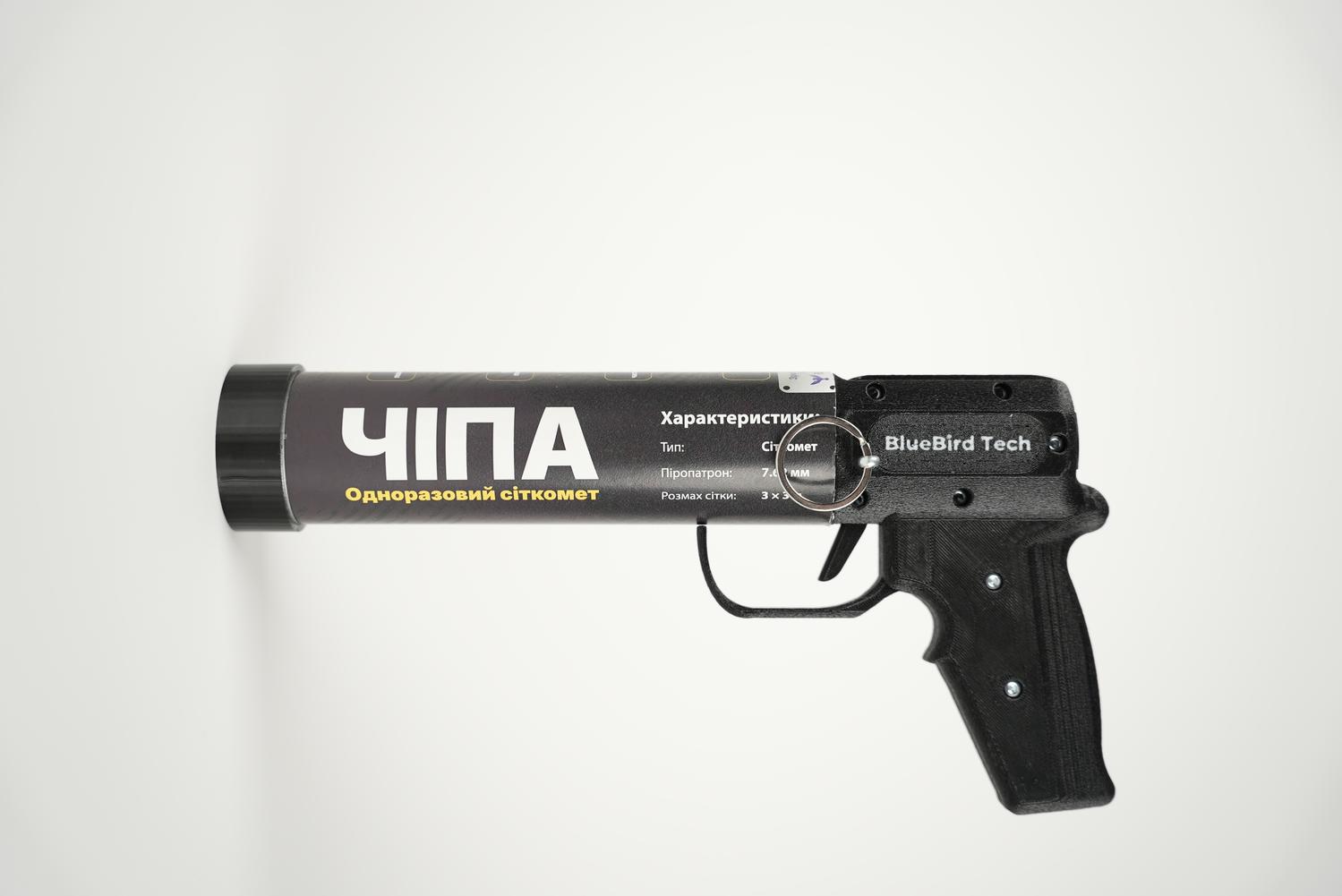
Ukrainian company BlueBird Tech unveiled the net launcher “Chipa” — a portable, pistol‑like device designed to intercept FPV drones at close range. According to LIGA.net, the device uses a pyrotechnic cartridge that ejects a net which deploys to roughly 3×3 meters and can entangle a drone’s rotors, stopping its flight.
How it works and why it matters
Effective range is up to 25 meters. After firing the net opens in the air; preparation takes only a few seconds: remove the safety, aim, and pull the trigger. Unlike firearms or electronic warfare systems, the “Chipa” does not generate radio interference and does not reveal the operator’s position with loud signals, reducing risks to operators and nearby civilians.
Advantages on the battlefield and in cities
The net launcher makes it possible to neutralize drones without major destruction and without secondary injuries from debris. For defending positions, patrols, or protecting infrastructure this means an additional tool in the arsenal that combines rapid response with relative safety for the surroundings.
"Chipa is designed to act quickly and minimize risks to people and equipment — a simple but effective solution for close‑range interception scenarios."
— Representative of BlueBird Tech, company press service
Context: Ukrainian innovation in defense
The presentation of “Chipa” fits into a broader picture: Ukrainian developers continue to supply new tools to the front and the market — from drones to interceptors. The recent status of Magura Uforce as a “unicorn” and the development of the Sokyra interceptor with speeds up to 240 km/h point to a growing ecosystem of defense technologies in Ukraine. Defense industry analysts note that such products not only provide protection but also increase partners’ confidence in Ukrainian science and manufacturing.
What’s next
“Chipa” is not a universal answer to all threats, but it is a practical tool for certain FPV interception scenarios. It will now be important to understand how the device will be integrated into unit tactics and infrastructure protection, and what training and logistics are required for widescale use.
Summary: compact, fast, and relatively safe — “Chipa” adds another layer of protection to an arsenal where each innovation can save lives and minimize damage.