France builds layered air defense for airbases — and the key link is not yet ready
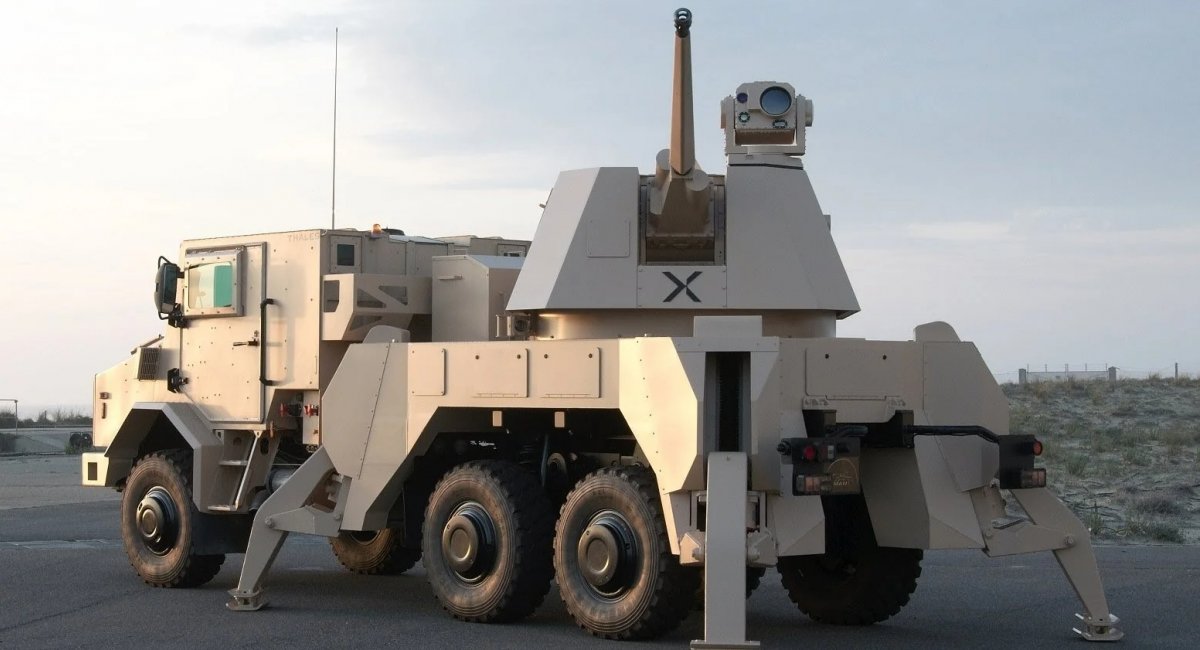
Seven RapidFire systems will protect French air bases from drones and loitering munitions until 2030 — but the specialized A3B ammunition, without which the system can unlock its full potential, will not appear until 2027.

By Tetiana Suchkova-Ladik
April 16, 2026 · 3 min read
When the French army announces the purchase of new air defense systems, the typical reaction is to note the order and move on. But in the case of RapidFire, there is a detail that makes the deal more interesting than the figure "7 systems."
What France is buying — and why now
The French Ministry of Armed Forces has ordered seven RapidFire air defense gun systems with a 40 mm caliber manufactured by KNDS France and Thales. They will become part of the multi-layered air defense system of the Air and Space Forces: RapidFire covers the close range, the middle range is covered by SAMP/T NG and VL-MICA complexes. Funding is provided under the defense program for 2024–2030, with deployment scheduled by the end of the decade.
The procurement decision reflects a pan-European trend: airbases that were previously considered protected in the rear are now targets for cheap drones and "Shaheed-like" loitering munitions. Traditional air defense missile systems for intercepting such threats are economically senseless — a million-euro missile against a thousand-euro drone.
A system at the intersection of two domains
RapidFire is neither a classical air defense gun nor a C-UAS solution in the conventional sense.
"The system stands at the intersection between the domain of very short-range air defense and counter-UAS — it can deal with conventional threats while significantly extending the range of C-UAS missions"
— KNDS representatives, EDR Magazine
The CTA 40 mm gun fires up to 180 rounds per minute, has 140 ready-to-fire rounds in the turret magazine, and has an effective range of up to 4,000 meters. The fire control system recalculates the target position after each shot — this makes it possible to hit the target with the minimum number of rounds.
The key link that doesn't yet exist
The most interesting part is in the ammunition details. Among all the ammunition types for RapidFire, developers particularly highlight the A3B (Anti-Aerial AirBurst) — a munition with directed scatter of tungsten submunitions, effective against drones, helicopters, subsonic missiles, and even targets like "missile, artillery, mortar." It is supposed to provide the full air defense potential of the system. The problem: A3B is at technology readiness level TRL5 and will enter production only in 2027. The contract for development, industrial production, and delivery of the first batch of 500 units was signed at the end of 2024.
So France will receive the systems before the optimal ammunition for them becomes available. During the transition period, they will use existing fragmentation-blast and other programmable rounds — which is already a significant step forward compared to nothing.
Logic worth tracking
KNDS representatives have publicly formulated a new principle of engagement: not maximum number of shots, but maximum accuracy. This reduces the cost of one interception — a key metric in a scenario of a mass drone attack. The French approach is not unique: similar logic is embedded in the British Brimstone or the American SHORAD architecture, but RapidFire specifically attempts to bridge the gap between heavy missile air defense and light C-UAS systems in a single platform.
In parallel, the French Navy is already integrating RapidFire on new patrol ships — the first naval turret passed factory tests in May 2025, meaning the maritime and land versions are developing in sync.
If A3B achieves the planned characteristics in 2027 and confirms effectiveness against swarms of small drones — RapidFire will become one of the first serial solutions that fill the "cheap drone gap" in NATO's layered air defense without excessive expenditure of expensive missiles. If not — France will have an expensive system waiting for its main ammunition.