Genie 3 Turns Earth's Streets Into a Robot Training Ground — And It's Not a Metaphor
Google DeepMind has connected 280 billion Street View images to the generative model Genie 3. Practical consequence: Waymo is already training autonomous vehicles on scenarios that almost never occur in reality.

By Tetiana Suchkova-Ladik
May 20, 2026 · 2 min read
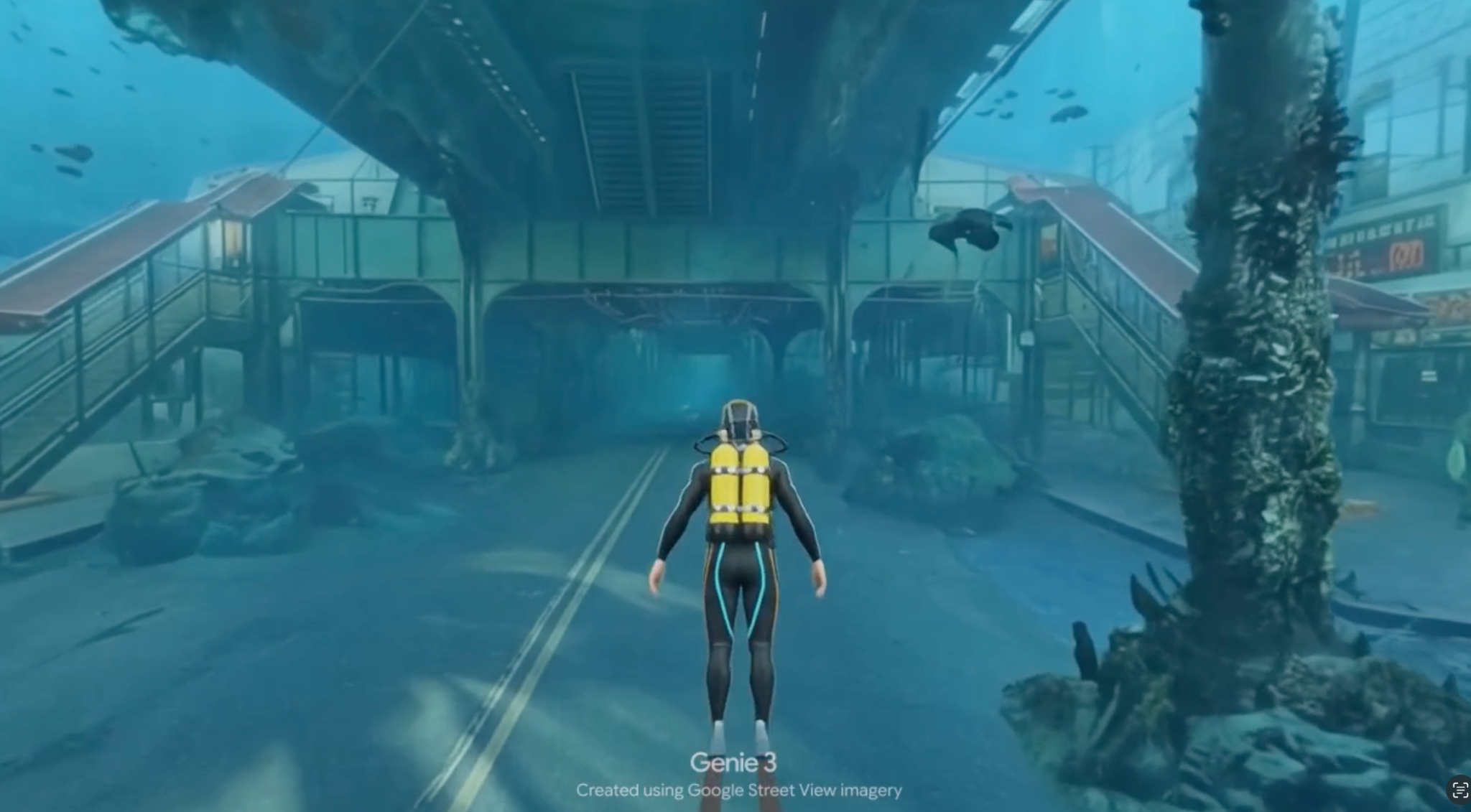
At Google I/O 2026, DeepMind announced the integration of Street View into the global Genie 3 model. On the surface — an impressive demo trick: enter any street, change the season or weather. On second glance — it's an infrastructure step for training physical agents that the company has been preparing for years.
What actually changed
Genie 3 has existed since August 2025 as a research preview, and since January 2026 — it's available to Google AI Ultra subscribers in the US. Until that point, the model generated interactive 3D environments from text prompts or images. Now it has gained a connection to the real world: according to DeepMind researcher Jack Parker-Holder, Street View provides «foundational capabilities» — a basis with real coordinates, on top of which the model builds a simulation.
The scale of the dataset is important: 280 billion images from 110 countries, collected over almost 20 years — by cars with cameras and people with «backpack trackers». No other company has comparable coverage of real space at such resolution.
London robot and New York snow
Parker-Holder explained the practical logic through a specific example: a robot deployed in London rarely sees the sun. If it's not trained on simulated sunny days with light flickering on Victorian facades — the first bright day could throw off the sensors. Genie 3 allows generating exactly these rare scenarios tied to a specific location.
«At the same time, you can say: I'm going to New York, but not in this season. I want to see what that neighborhood looks like in the snow».
Jack Parker-Holder, Google DeepMind researcher, TechCrunch
This is not just about tourist fantasies. Waymo is already using Genie 3 in one of its simulators — to prepare autonomous vehicles for «extremely rare events»: tornadoes, a sudden elephant appearing on the road. Before the Street View integration, Waymo's simulators worked exclusively from the car's point of view. Now the model can change perspective — simulating the same environment through a pedestrian's eyes or a robot manipulator's perspective.
Where the line between simulation and filming without permission lies
The technology remains experimental and is currently only available in the US. But the question the company sidesteps: Street View has been collecting data about private property, building facades, yard spaces for decades — often without explicit owner consent. Genie 3 now allows not just viewing these images, but generating interactive, changeable environments from them. The difference between «an archival street photo» and «a simulated space controlled by an agent» — is legally undefined.
- Current access: US locations only, AI Ultra subscribers only
- Genie 3 generates video at 720p / 24 FPS, the environment «lives» for over a minute before degradation
- Waymo relies on its own simulator for scaling across 11 US cities; Genie — a parallel tool, not a replacement
If the integration extends beyond the US and Street View covers your street in 110 countries — the question isn't whether a simulation of your yard will appear in someone's training dataset. The question is when Google will publish clear terms of use for this data in generative models — and whether it will do so before regulators start asking themselves.



