Google Entered Windows with Gemini — and Immediately Lost in File Search
Google has launched a desktop application for Windows with direct access to Gemini. The challenge to Microsoft Copilot turned out uneven: Google's AI assistant sees the screen better than its competitor, but cannot search within its own ecosystem.

By Tetiana Suchkova-Ladik
April 15, 2026 · 2 min read
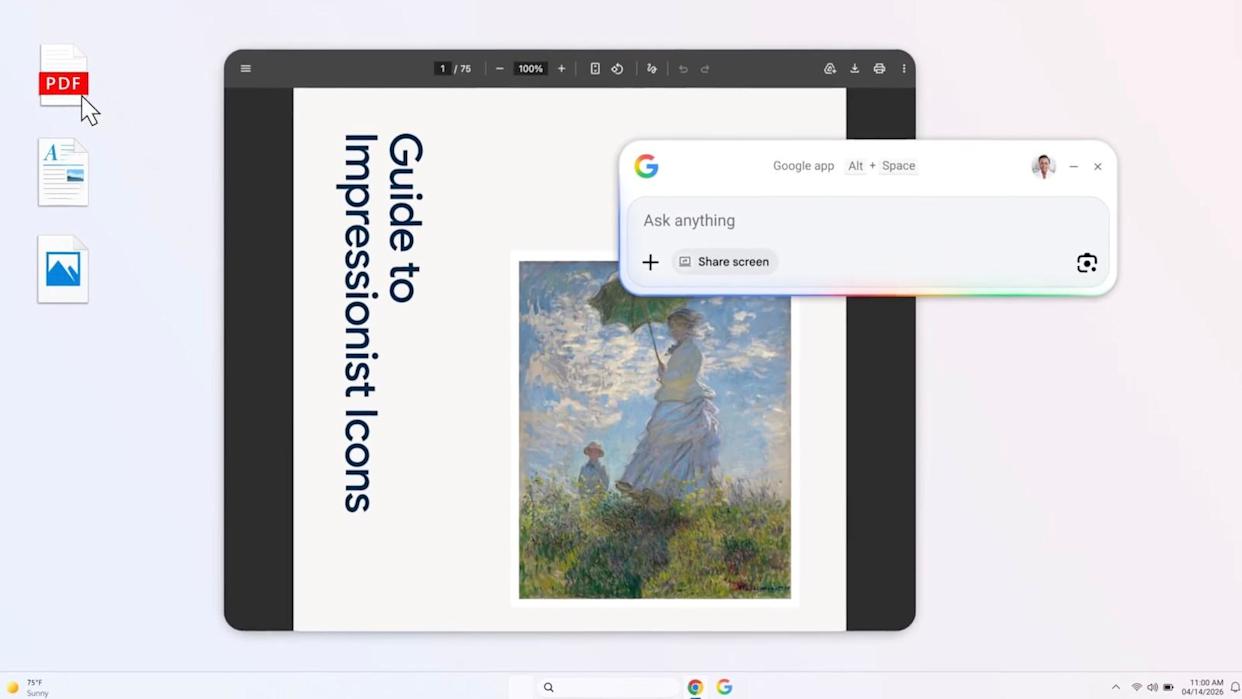
Google has released an application for Windows — not a browser or extension, but a separate program with a "floating" search panel over the desktop. Press Alt + Space — and within 200–300 milliseconds a Gemini window appears. For comparison: macOS has had Spotlight for 20 years. Windows only got an analog through Microsoft Copilot — and now a second player has entered this space.
What it can do — and where it falls short
The application works with local files, Google Drive, installed programs, and web search. There is Google Lens integration: you can share a window or the entire screen, and Gemini will analyze the image or text on it. In PCWorld's test, the application handled screen sharing better than Microsoft Copilot Vision — in particular, it recognized playing cards in solitaire and suggested moves more accurately than the competitor.
But there is a paradox. Google — the company that literally built its business on search — created an application that searches local files poorly, especially if they are stored outside Google services, like OneDrive. In other words, on a machine with a typical Windows ecosystem, Gemini searches worse than the built-in file explorer.
"I tried Google's new application for Windows — and it didn't convince me"
PCWorld, after practical testing
Copilot vs. Gemini: not an equal start
Microsoft Copilot is built into Windows 11, Microsoft 365, and Edge — it has system-level access. Gemini launches as a desktop overlay and Chrome extension, integrating mainly through the browser and Google's cloud services.
Currently, the application is only available in the USA and Canada, only in English, only for personal accounts — without support for corporate Workspace accounts. Global release and support for other languages are matters for the coming months.
A note on privacy
Unlike corporate Copilot, where data is confidential by default, Google applies a standard policy for consumer Gemini: conversations may be stored and used to improve products — likely including model training. This is not a hidden condition, but it should be considered by those planning to work with sensitive documents through the new application.
Technically: in idle mode, the application consumes approximately 150–200 MB of RAM, all AI processing occurs in Google's cloud — meaning it does not work without internet.
If Google does not open full search of local files outside its own ecosystem by the end of the year — the application will remain a convenient portal to the chat, not a replacement for system search. The question is not whether Gemini can compete with Copilot, but whether Google wants to truly integrate into Windows — or simply redirect user attention to its own services.



