Hildegard — jet-powered drone reaching up to 500 km/h: what it means for tactics and the defense sector
At the Enforce Tac 2026 exhibition, German firm Dronivo unveiled Hildegard — a compact jet-powered UAV designed for fast precision strikes. We examine why such platforms matter on the battlefield and what challenges they pose to air-defence systems and industrial cooperation.

By Tetiana Suchkova-Ladik
February 25, 2026 · 2 min read
A systemic shift in tactics: speed versus response time
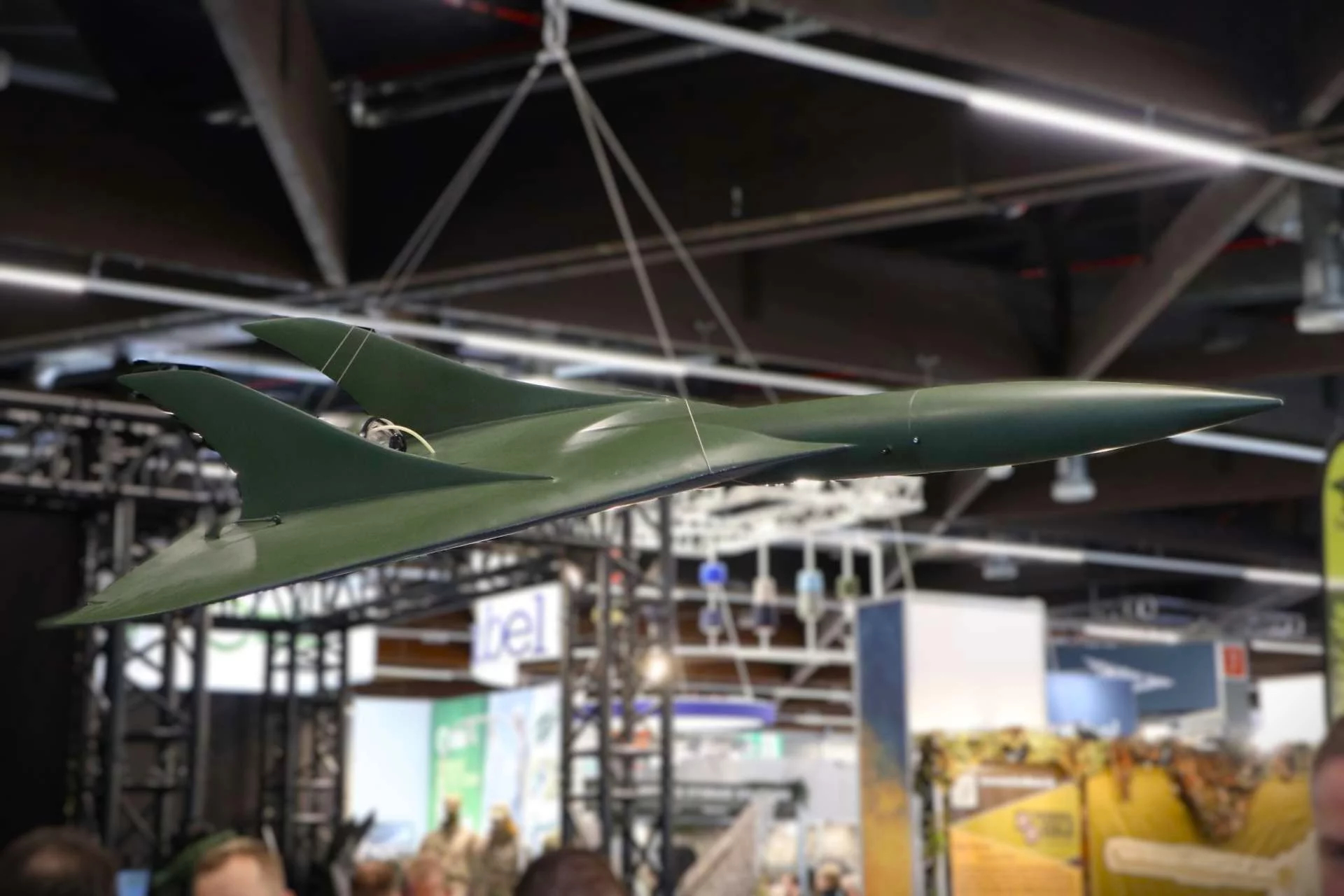
At Enforce Tac 2026 in Nuremberg Dronivo GmbH unveiled the jet-powered unmanned aerial vehicle Hildegard. The announced characteristics make it part of a new class of tactical strike systems where the decisive factor is precisely the time-to-target, not loiter time. Source: Army Recognition and the presentation at the exhibition.
Technical details — brief and to the point
Hildegard is a compact fixed-wing drone: length 1.95 m, wingspan 1.35 m. Maximum takeoff weight — 16–20 kg, weight without fuel — about 10 kg. The platform is equipped with a turbojet engine and can accelerate to 500 km/h. Fuel tank capacity — 3–6 liters of jet fuel; the airframe is made from carbon-fiber-based composites. The company reports autonomous navigation and intends to start serial production with options for weapons integration and testing resilience to EW.
Operational implications
A speed of 500 km/h significantly reduces time-to-target and forces a rethinking of safe launch distances. For air defenses this means increased vulnerability of point targets: classical air-defense systems designed for slower UAVs lose their advantage. At the same time, compact fast platforms can become a tool for rapid strikes against logistics nodes and command posts with minimal time spent in the engagement zone.
Trend and partnership
Hildegard is not an isolated example. Last month Quantum Systems announced the ground autonomous vehicle Mandrill with speeds up to 100 km/h, and Ukrainian Frontline and Quantum Systems announced joint drone production in Germany. This is part of a broader trend: European developers are quickly adapting platforms to the needs of the modern battlefield, and Ukrainian industrial cooperation here has practical value both for supply and for technology exchange.
"The drone is designed for rapid engagement of targets with minimal time-to-target."
— Dronivo GmbH, presentation at Enforce Tac 2026
What does this mean for Ukraine?
In short: the emergence of such platforms reinforces two demands at once — investment in adaptive air-defence measures and in domestic capabilities to create fast strike systems. Minimum steps — speed up vulnerability assessments, integrate detection algorithms for such fast targets into existing systems, and develop industrial links to localize production. Social proof: there is already a practice of joint production with European companies, which shortens the time from presentation to frontline deliveries.
Analysis: Hildegard is a signal not only about a single platform but about a change in priorities in design decisions. Will the defence ecosystem manage to adapt faster than such drones become a routine element of the battlefield?