Honor 600 with a 7000 mAh battery "beat" iPhone 17 Pro in a remote-controlled car race — but there's a catch
Honor has released a marketing video in which the batteries of three flagship devices power toy cars on a track. The winner is known in advance — and that's precisely what makes the test demonstrative rather than honest.

By Tetiana Suchkova-Ladik
April 23, 2026 · 2 min read
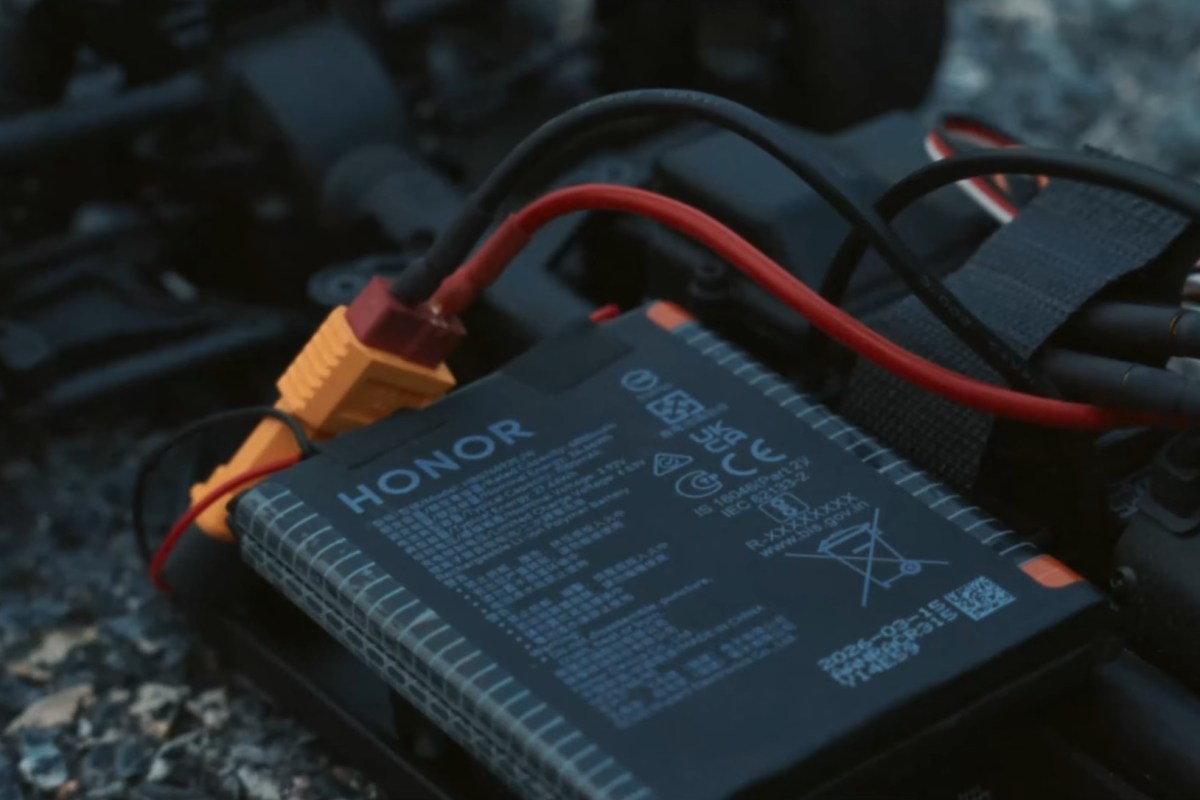
When Honor engineers pulled batteries out of smartphones and connected them to miniature remote-controlled cars, it looked like a technical demonstration. In essence, it was an advertisement with a predetermined outcome.
What happened on the track
Honor connected three batteries to identical RC cars and launched them on a track until complete discharge. Honor 600 received a battery with a capacity of 7000 mAh based on silicon-carbon (Si-C). iPhone 17 Pro — 4252 mAh, Samsung Galaxy S26 — 4300 mAh. A difference of almost 63% at the start.
The result is predictable: Honor finished last of those who stopped. In the video, the iPhone 17 Pro is labeled as "The First to Retire", Galaxy S26 — "The Persistent Challenger". The captions are sarcastic, but the numbers don't lie.
Technology versus marketing
Si-C (silicon-carbon) batteries do indeed allow you to store more energy in the same physical volume compared to standard lithium-ion batteries. Honor has been using this technology since at least the Magic lineup, and 7000 mAh in a chassis 7.8mm thick is a real achievement.
But there's a detail that Honor doesn't emphasize in the video: for the European market, Honor 600 is supplied with a 6400 mAh battery — 600 mAh less. The Asian version with the larger capacity was used in the test.
"Battery size changes by region. Honor lists a 7000mAh silicon-carbon cell for Asian markets and a 6400mAh cell for Europe"
The Gadgeteer
So a buyer in Warsaw or Berlin will get a device that would finish this same test with a smaller advantage.
Why this still matters
RC cars are not a real usage scenario, but they clearly illustrate one thing: the difference in capacity between Honor 600 and competitors is not 10-15%, but fundamental. Apple and Samsung have for years kept flagship batteries within the 4000-4500 mAh range, citing software optimization and chip energy efficiency.
- iPhone 17 Pro: 4252 mAh — the smallest battery of the three
- Galaxy S26: 4300 mAh — 8 mAh more than iPhone, lost to the other two
- Honor 600 (global): 7000 mAh — 63% more than both competitors
The question is not whether a larger battery will win in a race of toy cars. The question is whether Apple and Samsung can justify their "fewer mAh, but better optimization" strategy for one more cycle — if competitors are already massively switching to Si-C and breaking past the 6000-7000 mAh mark without increasing chassis thickness.