"Hail" with Cages: Armed Forces Learn to Protect MLRS from FPV Drones the Same Way as Tanks
# Translation The 50th Separate Artillery Brigade showcased "Grads" with grilles over launch guides, mesh structures on the cabin, and electronic warfare domes. In parallel, the National Guard went further — completely transferred the system to a MAN chassis with digital fire control.

By Tetiana Suchkova-Ladik
May 21, 2026 · 2 min read
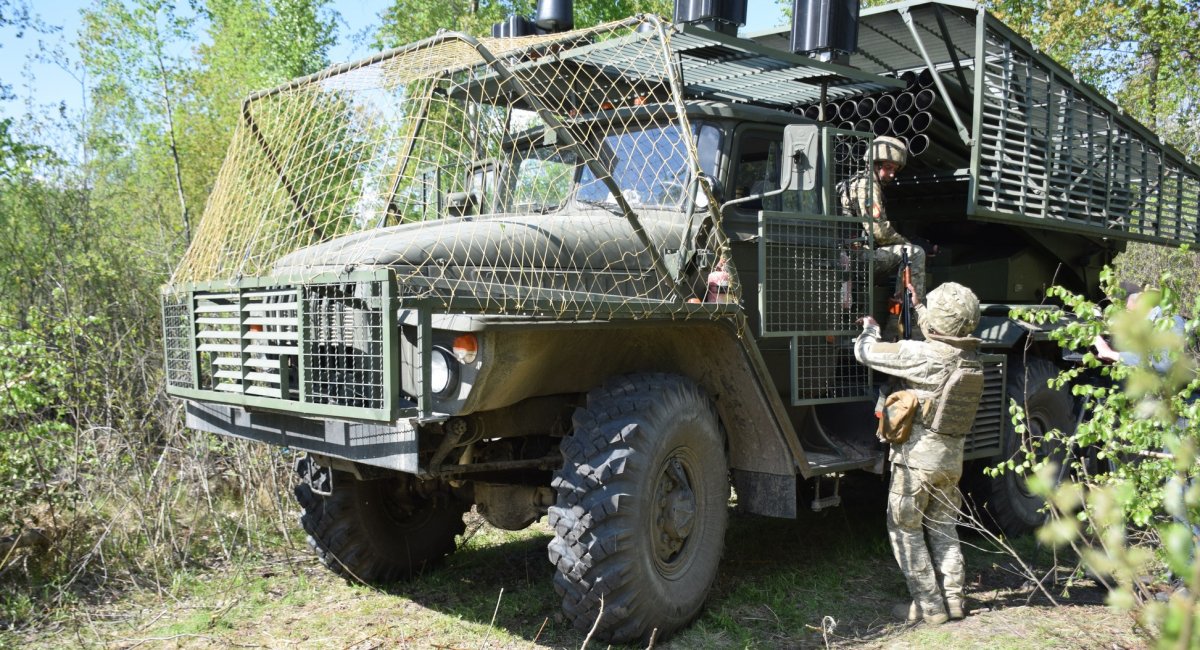
In photographs released by the press service of the 50th Separate Artillery Brigade of the Armed Forces of Ukraine during training exercises, several types of anti-drone protection can be seen on the BM-21 "Grad" MLRS simultaneously: metal grilles above the launch guides, mesh structures in front of the cabin, and domes of electronic warfare equipment. Additionally, there are grilles on the doors to protect the crew. This same logic of layered protection previously appeared on tanks and armored personnel carriers — now it has been transferred to rocket artillery.
Why "Grad" is a Special Target
The BM-21 operates at distances from 5 to 40 km, however the brigade chooses firing positions much closer to the line of contact than heavy artillery. This is precisely what makes the installations vulnerable to attack FPV drones with a range of 10–15 km: the vehicle has time to leave the position after firing, but the window of vulnerability during deployment and withdrawal remains. Grilles do not stop a drone on a fiber-optic cable — against which electronic warfare is powerless — but significantly reduce the effectiveness of standard FPV drones with cumulative warheads, forcing the charge to detonate before contact with the cabin armor.
What Changed — and What Was Not Mentioned
The official statement from the brigade notes "improvements in firing accuracy and effectiveness," but without technical details — standard practice for operational security. At the same time, a parallel modernization direction being developed by the National Guard of Ukraine provides more details. As reported by the commander of the National Guard of Ukraine, Brigadier General Oleksandr Pivnenko, their version received a MAN 6×6 chassis instead of the Soviet "Ural," electric drives for guidance systems, and a digital fire control complex.
"New digital complexes allow for significantly more accurate and timely target detection, coordinate calculation, and opening fire"
Commander of the National Guard of Ukraine Oleksandr Pivnenko
In addition, electronic warfare equipment was installed on the National Guard machine and the ammunition capacity was increased to improve autonomy — without the need for a separate transport-loading vehicle alongside it.
Two Approaches to One Problem
In fact, the Ukrainian defense industry is pursuing two parallel concepts:
- Field adaptation — grilles, electronic warfare domes, nets that are mounted on existing vehicles in the combat zone or near the front line. Fast, mass-produced, without factory conditions.
- Deep modernization — replacement of the chassis with a MAN, digital control, electric drives. Requires a factory base, but provides a qualitative leap in mobility and accuracy.
According to Defence Express, the number of available BM-21s in Ukraine suitable for conversion is not disclosed for security reasons — but the potential scope of the program is significant, given that the "Grad" has been the foundation of Soviet and post-Soviet rocket artillery for decades.
Anti-drone nets are not a guarantee of survival — they change probabilities. Drones on fiber-optic cables, which no electronic warfare can jam, are already being recorded on the front, and field cages are also ineffective against them. The question is whether the pace of deep modernization — with new chassis and digital control — will catch up with the pace of appearance of drones capable of bypassing any passive defense.



