Jackal without GPS: How an American missile is changing the rules of engagement in the electronic warfare zone
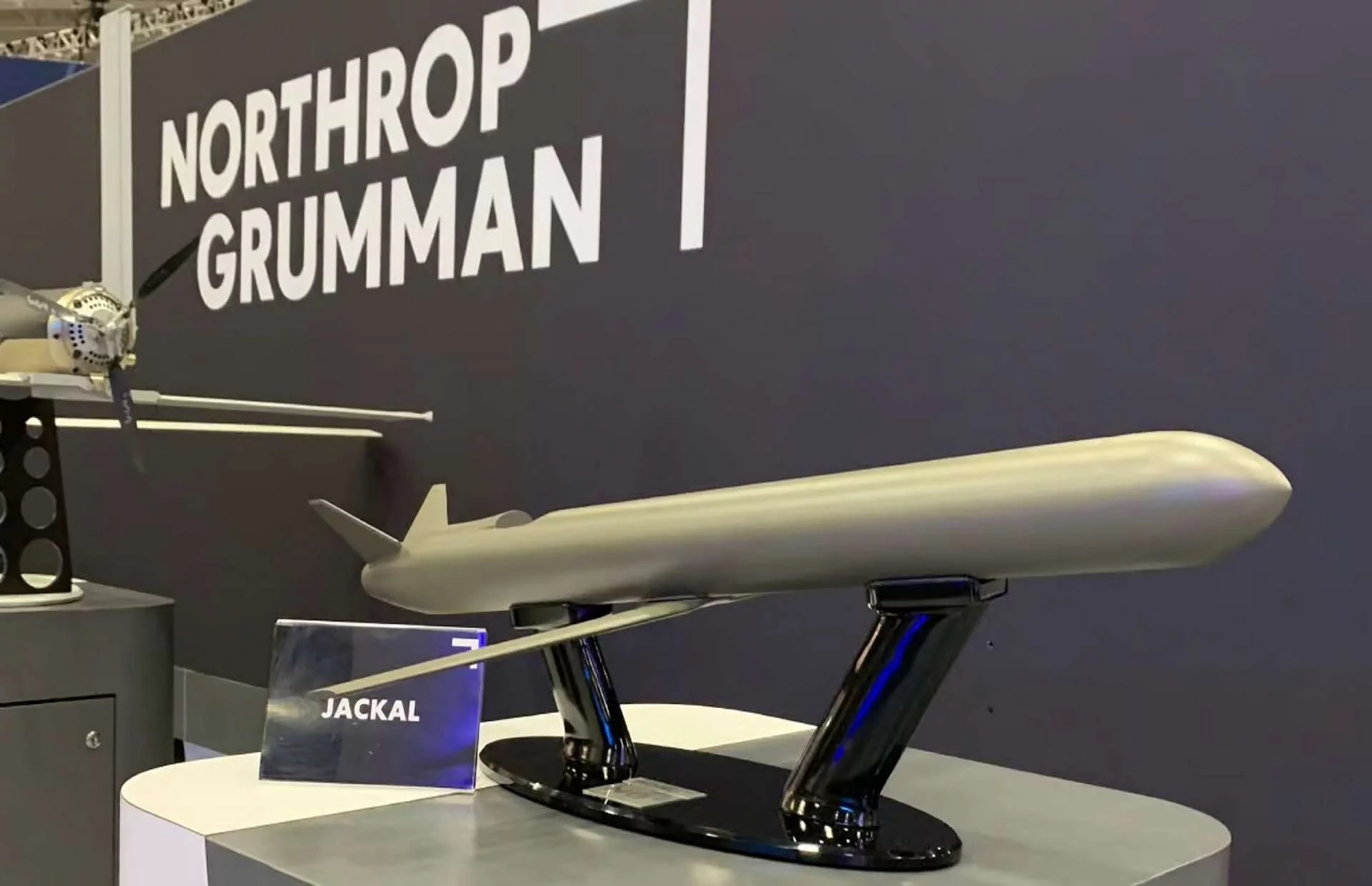
Northrop Grumman has revealed details of Jackal — a turbojet-powered missile that autonomously locates targets in areas of intense jamming. What threat does this pose and what conclusions should we draw today — briefly and to the point.

By Tetiana Suchkova-Ladik
January 26, 2026 · 2 min read
What is known about Jackal
In the United States the Jackal was described in detail — a turbojet cruise missile from Northrop Grumman designed to operate in conditions of heavy electronic jamming. According to Army Recognition and the manufacturer's press release, the system can operate without GPS and without a constant link to an operator.
Key characteristics: **speed up to 600 km/h**, range of more than **100 km**, loiter time of about **15 minutes** for autonomous target detection. The modular design allows the missile to be equipped with either warheads or reconnaissance sensors or EW equipment. Launch can be carried out from land, sea, or air.
"The system is built to operate in areas with strong electronic jamming"
— Northrop Grumman, press release
Tactics and capabilities
The Jackal is described as a platform suitable for **swarm tactics**: several missiles coordinate routes and distribute targets among themselves without direct operator intervention. This reduces the effectiveness of traditional air defense systems, which are designed for individual trajectories and precise coordinates.
Autonomous navigation and sensing in conditions of communications blackout or heavy electronic interference mean less vulnerability to classic GPS jamming or interruption of communication channels. Combined with maneuverability and modularity, this makes the Jackal a tool for complex tactical operations on saturated fronts.
"Analysts point out that such platforms increase the importance of integrated air defense and intelligence systems"
— defense technology analyst
What this means for Ukraine
In short: **Ukrainian air defense and tactics must adapt**. The Jackal in the hands of an ally can become an effective tool in striking critical infrastructure or disabling the enemy's reconnaissance assets and air defenses precisely where conventional guidance systems do not work.
At the same time, the appearance of such missiles strengthens the case for multi-layered, integrated air defense: mobile interceptors, improved radar and intelligence, EW countermeasures and physical protection measures — all of this becomes critically important. Concurrently, the US has ordered interceptors for THAAD, and Rheinmetall is assessing the costs of creating a comprehensive multi-layered air defense — a sign that partners are preparing for a new type of threat.
Conclusion
The Jackal does not make the battlefield unequivocally favorable to anyone, but it changes the rules of the game. For Ukraine the key practical question is how quickly and flexibly we integrate intelligence, EW and interceptors into a single defensive architecture. The answer will affect how effectively we can neutralize or exploit similar platforms in the coming months.



