JCB Wants to Break Water Speed Record — and Prove That Hydrogen Propulsion Is Suitable Not Just for Trucks
# Twenty Years After Dieselmax Record, British Company Returns to Bonneville Salt Flats with Hydrogen Racer Hydromax. The Stakes Are Higher Than They Appear.

By Tetiana Suchkova-Ladik
May 13, 2026 · 2 min read
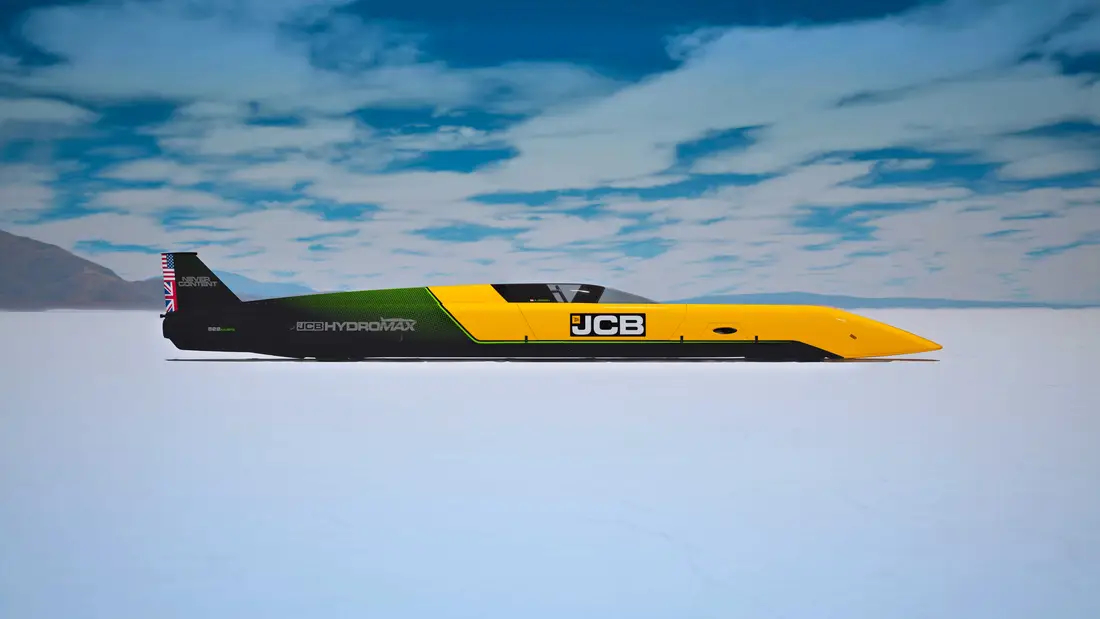
In 2006, JCB set a land speed record for diesel vehicles on the famous Bonneville Salt Flats in Utah — the Dieselmax race car reached 563 km/h. Now the company is returning there with a fundamentally different machine: JCB Hydromax runs on hydrogen, and the goal is not just to break the previous record, but to make a public statement about where heavy equipment is heading.
What is Hydromax and why this is more than just PR
Hydromax is not a concept car for an auto show. The race car is equipped with an internal combustion engine that burns hydrogen instead of gasoline or diesel. This approach differs from hydrogen fuel cells, where hydrogen is converted into electricity: here it's classic mechanics, but with zero CO₂ emissions at the exhaust.
For JCB, this is not the first experiment with hydrogen. The company has been developing hydrogen engines for its construction equipment — excavators, loaders, telescopic handlers — for several years. The record attempt at Bonneville is a way to test the technology under extreme conditions while drawing attention to an alternative to electrification in the heavy equipment sector.
Why Bonneville and why now
The Bonneville Salt Flats are a classic location for speed records: a flat surface, high altitude, predictable conditions. But the timing is no accident either. The heavy equipment industry is under pressure from regulators regarding decarbonization, and there is still no single answer — electric or hydrogen.
Construction machinery and agricultural equipment have specific characteristics: they operate in hard-to-reach places where charging infrastructure is absent, and the load cycles are so intensive that current-generation batteries cannot withstand them. A hydrogen engine that can be refueled as quickly as a diesel one is a technologically more attractive solution for this segment.
The real conflict: hydrogen versus electric in heavy equipment
The main conflict here is not between JCB and competitors, but between two technological paths. Most manufacturers — Caterpillar, Komatsu, Volvo CE — are betting on battery electrification or hybrid schemes. JCB is choosing the hydrogen ICE as its main direction.
The company's argument: a hydrogen engine is cheaper to produce than fuel cells, doesn't require rare earth metals for batteries, and can use existing service infrastructure. The counterargument from critics: green hydrogen production is still expensive, and its transportation and storage are technically complex.
The Bonneville record itself will not settle this dispute. But if Hydromax sets a mark above 600 km/h, it will be visual proof that hydrogen propulsion is capable of more than a slow loader on a construction site.
What's next
The specific date of the attempt has not yet been announced — JCB is in preparation, which includes engine tests and aerodynamic refinement of the race car. The salt season at Bonneville traditionally takes place in August–September, when the surface is most suitable for record runs.
If the attempt succeeds — pressure on competitors about the question "why not hydrogen?" will become noticeably more concrete. If not — critics will have grounds to argue that JCB's bet on hydrogen ICE was a dead end. The question is whether the industry is ready to wait for an answer while regulatory deadlines are already set.



