Katran on the Dnipro: A Sea Drone That Can Shoot Down Shaheds and Sink Ships 1600 km from Shore
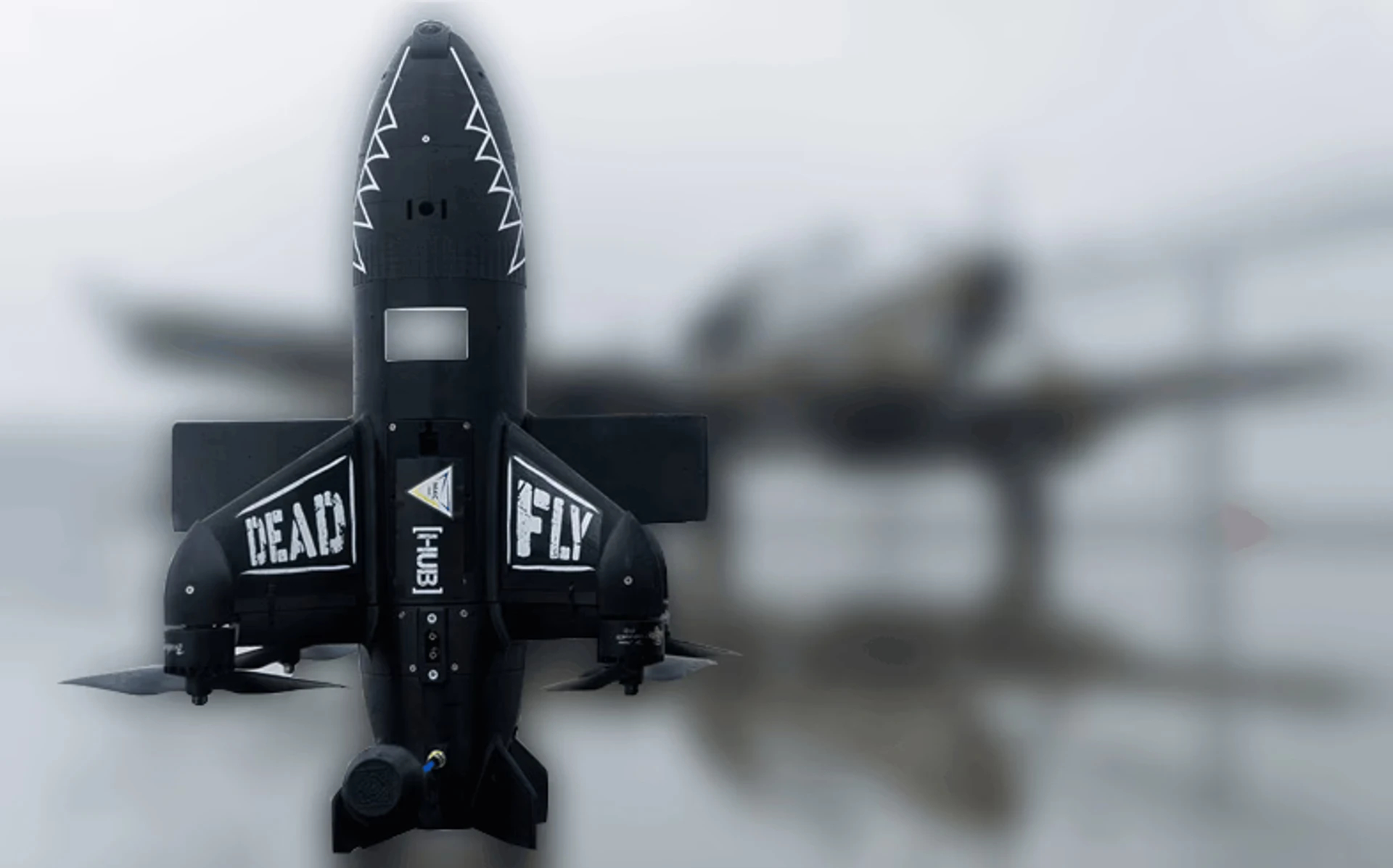
Military Armored Company HUB, as part of the Brave1 cluster, has unveiled the Katran X1.2 — an unmanned boat equipped with torpedoes, miniguns, portable air defense systems, and its own AI-guided MAC Dead Fly interceptors. This is not a concept: tests are already underway on the Dnipro River.

By Tetiana Suchkova-Ladik
May 19, 2026 · 2 min read
Minister of Digital Transformation Mykhailo Fedorov presented the marine drone Katran X1.2 from Military Armored Company HUB — a participant in the Brave1 defense cluster. According to Fedorov, details of combat missions remain classified, but the platform is already being tested in real conditions on the Dnipro River.
What Katran X1.2 Can Do
Katran is a twin-engine unmanned surface vehicle (USV) with a declared range of up to 1,600 km. Unlike most Ukrainian marine drones, which are disposable kamikaze systems, the X1.2 is designed as a reusable combat platform with a full weapons suite.
- Torpedoes — for engaging surface and underwater targets
- Miniguns and Browning machine gun — for ground targets and small enemy vessels with a 180° firing arc
- Piorun MANPADS — for engaging helicopters and low-flying targets
- Up to 27 MAC Dead Fly microinterceptors — unmanned vehicles accelerate to 380 km/h and automatically navigate to targets using AI
The electronic defense system includes laser threat detection, electronic warfare equipment, and thermal and smoke countermeasures — to prevent the drone itself from becoming an easy target.
Context: From Magura to Katran
Katran X1.2 is not Ukraine's first marine platform with unconventional weapons. Previously, Magura V5 already shot down at least one Russian helicopter using a modified air-to-air R-73 missile. Katran takes this logic further: instead of a single weapon type — a modular arsenal for specific tasks.
In parallel, data emerged about the world's first documented interception of a Shahed using an interceptor launched from a USV. According to Breaking Defense, the operation was carried out by a USV unit within the 412th "Nemesis" brigade of the Armed Forces' Unmanned Systems Forces. US Center for Maritime Analysis analyst Samuel Bendett noted that, according to open data, Russia has not yet achieved anything similar.
"This capability adds another protective layer for Ukrainians against Russian long-range drones — when integrated with other systems, this makes the Shahed even more vulnerable"
— Samuel Bendett, Center for Maritime Analysis, USA, for Breaking Defense
What Remains Open
The public presentation of Katran X1.2 is above all a signal: Ukraine is building up asymmetric maritime potential not only in the Black Sea, but also on inland waterways. A range of 1,600 km theoretically covers oil infrastructure in the Caspian Sea basin or off the coast of Novorossiysk — if the platform is deployed from appropriate positions.
Technical characteristics are declared by the manufacturer and have not yet been verified by independent sources or ISW. Combat use remains classified.
The key question: if Katran X1.2 is truly capable of launching MAC Dead Fly interceptors in autonomous mode — will it receive official approval for combat use without an operator in the loop, and how will this affect the legal framework for using AI-enabled weapons in active combat zones?



