Loong M9 — Chinese long-range kamikaze drone with over 1,600 km range: what it means for Ukraine's defense
At the World Defense Show 2026 in Riyadh, LoongUAV unveiled the heavy loitering munition M9 — a system with a range of over 1,600 km and a flight endurance of up to 9 hours. We examine why this matters now and what the implications are for infrastructure security and air defense.

By Tetiana Suchkova-Ladik
February 19, 2026 · 2 min read
What was shown in Riyadh
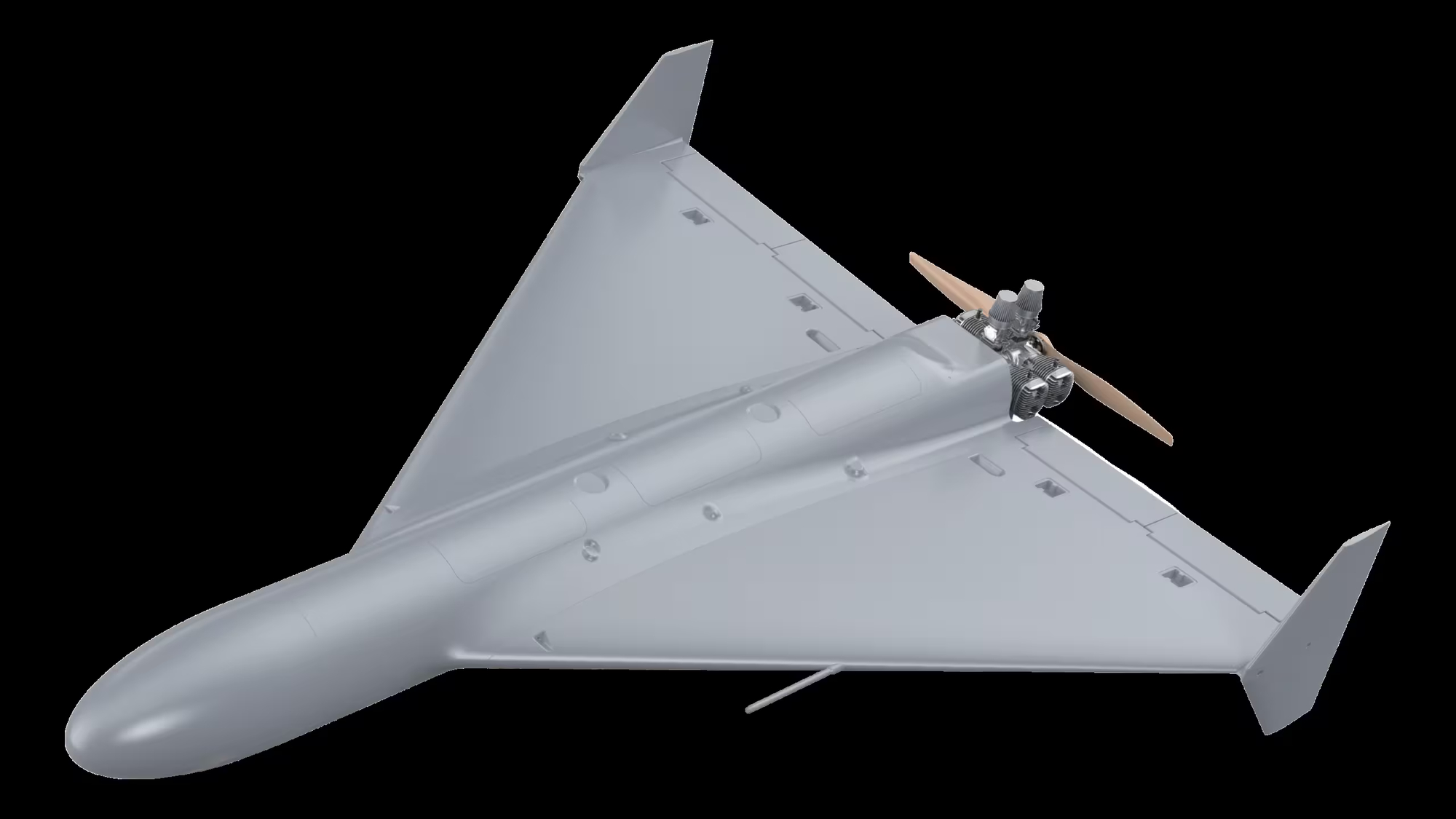
At the World Defense Show 2026, Chinese company LoongUAV openly demonstrated for the first time the heavy loitering munition Loong M9. The declared characteristics emphasize that this is not a light tactical device but a long-range system capable of operating against key infrastructure and air-defence assets at distance.
Key technical details
From the official description: strike range — over 1,600 km, flight endurance — up to 9 hours, warhead — around 50 kg, maximum mass — up to 200 kg. The drone has a triangular wing, is launched from a launcher with a rocket booster, is powered by a gasoline engine and operates at altitudes up to 4,500 m with speeds up to 220 km/h. The developer claims the M9 can operate under satellite navigation jamming and independently detect targets by coordinates or optical sensors; declared accuracy is around 10 meters.
“The M9 is intended for long-range strikes against infrastructure, headquarters and air-defence systems”
— LoongUAV (press release)
Why it matters — geopolitics and the technological context
The M9’s appearance comes against the backdrop of other Chinese demonstrations of technological progress (the emergence of the J-20A with WS-15 engines, an unmanned convertiplane with a range of 4,000 km). For China this is part of a strategy: to increase power-projection capabilities and expand export offerings in the arms sector. Analysts in defense outlets note that the appearance of such systems changes requirements for early-warning means and creates demand for long-range air-defence and electronic-warfare capabilities.
Implications for Ukraine and practical takeaways
The Loong M9 is not just statistics. For Ukraine the practical significance of this announcement is clear: such a platform can strike critical infrastructure at long range and bypass local air-defence zones. This increases the need in three areas:
- strengthening long-range early-warning capabilities (radar, optical/IR networks, space-based reconnaissance);
- investing in systems capable of countering loitering munitions (targeted EW, integrated air-defence with the ability to deliver short high-power bursts, and low-speed interception systems);
- enhanced international cooperation on intelligence-sharing and on producing systems capable of covering critical assets.
In practice, every step in the development of long-range unmanned strike potential by major players forces adaptation not only of equipment but also of doctrine: how to allocate resources, which points to protect first, and how to integrate partner support.
Conclusion
The announcement of the Loong M9 is a signal that long range and autonomy are becoming central to modern strike systems. For Ukraine this is not a horror scenario but a technical task: turn information into decisions — strengthen surveillance, protect critical infrastructure, and ramp up cooperation with partners. The ball is now in the court of those who can ensure the rapid deployment of the necessary means and resources.