World's smallest QR code: Austrian scientists stored data in an area smaller than a bacterium — why it matters for Ukraine
At a time when archives and cultural heritage are under threat, Viennese scientists and the startup Cerabyte have demonstrated how to physically store data at the scale of a bacterium. We examine the technology, its limitations, and its practical significance for preserving Ukrainian memory.

By Tetiana Suchkova-Ladik
February 19, 2026 · 2 min read
Record: what the scientists did
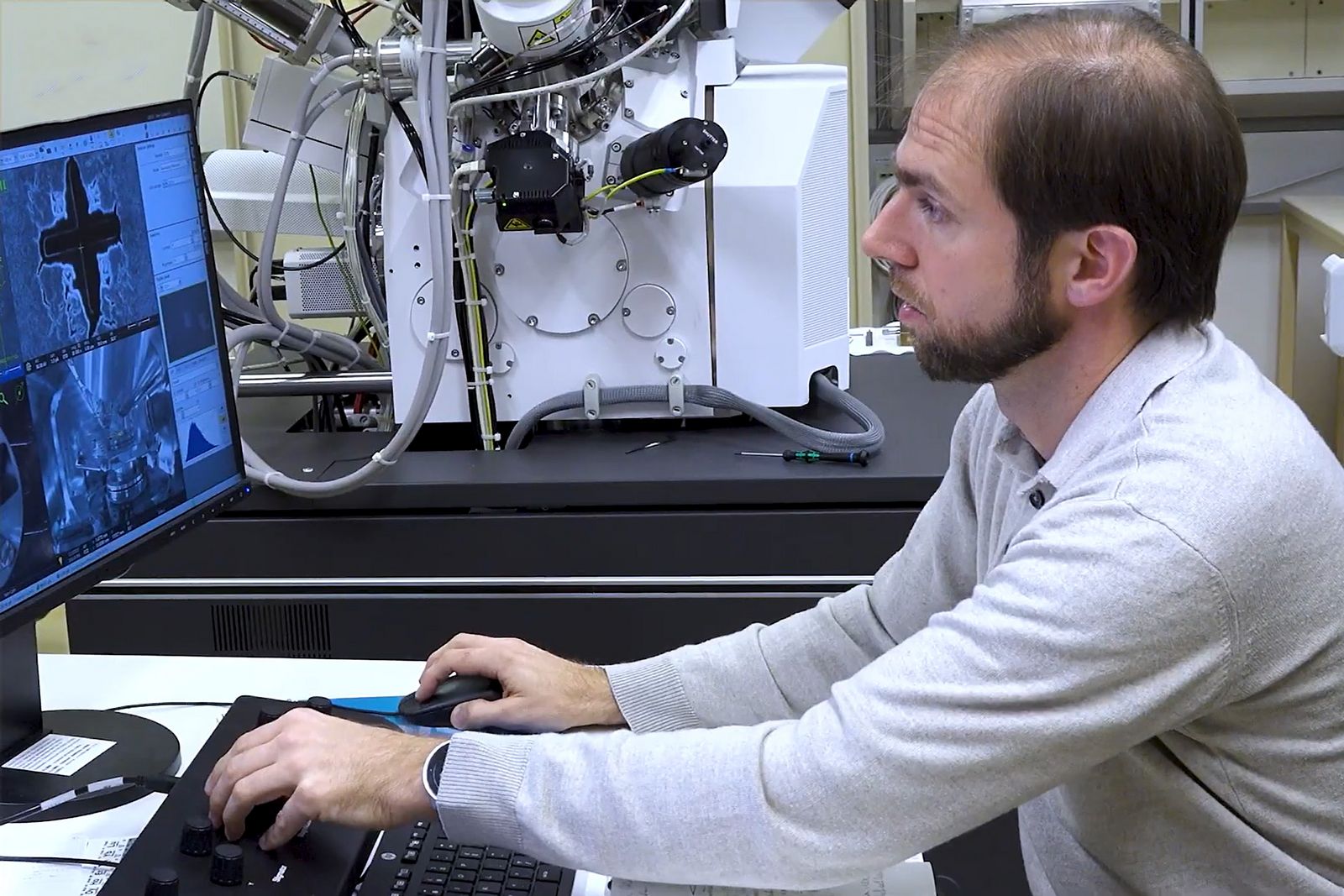
Researchers at the Vienna University of Technology (TU Wien), in collaboration with the Austrian‑German startup Cerabyte, created the smallest QR code in the world. Its area is 1.98 square micrometers (that is, smaller than most bacteria). The achievement was confirmed by Guinness World Records: the new code turned out to be 37% smaller than the previous record holder.
The QR code has a structure of 29 × 29 modules; the width of one “pixel” is 49 nanometers, roughly one tenth of the wavelength of visible light. Because of this it cannot be seen with the naked eye or with a conventional optical microscope — an electron microscope is used to read it.
Technology and reliability
The code was engraved with a focused ion beam onto a thin ceramic film. Ceramic was chosen for its high stability and resistance to external influences, which allows information to be stored without power or cooling. According to the researchers’ estimates, such nano‑carriers could theoretically preserve data for hundreds to thousands of years, making the technology attractive for archives and long‑term preservation of important documents.
"We have shown that physical archiving of data can be extremely compact and durable"
— Paul Mayrhofer, professor at TU Wien
Practical cost: possibilities and limitations
The advantages are clear: high storage density, low power consumption after writing, and longevity. But there are limitations: production requires complex equipment (a focused ion beam), and reading requires an expensive electron microscope. This is not a technology for everyday devices, but for specialized archives and scientific applications.
Why this matters for Ukraine
During the war, the issue of physically preserving documents and cultural heritage becomes practical rather than theoretical. The technology of ceramic nano‑carriers provides a tool for creating long‑lasting “physical copies” of key archives: from state registers to national monuments and digital evidence of crimes against humanity. The expert community notes that such solutions are part of a resilient information‑protection strategy, where not only backup servers matter but also autonomous physical media.
What’s next
The technology already holds a record and demonstrates potential. The next steps are standardization of the media, reduction of manufacturing costs, and development of mass‑reading/verification procedures. For Ukraine this is not only a matter of science but of preservation policy: can we integrate such approaches into programs for protecting archives and cultural heritage? This is a strategic decision — an investment in memory that can outlast generations.
In short: Austrian scientists created the smallest bacterium‑scale QR code — the technology promises a practical solution for long‑term data preservation, but for now remains a tool for specialized archives and scientific institutions.