NRK "Gnome" Learned to Look Up: Tethered Drone Above Combat Platform Is Nothing New, but a First for a Ukrainian Ground Robot
Temerland has installed a tethered drone with platform power supply on the "Gnome" — it hangs up to 50 meters high, requires no operator, and simultaneously conducts reconnaissance and relays signal. This fundamentally changes the logic of using unmanned ground vehicles: instead of a "blind" machine — an autonomous "ground + air" pair.

By Tetiana Suchkova-Ladik
May 14, 2026 · 3 min read
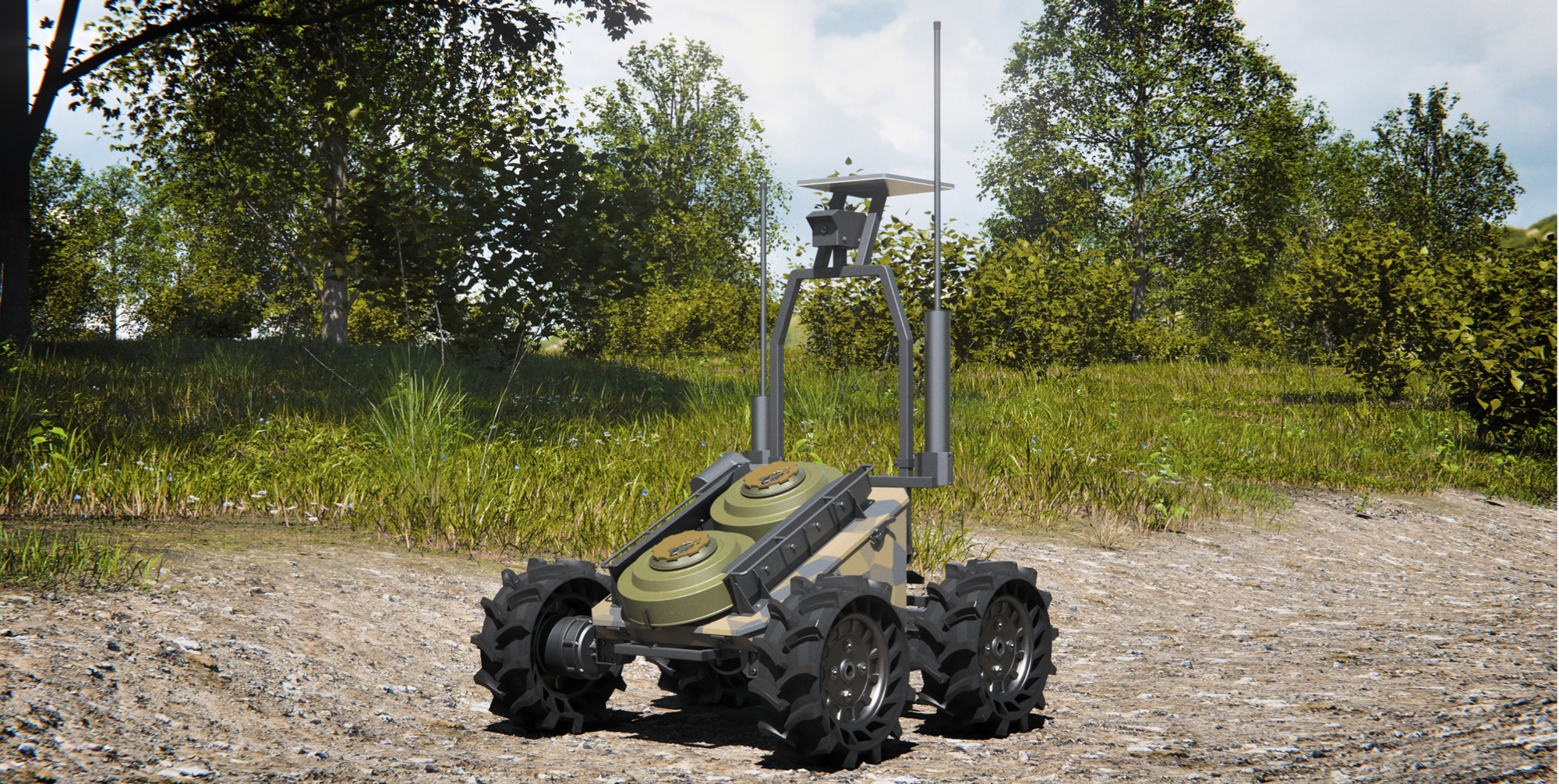
The Zaporizhzhia company Temerland has unveiled a new configuration of the already codified ground robotic complex "Gnome Drone Carrier" — featuring a tethered reconnaissance drone on board. The principal difference from previous versions: the drone does not fly autonomously and does not require a separate operator — it is attached by a tether and receives power directly from the platform through a DC400V bus.
How It Works Technically
The drone rises to a height of up to 50 meters and can simultaneously perform two functions: reconnaissance and radio signal retransmission for units in areas with poor coverage. According to Temerland CEO Eduard Trotsenko, power from the platform allows the drone to remain in the air for over four hours — whereas a battery-powered drone of the same class typically operates for 20–30 minutes.
"The tethered scheme eliminates the main limitation of FPV in reconnaissance — flight time. The platform moves, the drone moves with it, communication is not interrupted"
— Elistair, leading manufacturer of tethered systems for NATO armies, on the logic of UGV + tethered UAV integration
This very concept — a mobile ground carrier plus a constantly hovering aerial observer — was officially outlined by the U.S. Army in 2024 as a desired architecture for reconnaissance in enemy territory. The "Gnome" with DC400V implements it right now, albeit in a test version.
"Gnome" — A Platform That Multiplies in Configurations
In recent months, Temerland has consistently presented several separate versions of the same chassis:
- Gnome-ND — carrier of strike FPV drones with launch via Starlink, LTE, and fiber optics
- Gnome + Smart Shuttle — evacuation of the wounded with a single-arm robot manipulator with a tether up to 15 meters
- Gnome-Miner — remote mining in the "gray zone," places TM-62 or MON-90
- Gnome Drone Carrier — current version with tethered reconnaissance and counter-drone system
The logic is obvious: one codified chassis, various modular superstructures. This reduces logistics costs and simplifies personnel training — one platform type, already accepted by the Ministry of Defense, can cover several tasks depending on the mission.
Counter-Drone System — Second Layer
In addition to the tethered reconnaissance drone, the new configuration received a counter-drone system for detecting and defeating enemy UAVs. Trotsenko did not disclose details about the type of strike means; however, the combination of "reconnaissance from above + defense from above" allows the "Gnome" to operate in a zone of active drone confrontation without constant infantry cover.
This is important in a context where enemy FPV drones attack precisely ground robotic platforms — as documented in reports from the Kursk direction, where the first batches of "Gnomes" have already seen combat use as part of the 8th Separate Regiment of Special Purpose.
What's Next
The platform is in the testing stage, codification has been completed — meaning the path to state procurement is formally open. However, the experience of other Ukrainian developers shows: codification ≠ contract. The very manufacturer VOLS publicly noted that serial production is "stalled" by the state due to a mismatch between the Ministry of Defense's technical requirements and actual combat concepts.
Will the modular architecture of the "Gnome" — where one chassis covers reconnaissance, evacuation, mining, and strike missions — be able to convince buyers to conclude a framework contract for several configurations at once, rather than waiting for separate codification for each superstructure?