Mesh Instead of Silencer: Polish-Ukrainian Turret Learned to Shoot Down FPV Without Operator and Without Radio Jamming
Scan Horizon by Postup Solutions captures FPV drones with a net autonomously — and this is fundamentally important because electronic warfare is powerless against fiber-optic drones.

By Tetiana Suchkova-Ladik
May 11, 2026 · 2 min read
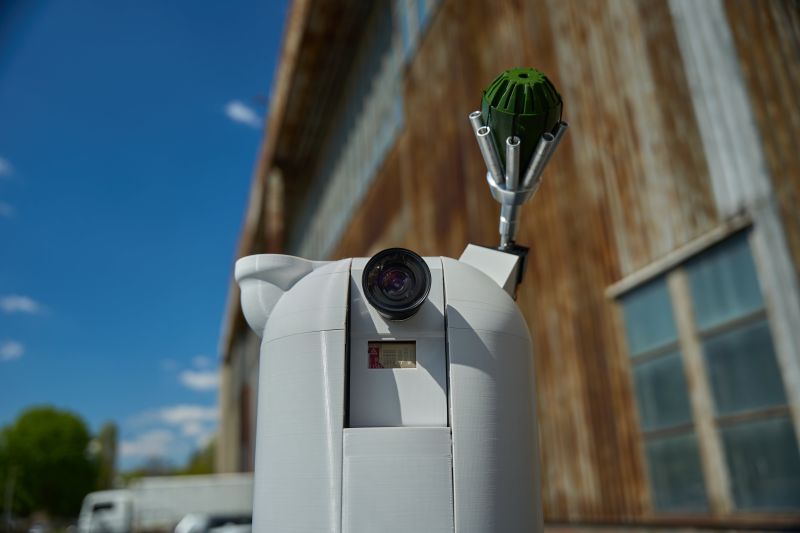
When on May 1–3 the Postup Solutions team demonstrated a turret at the EDTH Hackathon in Kyiv that independently "heard," tracked, and caught an FPV drone with a net, behind the scenes of the demonstration stood a concrete problem. More than 75% of equipment losses at the front are caused by cheap FPV drones, and an increasing share of them fly via fiber optic cables — meaning they do not respond to any jammer.
Why a net instead of interference
Classical electronic warfare blocks the radio signal between the drone and the pilot. But a fiber optic FPV drone is controlled by a cable — a jammer means nothing to it. That is why Scan Horizon deliberately avoids electronic warfare as a neutralization method: instead, it uses physical capture with a net at a distance of 2.5–6 meters. If the drone reaches this line — it is already in the net, literally.
How the system "sees" the target without an operator
The turret has a 360° view and uses sensor fusion — parallel processing of data from three independent sources simultaneously:
- Acoustics: a microphone array with AI "hears" the drone at distances up to 20 meters — even in darkness and fog
- Camera with AI: visually confirms the target at approximately 25 meters
- Radar: localizes the object up to 18 meters
The combination of three channels reduces the number of false positives — a critical parameter for a system that operates without human participation in the decision to fire.
"Over four hackathons, we were able to gradually develop and demonstrate not just a concept, but a real working result"
Vlad Kozak, CEO of Postup Solutions, Dev.ua
The scale of the problem extends beyond Ukraine
Postup Solutions is a Polish-Ukrainian company, and its bet is not only on the Armed Forces of Ukraine. According to the developers, over one million units of equipment from NATO countries' armies remain practically defenseless against the FPV threat. Scan Horizon is positioned as a low-cost solution — a turret that can be scaled without significant costs per unit.
At the same time, there is a technical limitation that the developers do not hide: the range of net interception is only 2.5–6 meters. This means the system activates at the very last line of defense — when the drone is right at the facility being protected. The team promises to increase the range and reliability in the next version, but has not yet provided specific figures.
If the next iteration of Scan Horizon increases the interception distance to at least 15–20 meters — the system will move from the category of "last resort" into the category of a full-fledged defense line. This parameter alone will determine whether the autonomous turret becomes a real solution for protecting equipment in open terrain, and not just point objects.



