Snapdragon 6 Gen 5: Wi-Fi 7 and 144 Hz in a budget device—but at the cost of USB 2.0 and memory performance degradation in the lower-end model
Qualcomm has announced two new chips for budget smartphones. Behind every “plus” in the specs lies a compromise that the manufacturer doesn't highlight.

By Tetiana Suchkova-Ladik
May 7, 2026 · 2 min read
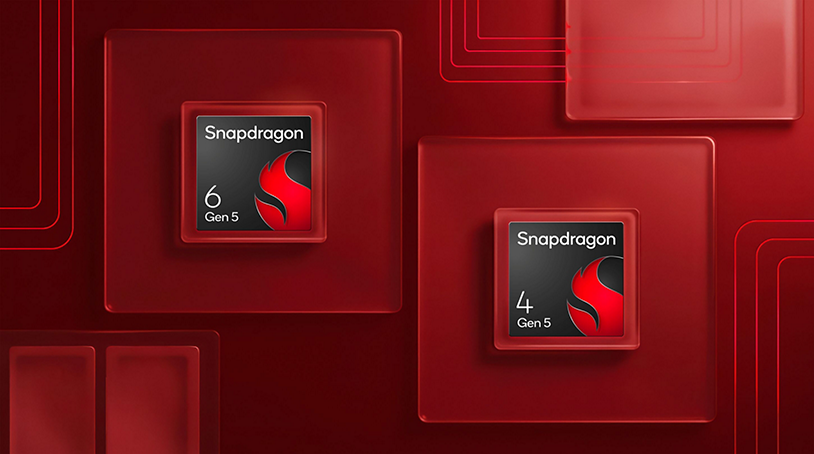
Qualcomm has officially unveiled the Snapdragon 6 Gen 5 and Snapdragon 4 Gen 5 — processors aimed at mid-range and budget smartphones. The first devices based on them are expected in the second half of 2026. On paper, both chips look like a step forward. But a closer comparison with their predecessors’ specifications paints a different picture.
What has actually improved
The Snapdragon 6 Gen 5 is built on TSMC’s 4-nanometer process. The chip features eight cores: four performance cores clocked at 2.6 GHz and four efficiency cores at 2.0 GHz. Adreno graphics performance has increased by 21%, apps launch 20% faster, and interface latency is reduced by 18% compared to Gen 4. Support for displays up to 144 Hz, Wi-Fi 7, and Bluetooth 6.0 truly debuts in Qualcomm’s budget-oriented lineup.
The Snapdragon 4 Gen 5 is also manufactured on a 4 nm process. It includes two performance cores at 2.4 GHz and six efficiency cores at 2.0 GHz. The GPU performance jumps by 77%, and support for 4K video recording has been added — a feature previously absent from this price segment.
Compromises Qualcomm didn’t put in the headlines
This is where things get interesting. The Snapdragon 6 Gen 5 downgrades the USB interface to version 2.0 — a step back from the Gen 4’s USB 3.1. This means slower file transfers and more limited support for external accessories. At the same time, mmWave 5G support and the L2 GPS band have been removed.
The situation with the lower-tier model is even more telling. While the Snapdragon 4 Gen 4 supported fast LPDDR5 memory, the Gen 5 rolls back to LPDDR4X with a maximum frequency of 2133 MHz, compared to 3200 MHz in its predecessor. For users, this is noticeable: slower memory limits multitasking and data throughput, despite all the gains in graphics performance.
“Qualcomm appears to be deliberately balancing premium features against bill of materials costs: removing rarely used hardware — mmWave, high-speed USB — in order to invest the budget into the GPU and camera capabilities.”
Notebookcheck, technical analysis of Gen 5 specifications
Why this matters beyond raw specifications
This discussion concerns the segment where the majority of the world’s smartphones are sold. According to Counterpoint Research, Qualcomm holds around 62% of the flagship SoC market, but it is the mid-range and budget tiers that drive overall shipment volumes. Competitor MediaTek is applying strong pressure in this space, making every Qualcomm decision not only an engineering one, but a commercial one as well.
Smartphone manufacturers choosing between Gen 5 and MediaTek Dimensity alternatives receive a clear message: Wi-Fi 7 and a faster GPU in exchange for slower USB and memory. For the end consumer, priorities depend on usage scenarios — but they are unlikely to read the fine print of the spec sheet.
If Android smartphone makers in 2026 are choosing between the Snapdragon 4 Gen 5 and MediaTek Dimensity, the rollback to LPDDR4X memory could become a decisive argument against Qualcomm — but only if buyers learn to check not just the chip name, but also the type of RAM installed.