TikTok Knows Where You Want to Go — And Now It Will Sell You a Ticket There
TikTok Go transforms watching travel videos into booking hotels and attractions in a single tick. This isn't a convenient feature — it's a shift in who controls the tourism funnel.

By Tetiana Suchkova-Ladik
May 13, 2026 · 2 min read
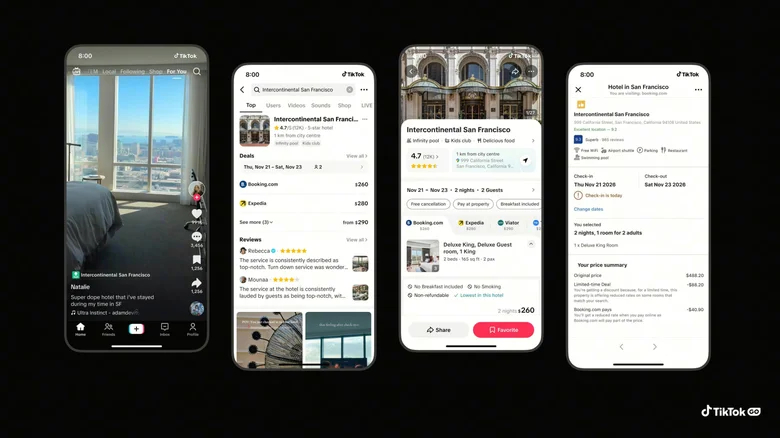
Imagine: you're watching a video about a fishing village in Portugal, and with two taps you're already booking a hotel there. No Google, no Booking in your browser — everything inside TikTok. That's exactly what TikTok Go does now — a new feature the platform launched for American users aged 18 and over.
How it works
Booking options appear directly in travel videos, search results, and location pages. Upon seeing a hotel, attraction, or activity, a user taps, checks availability, and completes the booking without leaving the app. Launch partners include Booking.com, Expedia, Trip.com, Viator, GetYourGuide, and Tiqets.
But there's a nuance that sets TikTok Go apart from, say, TikTok Shop: the transaction takes place on the partner's website, not inside TikTok — the platform provides exclusive rates and support during promotional campaigns. So TikTok isn't yet taking money, but rather attention and data.
What content creators get
Authors who showcase hotels, attractions, and experiences can link videos directly to booking options. TikTok promises them commissions and participation in special campaigns — this is the platform's first clear monetization mechanism for travel content.
"Inspiration and booking are now side by side. Content doesn't just entertain — it converts. This makes social platforms a serious new distribution channel for tourism."
Florian Bouchaye, travel market analyst, in a comment to PhocusWire
The partner paradox
The most interesting aspect of the launch is not the product itself, but who supports it. Booking.com and Expedia simultaneously compete with TikTok in the travel search space — yet supply the inventory without which TikTok Go wouldn't work. They're financing their potential replacement because they can't afford to be absent where Gen Z plans vacations.
For traditional travel aggregators, the stakes are clear: "For years, travel planning started with Google. Now TikTok is claiming that same entry point," — and unlike Google, TikTok already knows not only what you're searching for, but what actually makes you stop and watch for three minutes.
For now — US only
Currently, the feature is available only to American users. But TikTok Shop started the same way — from a single market, then expanded to Southeast Asia and the UK within a year. If TikTok Go shows conversion above 2–3% — the standard for travel advertising — global expansion will become a matter of quarters, not years.
The real question isn't "will people travel based on TikTok recommendations" — they already do. The question is whether Booking and Expedia will accept staying in a back-end role when they see TikTok building its own audience of loyal buyers and gradually gaining the power to dictate commission terms.