Trump directed U.S. scientific agencies to implement artificial intelligence
President Donald Trump signed an executive order launching "Genesis Mission" — a plan to integrate AI into scientific research. The Department of Energy will open datasets and equipment to external researchers working with artificial intelligence tools.

By Oleg Bazylewicz
November 29, 2025 · 3 min read
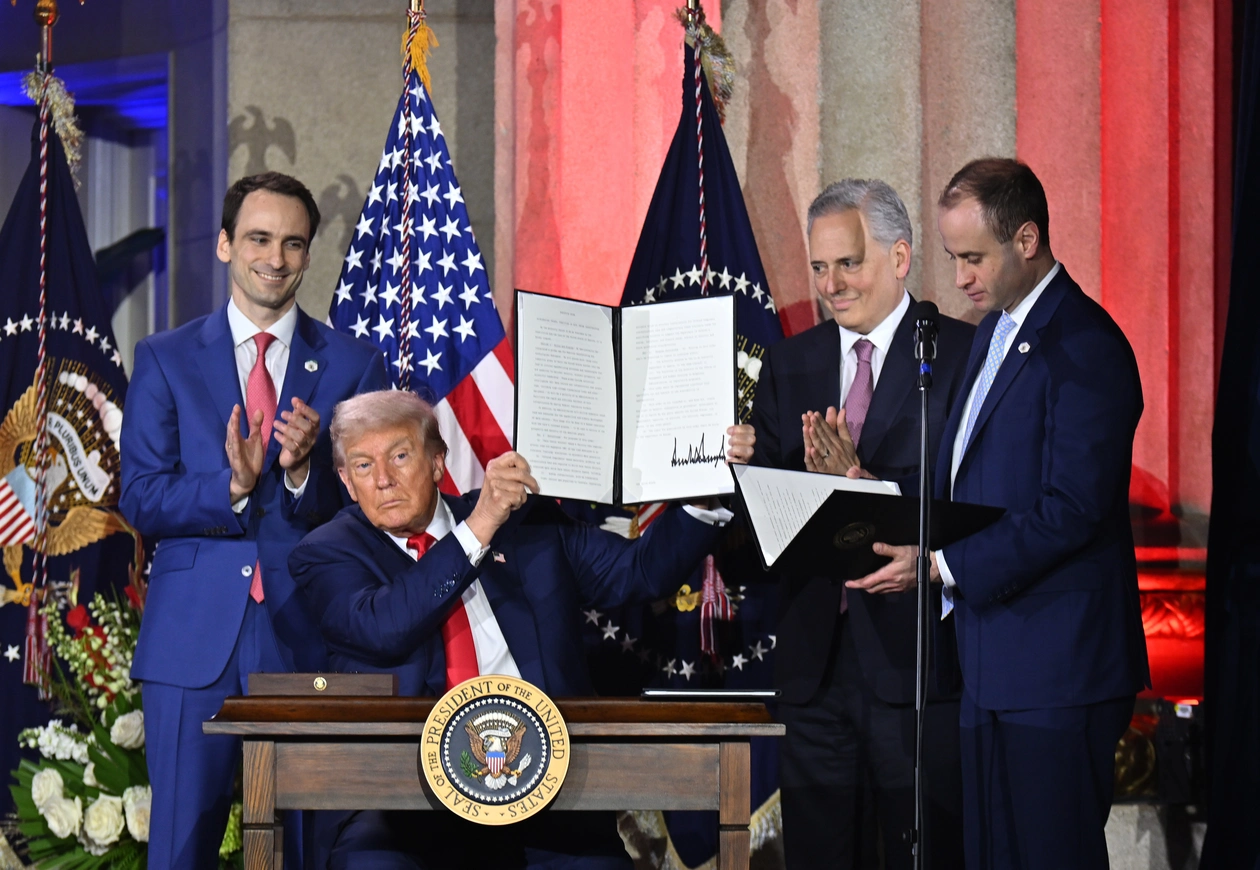
The White House wants to accelerate the country’s scientific research through the adoption of artificial intelligence.
President Donald Trump on Monday signed an executive order launching "Genesis Mission" — a new plan that directs the Department of Energy and other scientific agencies to aggressively deploy AI.
Michael Kratsios, head of the White House Office of Science and Technology Policy, described it as "the largest mobilization of federal scientific resources since the Apollo program." Speaking to reporters, he said the initiative is expected to speed scientific breakthroughs in areas such as pharmaceuticals, energy production and engineering.
Using AI to analyze data
On the same call, Energy Secretary Chris Wright emphasized using AI to analyze the vast datasets held by the department’s 17 national laboratories. Wright also promised "an incredible increase in the pace of scientific discoveries and innovations."
Among other provisions, the order instructs agencies to make their datasets easier for neural networks and other AI tools to read. Scientific data stored by the government and federal computing infrastructure will be made available to university researchers and private companies, as well as to national security practitioners.
One White House official, granted anonymity as a condition of speaking to reporters, said funds from the One Big Beautiful Bill Act passed this summer will help finance the project.
Goal of the program
"Since the 1990s, America’s scientific advantage has faced growing challenges."
– Kratsios said, pointing to fewer drug approvals and declining research outcomes.
He said Genesis Mission aims to overcome this by "aligning agencies’ scientific efforts and integrating AI as a scientific tool to revolutionize how science and research are done."
Wright said the order is also designed to use AI in ways that increase domestic energy production and make the grid more efficient.
"We are going to stop the rise in energy prices."
– Wright said.
Energy experts attribute recent price increases in part to the voracious electricity demands of AI data centers.
Program details
The order directs the Department of Energy to build integrated software that will allow scientists and engineers to mash up agency datasets and scientific tools with AI neural networks.
Kratsios said the technology will be used to automate experiment design, build new predictive models and accelerate complex simulations in areas such as protein folding and nuclear fusion. Another White House official who was also on the call said AI is expected to make advanced simulations "10,000 - 100,000 times faster."
The order also directs the Department of Energy to create a new portfolio of scientific and engineering challenges that could benefit from AI adoption, with a specific focus on energy problems, discovery science and national security issues.
Data categories
The scientific data the White House plans to open for AI analysis is divided into three broad categories. The first will be available to a wide range of researchers, including academic and private scientists. The second will be reserved for proprietary work — the White House official cited, as an example, a semiconductor company seeking to use government X-ray accelerators to develop or test a new product.
The third category concerns datasets relevant to national security and will be restricted to researchers with appropriate clearance.
Program partners
White House officials said the project ultimately aims to connect large government datasets and powerful supercomputers with the capabilities of private AI hyperscalers. Companies such as Nvidia, Oracle, Dell, AMD and Hewlett Packard Enterprise recently announced partnerships with Washington supercomputers — and one official said these and many other firms are expected to play a role in Genesis Mission.