Three Grams Determine Connection: Why a Drone Antenna Weighs Less Than a Coin
BlueBird Tech has released the HELIX Lite 5.8 series — miniature helical antennas for drones and relays designed for applications where every gram counts. According to their technical specifications, they fill the exact niche where Ukrainian operators most frequently lose signal.

By Tetiana Suchkova-Ladik
May 11, 2026 · 2 min read
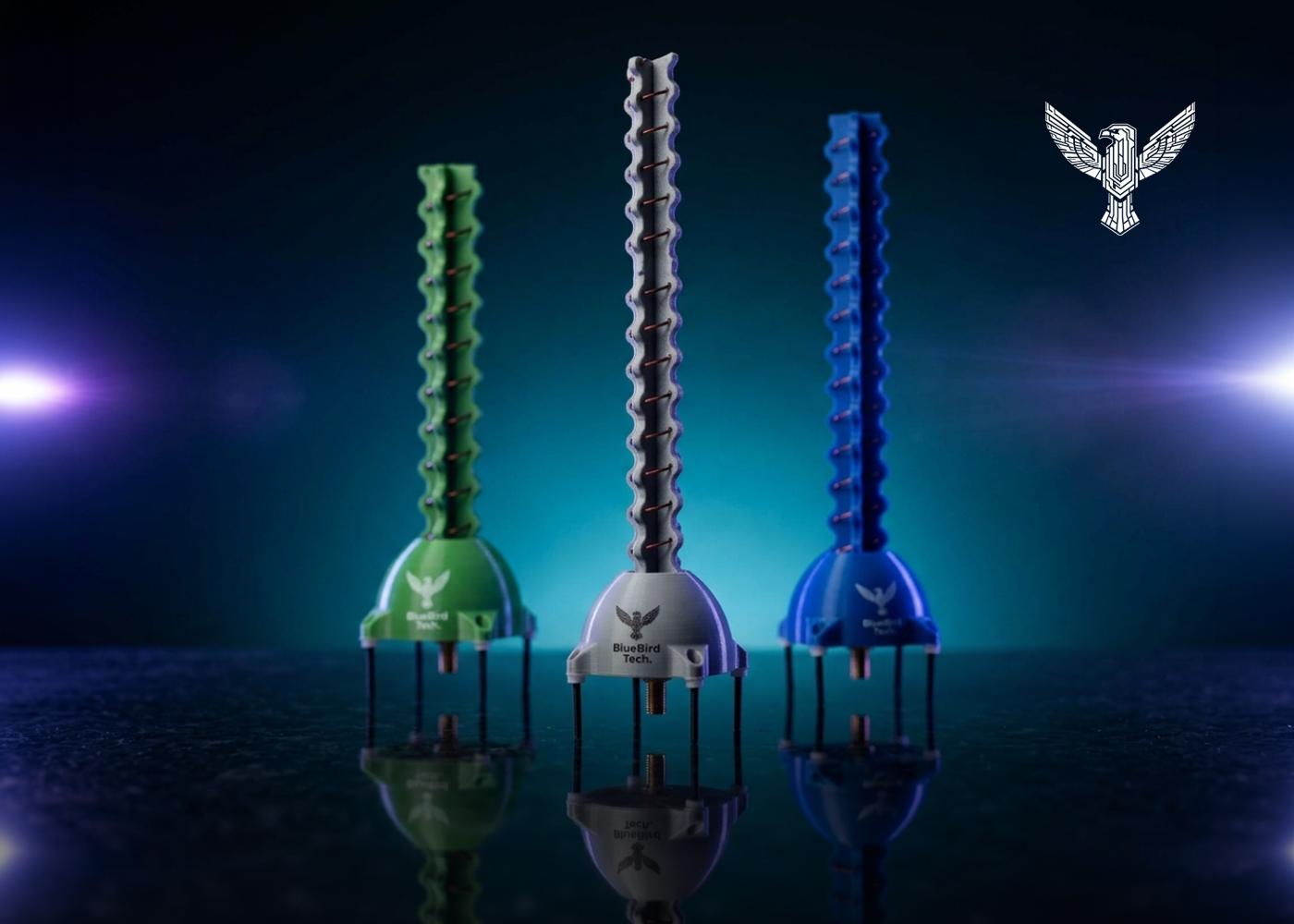
When a drone rotates or enters an area of dense urban development, an antenna with conventional linear polarization begins to "lose" signal — the angle of inclination changes, reflections multiply. This is precisely the problem addressed by the new HELIX Lite 5.8 series from Ukrainian manufacturer BlueBird Tech.
What's Inside
The series consists of three antennas — HELIX Lite 5.8/12, HELIX Lite 5.8/15, and the senior model with 15 dBi gain. All three operate in the 4.9–6.1 GHz range and use right-hand circular polarization (RHCP). Circular polarization is fundamentally different from linear: the antenna "receives" signal regardless of the drone's orientation in space — this eliminates the so-called polarization fading.
The HELIX Lite 5.8/12 design is built on 12 calculated spiral turns, which form a narrow single-band radiation pattern — only 35° at the −3 dB level. In simpler terms: the antenna "looks" at one point and ignores interference from the sides. The HELIX Lite 5.8/15 adds three more turns and raises the gain to 15 dBi, maintaining an Axial Ratio below 1.5 — a metric of circular polarization quality, important precisely under active maneuvering conditions.
"An ideal solution for professional long-range systems, drones, ground relays, and tactical radio systems"
BlueBird Tech, technical description of HELIX Lite 5.8/15
Why Weight Matters
The name "Lite" is not branding for branding's sake. On an FPV drone or relay drone, every extra gram reduces flight time or payload capacity. The manufacturer positions the antennas specifically for mobile platforms and onboard systems, where installation must be quick and mechanical durability must be guaranteed without additional fasteners.
- HELIX Lite 5.8/12 — 12 turns, up to 14 dBi, HPBW 35°
- HELIX Lite 5.8/15 — 15 turns, up to 15 dBi, Axial Ratio <1.5
- Range of both: 4.9–6.1 GHz, RHCP, compatibility with ground stations and onboard systems
Context: Where It Matters
The 5.8 GHz band is one of the most widely used in drone control, and simultaneously one of the most "noisy" in active combat zones. As documented by MIT Technology Review, electronic warfare on the front line has become a constant race between operator frequencies and jamming equipment. The narrow pattern and circular polarization of the HELIX Lite is not only a counter to physical obstacles, but also passive protection against side interference generated by electronic warfare systems that "flood" a wide range uniformly.
BlueBird Tech delivers products through "Nova Poshta," "Ukrposhta," and Meest Express — meaning it primarily targets the domestic market and volunteer supply networks.
The question that remains open: if antennas already solve the problem of polarization losses and side interference, is this enough for stable communication — or is the next link that will need to be upgraded the receivers themselves mounted on the drones?
```