McDonald's opened a restaurant in Kyiv made from coffee waste and recycled plastic — and it's not about ecology, but about money
Since 2022, the network has invested almost 5 billion hryvnias in Ukraine and opened 127 establishments. Sustainable design is the next signal: despite the war, the business is expanding rather than freezing operations.

By Tetiana Suchkova-Ladik
May 12, 2026 · 2 min read
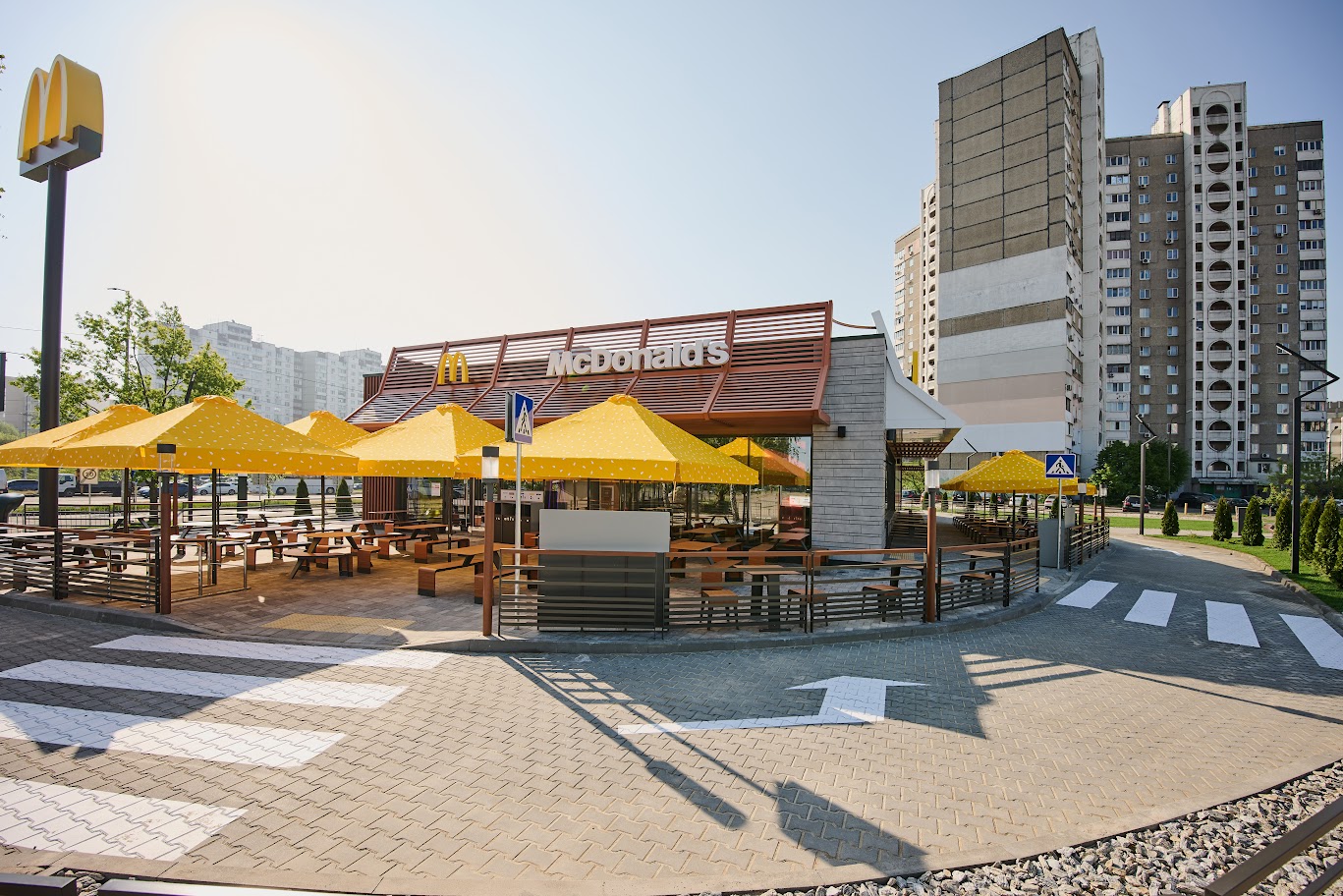
On May 12, a new McDonald's opened on Revutsky Street, 4-B in Kyiv — near Sonyachne Lake. Formally, this is news about interior design: furniture, walls and ceilings are made from recycled plastic, textiles, wood and coffee waste. In reality, it's a signal about something else.
What is "sustainable design" and why is it here
The first such establishment in Ukraine opened in September 2024 in Lviv — on Shevchenko Street in the Ryasne neighborhood. The Kyiv one became the second. The design of both embodies the principle of mono-materiality: each design element is made from one type of material, making it easier to recycle after disassembly. Fasteners are mechanical, without glue. Structures can be disassembled and reused.
The establishments also have heat recovery systems, heat pumps and electric vehicle charging stations. According to my.ua, citing the company, the Lviv McDonald's has eight charging stations for electric cars — a detail that in 2024–2025 in Ukraine no longer looks exotic.
Figures that matter more than interior
According to open4business, from 2022 to 2025, McDonald's Ukraine invested 4.84 billion hryvnias in expansion and modernization. The network's revenue in 2025 reached 21.3 billion hryvnias — 26.6% more than a year earlier. Net profit increased by 21.3%, to 1.567 billion hryvnias.
"In 2026, McDonald's plans to continue expanding its network and strengthening its presence in Ukrainian regions"
— McDonald's Ukraine press service, according to open4business
Currently, the network has 127 open establishments in 42 settlements and almost 11,000 employees. For comparison: in September 2024, when the Lviv "sustainable" McDonald's opened, it was the 114th establishment in Ukraine. In less than a year — plus 13 locations.
Why sustainable design — and why now
Globally, McDonald's came under pressure: the European Union, through the "Green Deal," obligated major networks to reduce CO₂ emissions and transition to recycled materials. According to Sustainability Magazine, the company has already accelerated environmental initiatives across the network — from uniforms made of recycled polyester in the USA to "closed-loop" construction waste systems in France.
But there's also purely local logic. Opening restaurants with standard design in Ukraine means investing in materials that are harder to move or recycle if damaged. A modular structure where everything is mechanically fastened and disassembles without losses — this is not just about ecology. It's also practical under conditions of uncertainty.
- All design elements are dismantled without glue — suitable for reuse
- Heat pumps and heat recovery reduce dependence on external energy grids
- Electric vehicle charging — additional traffic and loyalty without major expenses
So "sustainable design" in the Ukrainian context is simultaneously a response to the global ESG trend and local adaptation to risks.
What's next
McDonald's Ukraine has already announced expansion in 2026. The question is not how many new establishments will open — but whether sustainable design will become the standard for all new locations, or remain a marketing showcase for two or three "flagship" restaurants. If the next 10 openings follow the same principle — that's a systemic change. If not — just another "green" press release with nice photos by Sonyachne Lake.



