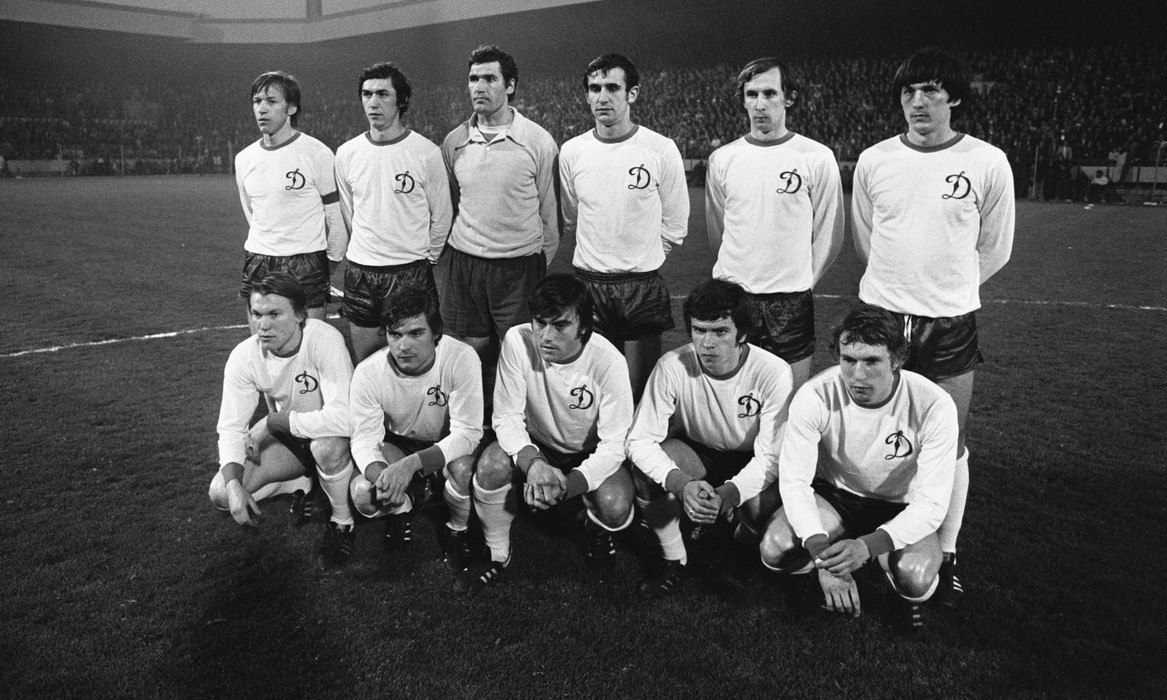
Kyiv Dynamo of 1976 — a sore point in Ukrainian football's memory
On March 17 it marked the 50th anniversary of Dynamo Kyiv's defeat by French side Saint-Étienne in the European Cup quarterfinal during the team's difficult 1976 season. Over the past half-century, the subject of Dynamo Kyiv's unsuccessful performances that season has been covered repeatedly, but, unfortunately, mostly inaccurately.

By Oleg Bazylewicz
March 19, 2026 · 4 min read
It is finally necessary to give some explanations, especially regarding the “excessive loads” and “unchecked experiments” — precisely the accusations that to this day are still levelled at the Kyiv coaching staff, Valeriy Lobanovskyi and Oleh Bazylevych.
Coaching experiments?
In fact, the main experiments with this system of preparing footballers were completed in 1970–1973 in the teams where Lobanovskyi and Bazylevych were working at the time: Desna (Chernihiv), Shakhtar (Kadiivka), Dnipro (Dnipropetrovsk) and Shakhtar (Donetsk). The scientific director of these experiments was Anatoliy Zelentsov, and the connecting link between Lobanovskyi and Bazylevych was Lobanovskyi’s assistant at Dnipro, Oleksandr Petrashevskyi.
All of these people are no longer with us, so let us pay due tribute to their inspired work. And also to the experiments that fully justified themselves and revealed the true potential of the new coaching methods already at Kyiv Dynamo in 1974–75. Thus, in preparation for the 1976 season the coaches did not even think of planning any experiments that would radically change the team’s preparation.
New tasks that could not be refused
In 1975 the sports leadership in Moscow effectively forced Lobanovskyi and Bazylevych to take responsibility for the USSR national team’s performances. It is widely known that Kyiv Dynamo were obliged to play in national team shirts. Lobanovskyi and Bazylevych were against it because they understood the risks, but Moscow insisted, and refusal was not an option.
Moreover, the team and these coaches were given the task: to win the Olympic Games in Montreal (1976).
You would think that if you set people such tasks, you would give them the chance to work calmly, as they know and can. In fact, Lobanovskyi and Bazylevych hoped that this would happen. But it turned out differently.
Moscow’s jealousy and the set‑up
The Lobanovskyi–Bazylevych–Zelentsov system in many ways contradicted the established coaching methods of the Soviet era and the manuals of Moscow institutes, and—most importantly—greatly annoyed Moscow officials. They considered Lobanovskyi and Bazylevych “upstarts” and “adventurous experimenters” and constantly chastised them at meetings of the USSR Sports Committee.
One cannot fail to see the traditionally condescending attitude from Moscow, as well as Moscow’s jealousies that arose when Kyiv succeeded at something that Moscow did not. It was also classic imperial appropriation: all awards and achievements — “into the piggy bank of Soviet sport.”
But here was the pretext.
Moscow decided that the national team’s coaching staff “required strengthening,” and that their methods needed serious correction. A “supervisor” was attached to the team, a certain Mark Godik — a Doctor of Sciences, professor, a theoretician in the field of athlete preparation. He arrived with Moscow manuals and recommendations that effectively undermined the preseason training program for 1976.
Without going into details, I will note: all this Moscow theory boiled down to manipulating the parameters of volume and intensity of loads (very much in the spirit of the then‑prevailing “steady increase” of everything possible and impossible) without due attention to the functional orientation of the training. Our Kyiv school was already, in those years thanks to the efforts of Lobanovskyi, Bazylevych and Zelentsov, significantly more progressive.
But as a result all of Godik’s “scientific” recommendations amounted to an unjustifiably high share of high‑intensity training in conditions of the base hypoxia of the mid‑mountains. This is about that “overly heavy” training camp in Belmeken (Bulgaria) before the 1976 season — a camp that effectively drove the team into a functional hole. The coaches tried during the season to somehow correct the situation, but they really acted almost blindly. They truly did not have the experience of an urgent correction of the team’s functional state after a disastrous preparatory period.
Today this may seem barbaric: to turn a club team into the national team, to grossly interfere in the training process, to force them to follow the recommendations of some institute — even if it was the central Institute of Physical Culture. But those were different times. The coaching staff was forced to agree because this was effectively an order from the USSR Sports Committee. For now they were the coaches of the USSR national team and had to obey.
One can now speculate about what could have been refused, but one must understand the Soviet realities of those years. There were many levers of pressure on essentially powerless athletes and methods of reprisal, from “your party membership card on the table” and the like.
Obviously, no coach will change a preparation system that brings good results year after year. Why would they?
So Moscow forced the coaches to do what they did not want, and then put all the blame on them. Well, nothing surprising — Moscow always acted that way.
Even today we don’t really understand what happened then
Today, fifty years on, talk still circulates about “young coaches” who “caught a big head” and did something wrong, introduced some “excessively high loads” — the same things that Moscow newspapers wrote back then about Kyiv Dynamo.
It felt as if they were glad about the failure. But it was a relative failure. A European Cup quarter‑final, Olympic bronze medals — today we can only dream of such “failures” in Ukrainian football.
Over the years I have increasingly thought that it was all done deliberately: to heap obligations on people and create a situation in which they simply had no chance of coping one hundred percent.
By the way, seven years after all this Mark Godik did nevertheless admit his mistake, the error of those “recommendations,” and apologized. Not publicly, but privately, in a conversation with Bazylevych when the latter defended his dissertation “Management of the preparation of highly qualified footballers on the basis of modeling the training process” in Moscow, at the same central Institute of Physical Culture (GTSOLIFK), in 1983.
To hell with Moscow.
But that’s another story