Game about the storming of Hostomel on Steam: why it's more than an "illusion of war" and how to get it removed
A Russian project has appeared on Steam that presents the battles for Hostomel through a propaganda lens. Setting emotions aside — we examine why this is a threat to public memory and how to act systematically to hold the platform accountable.

By Tetiana Suchkova-Ladik
March 12, 2026 · 2 min read
What happened
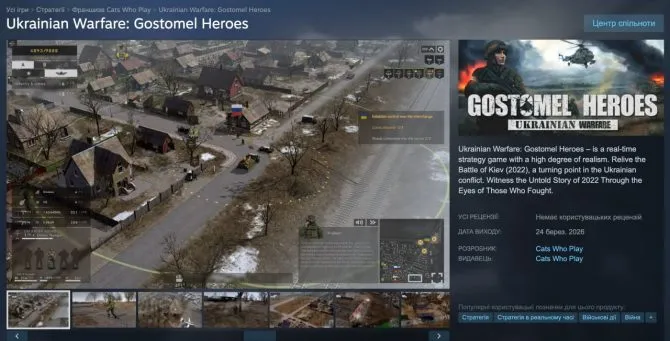
A page for the game Ukrainian Warfare: Gostomel Heroes (the Russian version of the title — «Гостомельські богатирі») from the studio Cats Who Play has been published on the digital store Steam. According to the description, the player takes the side of Russian forces during the battles for Hostomel in the first days of the full-scale invasion by the Russian Federation. This was reported by Ukrainian News.
Why it matters — not just for gamers
This is not merely entertainment content. Games shape narratives: they influence how history is perceived, normalize certain roles, and can serve as a tool of information aggression. According to the game's own description:
"This is not a documentary, but it recreates the events of the first days of the war with full seriousness — from the moment of the brilliant Russian landing on the outskirts of Kyiv to the time when the war seemed like it could end with the signing of a draft peace agreement in Istanbul in March 2022."
— description of the game on Steam
Such a portrayal reproduces Russian narratives and effectively justifies or romanticizes the invasion. For Ukraine, this is a matter of historical memory, information security, and a moral response to attempts to rehabilitate the aggressor.
Reasoned action: how to file a complaint and why it works
The Ukrainian gaming community is calling for mass use of the complaint mechanism on Steam — this is a direct way to draw the platform moderators' attention. Platform algorithms and policies respond to coordinated user reports and public resonance.
Steps suggested by activists:
- Go to the game's page on Steam.
- Click the button with the flag icon ("Report").
- In the form, choose a reason (for example, "Slander" or "Violation of law") and indicate that the game contains: discrimination against Ukrainians, propaganda of Russian fascism, justification of war, and manipulations of historical facts.
What’s next and what to expect
Platforms make decisions based on policies and internal investigations: mass complaints accelerate review, but the final decision depends on Valve’s internal criteria. At the same time, it is worth collecting materials for media and human rights organizations — this increases public and legal pressure.
This situation is an example of a broader problem: information aggression seeks legitimization not only through propaganda media but also through cultural products. Therefore the response must be systemic: technical complaints, public analysis, and coordination with partners who work with digital platforms.
Conclusion
It is important to act quickly but rationally: complaints on Steam are an effective tool of civic oversight, but only one element. The issue of content moderation on large platforms is a matter of security and memory. Whether users can compel the platform to act responsibly depends on the scale and coordination of actions.