The End of the Imperial Cycle
Empires are not eternal. Especially those that expand by territory rather than by routes. Empires that build a world of borders instead of communications, and constantly try to draw new lines on the map—such realms are doomed to stagnation and collapse. Only the "communication" or "route-based" component of imperial state-building gives empires a chance at a dignified death, or at a transformation into something better—more progressive, dynamic, successful, and freer.

By Oleg Bazylewicz
January 5, 2026 · 3 min read
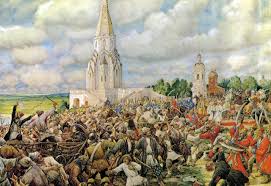
Land empires usually die ingloriously — first they rot for a long time, then choke on blood and fall apart into pieces — in agony, in convulsions, in senility and degradation. And this is all because the desire to control a larger territory somehow materializes into despotic, authoritarian, and generally historically doomed repressive rule. In other words, into everything that can be described as “regress of freedom”.
Thalassocracy and tellurocracy
For those who want to reflect a bit more on the reasons behind the general connection between increasing territorial control and the regression of freedom, it may be useful to refer to the idea of two types of civilizations: thalassocratic (from Gr. “thalassa” — θάλασσα — sea) and tellurocratic (from Lat. “tellus” — tellus — earth, soil).
Civilizations of the first type “grow” through seafaring, manufacturing, trade and communications, and those of the second — through territories, rent and tribute. There are hybrid models, more or less successful. Ukraine is also a hybrid model. We are both “from the Varangians to the Greeks” and “from the San to the Don.” This is only a civilizational vector, not a state-building model. Ukraine will never be an empire.
But the tellurocratic imperial model in its “pure form,” that “gathering of lands,” always creates an empire of evil.
History — the progress of freedom
The regress of freedom is a fundamentally anti-historical phenomenon. As Hegel rightly pointed out (“Lectures on the Philosophy of World History”):
“World history is the progress in the consciousness of freedom (1822–1831).”
So the typical land-empire aspiration to limit freedom, to enslave, or, as they say in Moscow, “take and not let go” — these are only attempts to row against the current.
The current of historical time moves in the direction of progress of freedom. In general, time is the greatest force in the Universe, so it is not worth rowing against it. Of course, over short stretches there may form an illusion of success, or even some grandeur of a particular despotic land empire. Moreover, such empires may, for certain historical purposes, have been needed. But overall everything ends the same. Always.
The Achaemenid Persian Empire, Alexander the Great’s empire, Rome and Byzantium, the Golden Horde, the Ottoman Empire, Austro-Hungary, the Tsardom of Moscow, the Ming and Qing empires, and other, less large “imperial projects” — in all these classic land empires that existed in different historical epochs, the end of the road is the same: rot, degradation, agony, blood and death, and ultimately — disintegration.
Temporary deviations are not exceptions
Of course, we see that the life cycle of some empires has not yet ended. The imperial projects of the PRC and the RF still exist, and not only exist but actively influence affairs in the world. But one should take into account that both of these imperial projects have already suffered grand socio-historical catastrophes several times, not just once. Hence systemic vulnerability exists — as does, so far, a “rallying point” that makes it possible to restore the realm after such catastrophes and to “get back to the old ways.”
Yes, “sometimes they come back.” But for now let us set the Chinese project aside, since it is no longer tellurocratic in its pure form. It is already hybrid and includes a significant thalassocratic component — at least since Deng Xiaoping’s “open-door policy.” Manufacturing, seafaring, trade and communications, rather than territories, tribute and rent as the main civilizational engine — this is a fundamental difference of the current civilizational model. Although, of course, there are important nuances.
But it is precisely in the thalassocratic component that the root difference between the Chinese project and the Moscow project lies. The Moscow project is still territories, tribute and rent. In this sense, the Russian Federation is a classic empire of evil of bygone times. It is quite possible that its life cycle is coming to an end before our eyes. It is a pity that it is once again happening on our land, but such is Ukraine’s fate.
Empires die here.
In subsequent publications we will reflect on what role Ukraine and the Caucasus appear to play in completing the Moscow imperial cycle, and on what it depends for this cycle to be the last.